I came across this wonderful śloka, just now, in the epic poem of Kālidāsa, Kumārasambhavam, 5th Canto. In this epic poem, the poet describes the union of Śakti with Śiva for the benefit of all creation.
Sati, Śiva's wife, immolates herself, unable to bear the insult to Śiva by her father, Dakṣa, at the time of her father's big Yajña. Dakṣa is duly taught a lesson by Śiva. Śakti is again born as Pārvatī, daughter of Himavān and Menā.
When Pārvatī is informed by the sage, Nārada, that she is Śakti herself reborn to marry Śiva, she goes to woo the Lord who is then seated in Tapas. Manmatha, the god of love, comes to her aid. But alas, Pārvatī, with all her devotion and beauty, fails to win over Śiva. Manmatha is burnt to ashes by the Lord when he opens his third eye in rage.
Then Pārvatī decides to undertake the most severe penance to appease and win over Śiva. Her austerities win the admiration of the most ardent Tapasvīs. She does not eat anything, burns herself under the sun, and bathes in the ice-cold river. She immerses herself in constant prayer to Śiva to come and accept her as his wife. Pārvatī, famed for her ethereal beauty, has now become a figure of great emaciation and suffering. Even then, her ardour and faith in Śiva have not waned one bit.
That is when Śiva, before conferring his grace on his beloved Śakti, appears in her Āśrama as a Brahmachāri to tease and test her faith for all ostensible purposes. He politely tells her that with her royal position, immeasurable wealth, ethereal beauty, and divine charm, she should be the one who is wooed, that too by the best of gods. Why is she performing this penance now, running after an ash-smeared, weird person, viz. Śiva, who roams the crematoria, wearing an elephant hide? The Brahmachāri is full of commiseration and asks Pārvatī to stop her penance.
Pārvatī is incensed by this disrespectful description of her beloved Śiva. She replies sternly that men of deficient understanding cannot appreciate the glory of Śiva, the lord of the three worlds, as they go only by outer appearances. Then she delivers this master-stroke, explaining the significance of the sacred ash that even the gods wear on their foreheads!
तदङ्गसंसर्गमवाप्य कल्पते
ध्रुवं चिताभस्मरजो विशुद्धये ।
तथाहि नृत्याभिनयक्रियाच्च्युतं
विलिम्प्यते मौलिभिरम्बरौकसाम् ॥ ५.७९ ॥
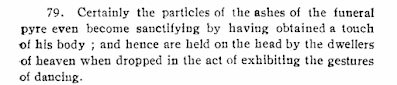
Meaning: By getting smeared, out of Śiva̍'s own choice, on his body, the ashes from the funeral pyre attain sanctity. That is the reason indeed that, when the ashes drop from the Lord's body during his cosmic dance as Naṭarāja, they are his sacred gift of infinite grace. Therefore, even the dwellers in heavens (gods) collect them and wear them on their foreheads!
***
(Copied from M.R. Kale edition, archive.org)
***
We, therefore, need to understand that the ash we wear is not from the cremation ground. We wear the sanctified ash that drops from the form of Naṭarāja Śiva, the Cosmic Dancer who rules over all creation! This is his eternal grace, and our immeasurable good fortune!
What a wonderful explanation!
Postscript: Why did the Lord choose ash to smear himself with? Coming to think of it, ash is the best example of
Śiva - Śakti
Matter - Energy
Sentient - Insentient
Transient - Intransient
Life - Five Elements
Puruṣa - Prakṛti
!!!!!!
***
॥ हरिः ॐ तत् सत् ॥