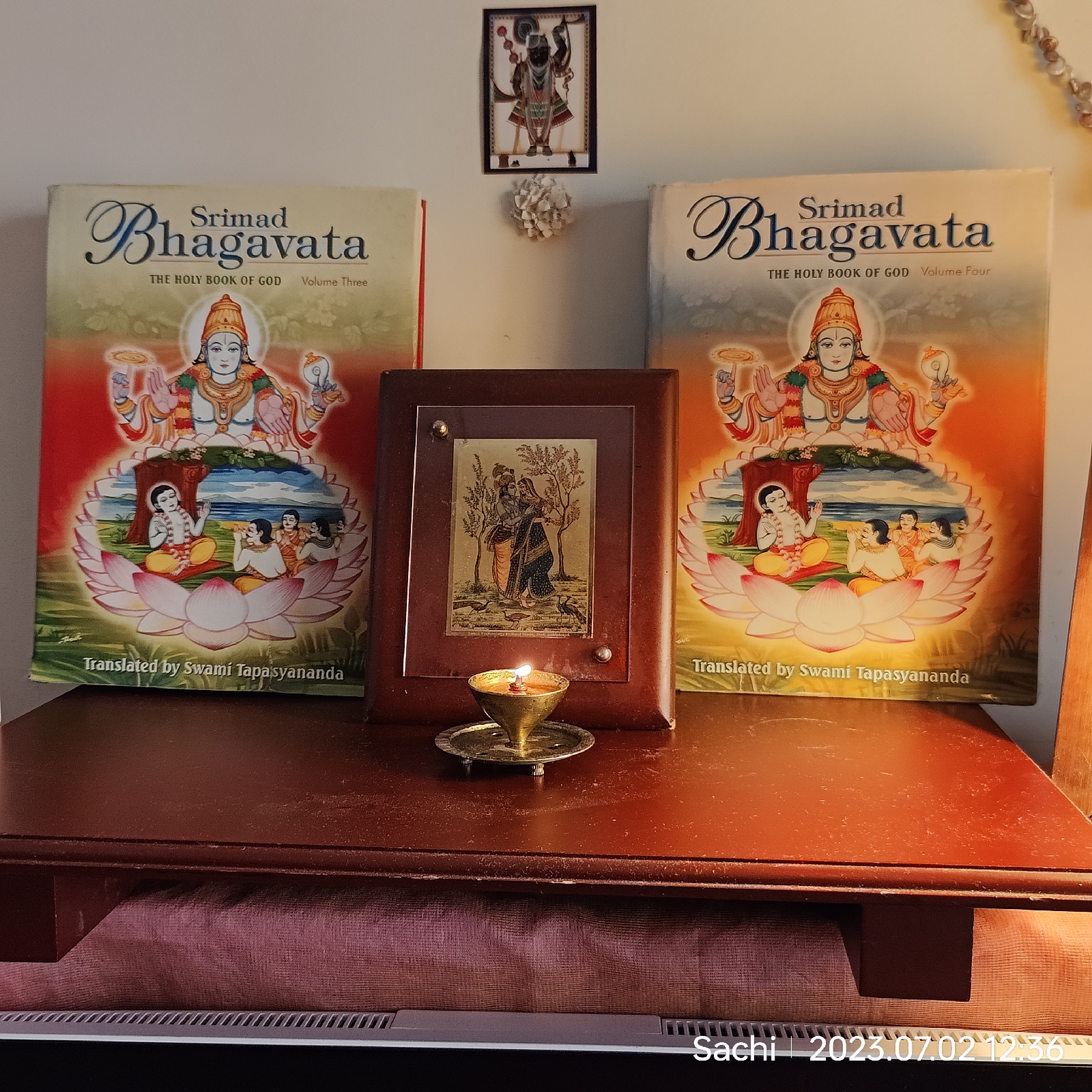
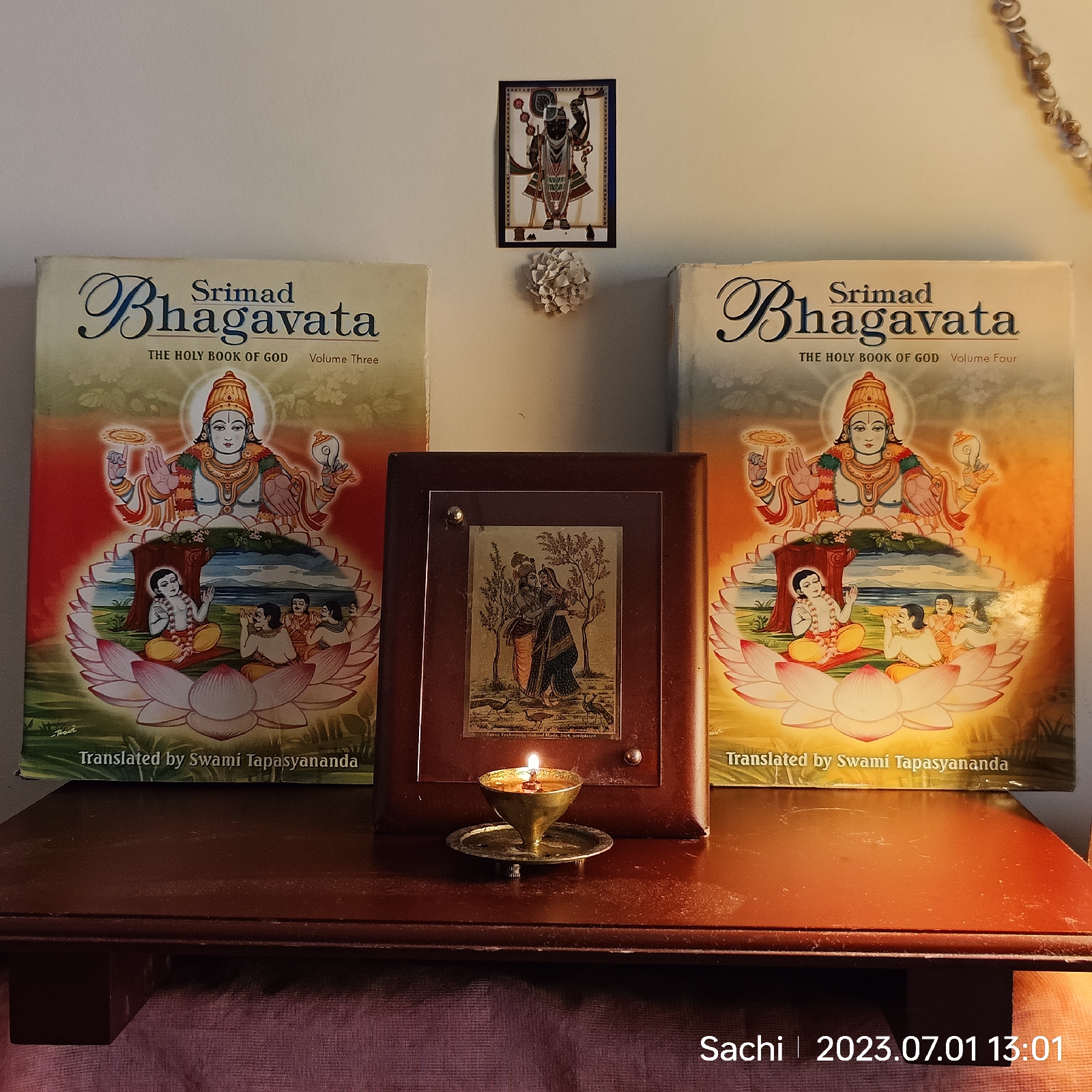
Showing posts with label Skandha X b.. Show all posts

Monday, July 3, 2023

Srimad Bhagavatam X b.90 - 3 July 2023


॥ ॐ नमो भगवते वासुदेवाय ॥

3 July 2023, Monday - Srimad Bhagavatam X b.90- A wrap-up of the Leelas of Bhagavan Sri Krishna in Dwaraka.
***

Sage Shuka wants to describe eloquently Sri Krishna pastimes in Dwaraka. Sri Krishna had a threefold purpose.
1. To elevate the women in love with him to a state of bliss from union with their beloved.
2. To restore Dharma by eliminating evil kings.
3. To bestow grace and liberate his devotees.

In fifty shlokas, Shuka accomplishes this description well. I shall quote only a few verses.

उद्यानोपवनाढ्यायां पुष्पितद्रुमराजिषु । निर्विशद् भृङ्गविहगैर्नादितायां समन्तत: ॥ 
रेमे षोडशसाहस्रपत्नीनामेकवल्ल‍भ: । तावद्विचित्ररूपोऽसौ तद्गेहेषु महर्द्धिषु ॥

वादयद्भ‍िर्मुदा वीणां सूतमागधवन्दिभि: ॥
T: Dwaraka was a perfect picture of a heavenly city where the Lord himself dwelt. beautiful palaces, lovely avenues, and impressive march of the military on the main streets occasionally, were accompanied by the natural splendour of the city where there were many gardens and parks with rows of flowering trees, where bees and birds would gather, filling all directions with their songs. In this heaven on earth resided the Lord of 16,108 queens, whose singular beloved was Sri Krishna. He performed the beautiful miracle of cohabiting with each of them giving them supreme connubial bliss. The entire city resonated with songs and chants and musical instruments like Veena, and the praises of the Lord by Vandi Magadhas (professional panegyrists).

ऊचुर्मुकुन्दैकधियो गिर उन्मत्तवज्जडम् । चिन्तयन्त्योऽरविन्दाक्षं तानि मे गदत: श‍ृणु ॥ 
T: The women besotted with Sri Krishna were maddened with love as they spoke poetically to even all inanimate things in nature. A mere sampler is here. 

त्वं यक्ष्मणा बलवतासि गृहीत इन्दो क्षीणस्तमो न निजदीधितिभि: क्षिणोषि ।
कच्चिन्मुकुन्दगदितानि यथा वयं त्वं विस्मृत्य भो: स्थगितगीरुपलक्ष्यसे न: ॥ 
T: "Oh, dear Moon! You seem to be suffering and weakened from severe tubercular congestion. Thus your rays are too faint to dispel darkness! Or is it that you have unfortunately forgotten the love-promises that Mukunda cooed to you, as we have too!?"

मेघ श्रीमंस्त्वमसि दयितो यादवेन्द्रस्य नूनं श्रीवत्साङ्कं वयमिव भवान् ध्यायति प्रेमबद्ध: ।
अत्युत्कण्ठ: शवलहृदयोऽस्मद्विधो बाष्पधारा: स्मृत्वा स्मृत्वा विसृजसि मुहुर्दु:खदस्तत्प्रसङ्ग: ॥
T: "Oh rain Cloud! How much you are loved by the Yadu Lord, bearing the Srivatsa mark! (Vishnu has been earlier compared to the rain cloud and Srivasta is the streak of ligthning across his dark chest!) Must be in your ecstatic meditation, you are shedding tears of love in a torrent!"

क्षौद्रालापय कामदं श्रियमृते सैवैकनिष्ठा स्‍त्रियाम् ॥
T: " Oh, Swan! You seem to be a messenger from our mean Lord. Tell him to come to us and without that wife of his, Lakshmi!"

जगद्गुरुं भर्तृबुद्ध्या तासां किं वर्ण्यते तप: ॥
T: Sage Shuka concludes by saying, "How can one adequately describe the Tapas of these women who loved Sri Krishna, the Jagadguru, so much in all these physical ways!?"

एवं वेदोदितं धर्ममनुतिष्ठन् सतां गति: । गृहं धर्मार्थकामानां मुहुश्चादर्शयत् पदम् ॥ 
T: Thus lived Sri Krishna the perfect life of a householder dedicating himself to Dharma, and being himself the Ultimate Destination of all seekers, set an example for how one should lead an ideal life that leads to liberation."

तन्निग्रहाय हरिणा प्रोक्ता देवा यदो: कुले । अवतीर्णा: कुलशतं तेषामेकाधिकं नृप ॥
T: In Bhagavan Maha Vishnu's Avatara as Sri Krishna, he ensured all the gods would be born too as good Yadus to fight the war of Dharma to eradicate the evil rulers.

कृष्णस्यैतन्न चित्रं क्षितिभरहरणं कालचक्रायुधस्य ॥ 
T: It this life of Sri Krishna not simply wonderful for the way he upheld this existence through his Chakrayuda called Kaala!(Time!)!"

इत्थं परस्य निजवर्त्मरिरक्षयात्तलीलातनोस्तदनुरूपविडम्बनानि ।
कर्माणि कर्मकषणानि यदूत्तमस्य श्रूयादमुष्य पदयोरनुवृत्तिमिच्छन् ॥
मर्त्यस्तयानुसवमेधितया मुकुन्दश्रीमत्कथाश्रवणकीर्तनचिन्तयैति ।
तद्धाम दुस्तरकृतान्तजवापवर्गं ग्रामाद् वनं क्षितिभुजोऽपि ययुर्यदर्था: ॥
T: Sri Krishna takes all these forms and plays out all these pastimes described in the Srimad Bhagavatam simply to instil and foster the supreme quality of Bhakti in us. The one who wants to serve his lotus feet should listen to these stories and relive within himself the Lord's glories, as it will eradicate the bondage of Karma. By regularly chanting and listening and meditating upon these glorious stories, one will develop Shraddha or steadfast devotion. He will achieve the same liberation that those Rajarshis achieved by forsaking their kingdoms and going away to the forest for Tapas.

***

इति श्रीमद्भागवते महापुराणे वैयासक्यामष्टादश-
साहस्र्यां पारमहंस्यां संहितायां दशमस्कन्धे उत्तरार्धे
श्रीकृष्णचरितानुवर्णनं  नाम नवतितमोऽध्यायः ॥ ९०॥

॥ इति दशमस्कन्धोत्तरार्धः समाप्तः ॥


The end of Dashamaskandha. 

Sunday, July 2, 2023

Srimad Bhagavatam X b.89 - 2 July 2023


॥ ॐ नमो भगवते वासुदेवाय ॥

2 July 2023, Sunday - Srimad Bhagavatam X b.89-  Sage Bhrigu tests and establishes who is supreme among the Trinity. Sri Krishna helps Arjuna fulfil his promise to a Brahmin to bring back his dead sons.
***

Once, a group of sages were performing a Yajna on the banks of the Sarasvati River. A controversy arose among them as to which of the three chief gods, Brahma, Vishnu or Shiva, is the supreme God. Eager to resolve this question, the sages sent Lord Brahma’s son Sage Bhrigu to find the answer. 

First, he went to his father’s court.


न तस्मै प्रह्वणं स्तोत्रं चक्रे सत्त्वपरीक्षया । तस्मै चुक्रोध भगवान् प्रज्वलन् स्वेन तेजसा ॥ 
T: To test how well Lord Brahma was situated in the mode of goodness, Sage Bhrigu failed to bow down to him or glorify him with prayers. The lord became angry at him by his own nature of Rajas. But Lord Brahma was able to subdue it by applying his intelligence, in the same way that fire is extinguished by its own product, water.

After that, Sage Bhrigu then went to Mount Kailasa. There Lord Shiva stood up and happily came forward to embrace his brother. But Sage Bhrigu refused his embrace, telling him, “You are a deviant heretic (breaking norms of decorum).” At this Lord Shiva became angry, and his eyes burned ferociously. He raised his trident and was about to kill Sage Bhrigu when Goddess Devi fell at his feet and spoke some words to pacify him. Sage Bhrigu then left that place and went to Vaikuntha, where Lord Janardana or Maha Vishnu resides.

शयानं श्रिय उत्सङ्गे पदा वक्षस्यताडयत् । तत उत्थाय भगवान् सह लक्ष्म्या सतां गति: ॥ 
स्वतल्पादवरुह्याथ ननाम शिरसा मुनिम् । आह ते स्वागतं ब्रह्मन् निषीदात्रासने क्षणम् ।
अजानतामागतान् व: क्षन्तुमर्हथ न: प्रभो ॥
T: There he went up to the Supreme Lord, who was lying with his head on the lap of his consort, Devi Lakshmi, and kicked him on the chest. The Lord then rose, along with Goddess Lakshmi, as a sign of respect. Coming down from his bed, Bhagavan, whose Darshan is aspired to by all pure devotees bowed his head to the floor before the sage and told him, "Welcome, Brahmin! Please sit in this chair and rest awhile. Kindly forgive us, dear master, for not noticing your arrival."

पुनीहि सहलोकं मां लोकपालांश्च मद्गतान् । पादोदकेन भवतस्तीर्थानां तीर्थकारिणा ॥ 
अद्याहं भगवँल्ल‍क्ष्‍म्‍या आसमेकान्तभाजनम् । वत्स्यत्युरसि मे भूतिर्भवत्पादहतांहस: ॥ 
T: “Please purify me, my realm and the realms of the universal rulers devoted to me by giving us the water that has washed your feet. This holy water is indeed what makes all places of pilgrimage sacred. Today, my lord, I have become the exclusive abode of the goddess of fortune, Lakshmi; she will consent to reside on my chest (Srivatsa!) because your foot has rid it of sins.”

Sage Bhrigu felt satisfied and delighted to hear the solemn words spoken by the Lord of Vaikuntha. Overwhelmed with devotional ecstasy, he remained silent, his eyes brimming with tears.
Sage Bhrigu then returned to the Yajna arena of the assembly on whose behalf he had gone to the three gods. He described his entire experience to them.

भूयांसं श्रद्दधुर्विष्णुं यत: शान्तिर्यतोऽभयम् ॥ धर्म: साक्षाद् यतो ज्ञानं वैराग्यं च तदन्वितम् ।
ऐश्वर्यं चाष्टधा यस्माद् यशश्चात्ममलापहम् ॥ 
T: Amazed upon hearing Sage Bhrigu’s account, the sages were freed from all doubts and became convinced that Maha Vishnu is the greatest Lord. From him come peace; fearlessness; Dharma; Jnana Vairagya; the eightfold powers of Yoga; and finally, the dawn of Bhakti which cleanses the mind of all impurities. His most dear form is that of pure goodness, and the Brahmins are His worshippable deities. 
So the debate was conclusively settled.

***
Sri Krishna and Arjuna retrieve a Brahmin’s Sons

Next follows a quaint story of Arjuna’s sense of duty as a Kshatriya and Sri Krishna’s grace toward him.

A Brahmin in Dwaraka begot many sons. Each of them used to die immediately after childbirth. The Brahmin created a big ruckus at the Royal Arch, shouting how evil kings were ruling the kingdom and hence Dharma had fled, resulting in this extreme distress for a devout Brahmin like him seeing his newborn sons die inexplicably.

Arjuna happened to be there. He admonished the Brahmin that his accusations did not hold water when Balarama. Sri Krishna and Pradyumna were still so active as protectors of Dharma and great Kshatriyas. 

He reminded the Brahmin that he was Arjuna, the most famous hero from Mahabharata, one who had pleased Lord Shiva himself! Now, Arjuna promised him that his next child would be protected by his valour! Arjuna used his power of archery and knowledge of Mantras to create a fortress-like protective ring around the Brahmin’s home. 

But alas, when the next child was born, the child simply disappeared into the sky! The Brahmin did not mince his words, calling Arjuna a powerless and Adharmic Kshatriya unable to fulfil his commitment.

Arjuna was livid. He decided to pursue the gods and get the child back. Using his well-acquired mystic Yogic powers, he proceeded to Yamaloka. The Brahmin’s child was not to be found. He then proceeded to Indraloka. There again, no sign of the boy child. Arjuna went to all the Lokas, growing more and more desperate. Everywhere, he was received by the gods with extreme courtesy, but he could not locate the baby. Arjuna decided that he had failed utterly and decided to enter the sacred fire as atonement. Just as he was about to enter the fire, Bhagavan Sri Krishna came and stopped him.

Sri Krishna said: I will show you the Brahmin’s sons, so please don’t despise yourself like this. These same men who now criticize us will soon establish our spotless fame.

Having thus advised Arjuna, Bhagavan had Arjuna join him on his divine chariot, and together they set off toward the west.

The Lord’s chariot passed over the seven islands of the middle universe, each with its ocean and its seven principal mountains. Then it crossed the Lokaloka boundary and entered the vast region of total darkness.
In that darkness, the chariot’s horses — Shaibya, Sugriva, Meghapushpa and Balahaka — lost their way as it was pitch dark. Seeing them in this condition, Sri Krishna, the supreme master of all masters of Yoga, sent his Sudarshana Chakra ahead of the chariot. That Chakra shone like thousands of suns and lighted up their path.

गुणच्युतो रामशरो यथा चमू: 
T: Vyasa says that Sudarshana dispelled primeaval darkness like an arrow shot from Sri Rama’s bow cuts through his enemy’s army.

Following the Sudarshana disc, the chariot went beyond the darkness and reached the endless spiritual light of the all-pervasive Brahma Jyoti. As Arjuna beheld this glaring effulgence, his eyes hurt, and so he shut them. From that region, they entered a body of water resplendent with huge waves churned by a mighty wind. Within that ocean, Arjuna saw an amazing palace more radiant than anything he had ever seen before. Its beauty was enhanced by thousands of ornamental pillars bedecked with brilliant gems.
In that palace was the huge, awe-inspiring serpent Ananta Adishesha. He shone brilliantly with the radiance emanating from the gems on His thousands of hoods and reflecting from twice as many fearsome eyes. He resembled white Mount Kailasa, and His necks and tongues were dark blue.

ददर्श तद्भ‍ोगसुखासनं विभुं महानुभावं पुरुषोत्तमोत्तमम् ।
सान्द्राम्बुदाभं सुपिशङ्गवाससं प्रसन्नवक्त्रं रुचिरायतेक्षणम् ॥ 
महामणिव्रातकिरीटकुण्डल- प्रभापरिक्षिप्तसहस्रकुन्तलम् ।
प्रलम्बचार्वष्टभुजं सकौस्तुभं श्रीवत्सलक्ष्मं वनमालया वृतम् ॥ 
सुनन्दनन्दप्रमुखै: स्वपार्षदैश्चक्रादिभिर्मूर्तिधरैर्निजायुधै: ।
पुष्‍ट्या श्रिया कीर्त्यजयाखिलर्धिभिर्निषेव्यमानं परमेष्ठिनां पतिम् ॥ 
T: Arjuna then saw the omnipresent and omnipotent Parama Purusha, Bhagavan Sri Maha Vishnu, sitting at ease on the serpent bed. His bluish complexion was the colour of a dense rain cloud. He wore a beautiful yellow garment, his face looked charming, and his broad eyes were most attractive. 

He had eight long, handsome arms. His profuse locks of hair were bathed on all sides in the brilliance reflected from the clusters of precious jewels decorating his crown and earrings. He wore the Kaustubha gem, the mark of Srivatsa and a garland of forest flowers. Serving that topmost of all Lords were his personal attendants, headed by Sunanda and Nanda; His Chakra and other weapons in their personified forms; His consort potencies Pushti, Sri, Kirti and Aja; and all his various mystic powers.

Sri Krishna offered homage to himself in this boundless form as Maha Vishnu! Arjuna, astonished at the sight of Sri Maha Vishnu, bowed down as well. Then, as the two of them stood before him with joined palms, the almighty Maha Vishnu, supreme master of all rulers of the universe, smiled and spoke to them in a voice full of solemn authority.

“I brought the Brahmin’s sons here because I wanted to see the two of you, my Avataras, who have descended to the earth to save Dharma. As soon as you finish killing the demons who burden the earth, quickly come back here to me. Although all your desires are completely fulfilled, Oh best of exalted personalities, for the benefit of the people in general you should continue to exemplify Dharma as the sages Nara and Narayana.

ॐ इत्यानम्य भूमानमादाय द्विजदारकान् ॥ 
T: Sri Krishna and Arjuna assented by chanting Om, and then they bowed down to almighty Lord Maha Vishnu. Taking the Brahmin’s sons with them, they returned with great delight to Dwaraka by the same path they had come along. There they presented the Brahmin with his sons, who were in the same infant bodies in which they had been lost.

Sage Shuka concludes the chapter by saying how Arjuna was totally amazed by Sri Krishna’s powers and the projection of experiences that he governed so seamlessly. Bhagavan Sri Krishna continued to emancipate all good people and uphold Dharma by destroying the wicked. He also knew that Yudhishtira was a good ruler and would protect Dharma always.

***

Saturday, July 1, 2023

Srimad Bhagavatam X b.88- 1 July 2023


॥ ॐ नमो भगवते वासुदेवाय ॥

1 July 2023, Saturday - Srimad Bhagavatam X b.88-  Vrikasura takes advantage of Lord Shiva's ready grace and Maha Vishnu steps in to mend matters.
***

Parikshit asks now a very interesting question.

श्रीराजोवाच
देवासुरमनुष्येषु ये भजन्त्यशिवं शिवम् । प्रायस्ते धनिनो भोजा न तु लक्ष्म्या: पतिं हरिम् ॥ 
T: Parikshit asked: "Dear Sage, why do gods, demons and humans always pray to Lord Shiva for material riches and boons when he is indeed an ascetic Tapasvi, instead of praying for material boons from Bhagavan Sri Hari, the consort of Goddess Lakshmi herself!?"

"Indeed, how does Shiva confer worldly boons when he is himself a renunciate!?" 

श्रीशुक उवाच
शिव: शक्तियुत: शश्वत् त्रिलिङ्गो गुणसंवृत: । वैकारिकस्तैजसश्च तामसश्चेत्यहं त्रिधा ॥
T: Sage Shuka replied: "Lord Shiva is always united with Devi Shakti, who embodies material nature and powers. In response to Shakti's impulses, he manifests as Rajas, Tamas and Sattva Gunas. This forms the basis of ego and desire. Indeed the sixteen components of creation are the mind, the five senses of perception, the five senses of action and the five elements - sixteen. This combination creates wealth and enjoyment."

हरिर्हि निर्गुण: साक्षात् पुरुष: प्रकृते: पर: । स सर्वद‍ृगुपद्रष्टा तं भजन् निर्गुणो भवेत् ॥ 
T: "However, Sri Hari is without Gunas, and beyond these effects. He is Parama Purusha, the eternal witness.  The one who prays to Sri Hari will himself become a Nirguna."

"Dear Parikshit, your grandfather King Yudhishthira asked the very same question after the great Yajnas to Bhagavan Sri Krishna and I shall share what the answer was."


श्रीभगवानुवाच
यस्याहमनुगृह्णामि हरिष्ये तद्धनं शनै: । ततोऽधनं त्यजन्त्यस्य स्वजना दु:खदु:खितम् ॥
T: Bhagavan Sri Krishna said: "If I especially favour someone, I gradually deprive him of his wealth. Then the relatives and friends of such a poverty-stricken man abandon him. In this way, he suffers one distress after another. When he becomes frustrated in his attempts to make money thereafter starts to befriend holy men, my devotees (for their obvious sense of peace and contentment), I bestow my special grace upon him. A person who has thus become sober fully realizes the Absolute as the highest truth, the most subtle and perfect manifestation of spirit, the transcendental existence without end. In this way, realizing that the Supreme Truth is the foundation of his own existence, he is freed from the cycle of material life. This is liberation in its truest sense."


अतो मां सुदुराराध्यं हित्वान्यान् भजते जन: । ततस्त आशुतोषेभ्यो लब्धराज्यश्रियोद्धता: ।
मत्ता: प्रमत्ता वरदान् विस्मयन्त्यवजानते ॥
T: "Because I am difficult to worship, people generally avoid me and instead worship other deities, who are quickly satisfied. When people receive kingly riches and superpowers from these deities, they become arrogant, intoxicated with pride and neglectful of their duties. They dare to offend even the gods who have bestowed benedictions upon them."

श्रीशुक उवाच
शापप्रसादयोरीशा ब्रह्मविष्णुशिवादय: । सद्य:शापप्रसादोऽङ्ग शिवो ब्रह्मा न चाच्युत: ॥ 
T: Sage Shuka continued: " Lord Brahma, Lord Vishnu, Lord Shiva and others can curse or bless anyone in any way they please. Lord Shiva and Lord Brahma are very quick to curse or bestow benedictions, but the infallible Supreme Lord Vishnu is not so ready with his grace."

Now Sage Shuka tells an ancient story.

***
Once, an Asura called Vrika, nephew of the Asura named Shakuni, met Sage Narada in the foothills of the Himalayas. He wanted to know from whom among the Trimurtis he could obtain the quickest of boons with the minimum effort. Sage Narada said with a smile, ' Why, of course!  Worship Lord Shiva and you will soon achieve success. He quickly becomes pleased by seeing his worshipper’s slightest good qualities — and is also equally quickly angered by seeing his slightest fault. Shiva became pleased with ten-headed Ravana, and also with Bana when they each chanted his glories, like bards in a royal court. Lord Shiva then bestowed unprecedented power upon each of them, but in both cases, he was consequently beset with great difficulty."

Vrika was delighted. He rushed to Kedaranatha Kshetra. He began a huge Yajna fire, which symbolises Lord Shiva's flaming mouth, and all the while chanting Shiva's name, he started cutting off parts of his body and putting them into the fire as Ahuti! 

Finally, Vrika was ready to cut off his own head with a hatchet. Lord Shiva appeared in a hurry out of the sacred fire, crying, "Stop! Stop!" and touched Vrika by grabbing with his arms. That instant, Vrika was completely whole, healed and well. 

तमाह चाङ्गालमलं वृणीष्व मे यथाभिकामं वितरामि ते वरम् ।
प्रीयेय तोयेन नृणां प्रपद्यतामहो त्वयात्मा भृशमर्द्यते वृथा ॥
T:  Lord Shiva said to Vrikasura: "My friend, please stop, stop! Ask from me whatever you want, and I will bestow that boon upon you. Alas, you have subjected your body to great torment for no reason, since I am pleased with a simple offering of water from those who approach me for shelter."

The benediction sinful Vrika chose from the lord would terrify all living beings. Vrika said, “May death come to whomever I touch upon the head with my hand. Lord Shiva, grant me this boon."

Upon hearing this, Lord Rudra seemed somewhat disturbed. Nonetheless, he uttered Om to signify his assent, granting Vrika the benediction with an ironic smile, as if giving milk to a poisonous snake.

At once, to test Lord Shambhu’s benediction, the demon then tried to put his hand on the Lord’s head. Now Shiva became frightened because of what he had done सोऽबिभ्यत् स्वकृताच्छिव:.
As the demon pursued him, Lord Shiva fled swiftly from his abode in the north, shaking with terror. He ran as far as the limits of the earth, the sky and the corners of the universe. The great gods could only remain silent, not knowing how to counteract the benediction. Then Lord Shiva reached the luminous realm of Vaikuntha, beyond all darkness, where the Supreme Lord Narayana is manifest. That realm is the destination of advanced renunciates who have attained peace and given up all violence against other creatures. Going there, one never returns.

The Supreme Lord, who infallibly relieves his devotees’ distress, had seen from afar that Lord Shiva was in danger. Thus, by his Maya Yoga Shakti, Narayana assumed the form of a Brahmachari, with the appropriate belt, deerskin, staff and prayer beads, and appeared before Vrikasura. The Lord’s effulgence glowed brilliantly like fire. Holding kusha grass in his hand, he respectfully greeted the demon.

The Lord said: "My dear son of Shakuni, you appear tired. Why have you come such a great distance? Please rest for a minute. After all, it is one’s body that fulfils all one’s desires. Oh mighty one, please tell me what you intend to do, if you think me fit to know. Usually one accomplishes his purposes by taking help from others!"

Vrika was completely disarmed by the grace and poise of the young Brahmin. He blurted out everything that had happened. Now this did not amuse the Brahmachari!

श्रीभगवानुवाच
एवं चेत्तर्हि तद्वाक्यं न वयं श्रद्दधीमहि । यो दक्षशापात् पैशाच्यं प्राप्त: प्रेतपिशाचराट् ॥ 
T: The Supreme Lord said: 'What! Indeed! If this is the case, We cannot believe what Shiva says. Shiva is the same lord of the Pretas and Pishachas whom Daksha cursed to become a carnivorous hobgoblin!
Oh, best of the demons, if you have any faith in him because he is "the spiritual master of the universe", then without delay put your hand on your head and see what happens. If the words of Lord Shambhu prove untrue in any way, Oh best of the demons, then kill the liar so he may never lie again."

Thus bewildered by Bhagavan's enchanting, artful words, foolish Vrika, without realizing what he was doing, placed his hand on his head. Instantly his head shattered as if struck by a lightning bolt, and the demon fell down dead. From the sky were heard cries of “Victory!” “Obeisances!” and “Well done!”
The celestial sages, Pitris and Gandharvas rained down flowers to celebrate the killing of sinful Vrikasura. Now Lord Shiva was out of danger.

Bhagavan wryly remarked to a much relieved Shiva: "Indeed, what living being can hope for good fortune if he offends exalted saints, what to speak of offending the lord and spiritual master of the universe?”

Sage Shuka concluded by saying how this story when heard with true devotion liberates the devotee.

***

Friday, June 30, 2023

Srimad Bhagavatam X b.87 Summary - 30 June 2023


॥ ॐ नमो भगवते वासुदेवाय ॥

30 June 2023, Friday - Srimad Bhagavatam X b.87 Summary -  A summary in my own words of this important and exhaustive chapter on Vedas and Brahman.
***
Summary

This chapter answers a vital question.

कथं चरन्ति श्रुतयः साक्षात्सदसतः परे – How can the Vedas (i.e. the scriptures of Sanatana Dharma) reveal the Truth called Brahman which is beyond dualities like Sat (Truth) and Asat (Falsehood) which are mental constructs?

The answer is provided in the words of great sages – Rishi Narayana, Sandandana, Narada and Shuka. But the actual content is supposed to be a prayer of the Vedas themselves to Bhagavan, who is none other than Brahman when he wakes up in a new cycle of creation. It has already been stated that between epochs or creative cycles, Bhagavan withdraws all creation into Himself and hibernates. So the Vedas are co-existent with Bhagavan! No wonder we elevate Vedas, the core of Sanatana Dharma, as equal to God.
 
यो वै भारतवर्षेऽस्मिन् क्षेमाय स्वस्तये नृणाम् 
A crucial statement is made also about Rishi Narayana. He is an incarnation of Bhagavan Maha Vishnu. He sits in eternal meditation in Badarikashrama, for the welfare of residents of Bharatavarsha! That is why we consider it an unmatched boon to be incarnated in our motherland.

जह्यजामजित दोषगृभीतगुणां त्वमसि समवरुद्धसमस्तभग:
अगजगदोकसामखिलशक्त्यवबोधक ते क्व‍‍चिदजयात्मना च चरतोऽनुचरेन्निगम:
Only Bhagavan can destroy Maya or the cause of ignorance of the Supreme Truth or Himself (Brahman). He creates and operates through this universe, empowering it with knowledge like the Vedas. He even allows the Vedas to get an inkling of Bhagavan or Brahman!

लोकमलक्षपणकथामृताब्धिमवगाह्य तपांसि जहुः
For the sages, recounting Bhagavan’s Leelas and Avataras is as important as ascetic Tapas, because it confers two benefits: Gives an inkling of His Reality, and also gives bliss that eradicates the misery of this existence of dualities.

दृतय इव श्वसन्त्यसुभृतो यदि तेऽनुविधा
The Lord alone permeates the five koshas or layers of the body, endowing them with the apparatus for knowing the Truth. The man who fails to know the Truth is breathing in and out senselessly like the mechanical bellows in the hands of a blacksmith. 

व्यसनशतान्विताः समवहाय गुरोश्चरणं वणिज इवाज सन्त्यकृतकर्णधरा जलधौ
The human mind is fickle and life is full of suffering for one who is not surrendered to the Guru. Imagine a group of merchants with their wares travelling in a boat in the difficult waters of the ocean without a helmsman! 

व्यवहृतये विकल्प इषितोऽन्धपरम्परया भ्रमयति भारती त उरुवृत्तिभिरुक्थजडान्
The Vedas are multifaceted and serve to fulfil worldly activities. Men deluded in this world cannot hope to depend on the Vedas for emancipation as finally, they will only be  bewildered.

There are three paths to know Brahman.
1. Meditating on the various Chakras in the body-energy complex culminating in experiencing Brahman in the thousand-petalled lotus that exists in the head.
2. Meditating intensely on the presence of Brahman in every atom of existence as the Enduring Spirit in all that is changing.
3. Loving and serving the Lord as his lover or living even as his enemy, immersed in His thoughts, Leelas or incarnations!

न परिलषन्ति केचिदपवर्गमपीश्वर ते चरणसरोजहंसकुलसङ्गविसृष्टगृहा:
Those who are fortunate to develop total and undivided Bhakti towards Bhagavan have no use for the Purusharthas of life – living life with values, pursuing wealth or pleasures, OR EVEN MOKSHA. This is because they are already in that permanent bliss, dwelling like swans in the divine lake of love, making their home in the lotus feet of their beloved Bhagavan who is none other than Brahman, and having no more attachment to this world. There is also a caution sounded. Those who do not connect with the Supreme Truth when given the opportunity of human birth will wander from life form to life form through rebirth in utter misery.

अत ऋषयो दधुस्त्वयि मनोवचनाचरितं कथमयथा भवन्ति भुवि दत्तपदानि नृणाम्
When the Vedic Rishis worship various deities, they are actually directing all their prayers only toward the Ultimate Brahman, just as when one steps on a stone of a clump of grass, he is stepping on the earth alone as it is the ultimate foundation beneath all. 

Some important tips to know Brahman
1. Lead a life of surrender to the Lord. This opens up your potential to know the Truth.
2. Lead a life of great self-control as even the best mystics could fall prey to temptations.
3. Keep yourself busy through Satsang and Yatra - travels to holy places sanctified by saints and sages.

ख इव रजांसि वान्ति वयसा सह यच्छ्रुतय-स्त्वयि हि फलन्त्यतन्निरसनेन भवन्निधना:
The Vedas describe how all creation is like specs of dust spinning in the space of Brahman as a part of the Time-Space phenomenon of creation which is the sport of Bhagavan Himself through His Maya. By pointing out that Brahman or Bhagavan is not the dust, but the eternal and unmodified space in which the dust is, the Vedas succeed in informing us of Brahman!

***

Thursday, June 29, 2023

Srimad Bhagavatam X b.87 Contd. - 29 June 2023


॥ ॐ नमो भगवते वासुदेवाय ॥

29 June 2023, Thursday - Srimad Bhagavatam X b.87 Part 2 -  The Vedas depict the connection between Bhagavan, Ishwara or Brahman and creation and the path to realisation.
***
Skandha X: Chapter 87-  Can the Vedas reveal Brahman?  Contd.

Surrender to the Lord is the Safeguard in Spiritual Life 

विजितहृषीकवायुभिरदान्तमनस्तुरगं य इह यतन्ति यन्तुमतिलोलमुपायखिदः ।
व्यसनशतान्विताः समवहाय गुरोश्चरणं वणिज इवाज सन्त्यकृतकर्णधरा जलधौ ॥ 
स्वजनसुतात्मदारधनधामधरासुरथैः त्वयि सति किं नृणां श्रयत आत्मनि सर्वरसे ।
इति सदजानतां मिथुनतो रतये चरतां सुखयति को न्विह स्वविहते स्वनिरस्तभगे ॥ 
भुवि पुरुपुण्यतीर्थसदनान्यृषयो विमदाः त उत भवत्पदाम्बुजहृदोऽघभिदङ्घ्रिजलाः ।
दधति सकृन्मनस्त्वयि य आत्मनि नित्यसुखे न पुनरुपासते पुरुषसारहरावसथान् ॥ 

T: 
The Vedas continued:  "Oh, Birthless One! Even though a person might have gained control over his senses and the Pranas, if he has not surrendered himself at the feet of the Guru, all his effort to discipline the extremely fickle mind, which is like an uncontrolled horse. will result only in the pain and trouble of striving, and he will be overwhelmed with deep sorrow because of failure. His condition will be like that of a party of merchants in the mid-ocean without a helmsman to direct the boat. "

Renunciation essential for Spiritual Life 

"When Thou, the essence of all bliss, art available as one’s very self to one who has resigned himself to Thee, what further use will he have for such objects as relatives, sons, body, wife, wealth, house, lands, life and properties like chariots etc.? And without knowing Thee, the bedrock of Reality, what joy can a man derive, who goes after the joy of sex life and other enjoyments of the world that are ephemeral and doomed to destruction by their very nature? "
 
Even realised Souls renounce the world

"Though these devotees, who are free from the pride of narrow egotism, hold Thy lotus feet in their heart, and have within themselves that all-sanctifying stream of devotion flowing from those feet of Thine, still they resort to holy centres of spiritual living and thinking during their life in the world, abandoning hearth and home. For, even those who have but once seriously bestowed their mind on the ever-blessed Atman, which is Thyself, can never feel happy in the self-centred life of the home which has a baneful effect on the spiritual essence in man. Not only that; by their visit to such holy spots, they sanctify them, and enhance their holiness." 

God and the World as Cause and Effect 

सत इदमुत्थितं सदिति चेन्ननु तर्कहतं व्यभिचरति क्व च क्व च मृषा न तथोभययुक् ।
व्यवहृतये विकल्प इषितोऽन्धपरम्परया भ्रमयति भारती त उरुवृत्तिभिरुक्थजडान् ॥ 
न यदिदमग्र आस न भविष्यदतो निधनात्अ नुमितमन्तरा त्वयि विभाति मृषैकरसे ।
अत उपमीयते द्रविणजातिविकल्पपथैः वितथमनोविलासमृतमित्यवयन्त्यबुधाः ॥ 
स यदजया त्वजामनुशयीत गुणांश्च जुषन्भजति सरूपतां तदनु मृत्युमपेतभगः ।
त्वमुत जहासि तामहिरिव त्वचमात्तभगो महसि महीयसेऽष्टगुणितेऽपरिमेयभगः ॥ 
यदि न समुद्धरन्ति यतयो हृदि कामजटा दुरधिगमोऽसतां हृदि गतोऽस्मृतकण्ठमणिः ।
असुतृपयोगिनामुभयतोऽप्यसुखं भगवन्अ नपगतान्तकादनधिरूढपदाद्भवतः ॥ 

 T:
"It is contended that all this world has arisen out of Sat, a really existent cause, and therefore it must also be real.  This, however, is not acceptable to reason; first, it is not universally applicable to all cases of cause and effect, as in the case of father and son. The son has a different identity from that of the father, and cannot be reduced into the latter's form, unlike a pot which can be reduced into mud, its cause. Next, sometimes, an effect may be a mere appearance on a real cause, as the snake is on a rope in an illusory perception. In both such types of instances, the rule that the effect is as real as the cause is not found to fit. At the most, from the point of view of practical efficiency, it may have some relevancy, even as a wrong idea blindly accepted on the ground of a transmitted tradition is found to work in practice or as a false coin passes for a genuine one undetected."

"The permanency of the fruits of Vedic rituals based on Thy words, the Vedas, is only the wishful thinking of dull-witted persons who are not able to comprehend the Vedas with their continuity, implications, suggestions and many-sidedness. Vedic rituals may bear fruits which may last long, but are not really eternal. "

The Phenomenality of the Effect

 "This universe was not existing before creation and will not exist after the cosmic dissolution also. So its existence In Thee, the Sat-Chit-Ananda, during the interval can only be in a phenomenal sense, without any substantiality. It is therefore compared to ornaments and pots which are the modifications of gold and mud respectively. Ignorant people mistake these temporary formations of the mind to be permanent."

The Contrast between Jiva and Ishwara

"Prompted by Maya, Thy creative Power or Shakti, the Jiva embraced the ignorance aspect of that Power and got established in the feeling that he is a body-mind complex. Consequently, he lost his blissful nature and became subject to birth and death in the transmigratory cycle. But Thou, who art established in Thy spiritual glory, hast shed ignorance, like a snake its slough, and shinest in Thy unlimited majesty exhibiting the sixfold powers 

(Note: We read about the six Bhagas of Ishwara long ago that make Him the Supreme Creator-Preserver and Destroyer, in effect beyond even Brahmanhood aspired to by seekers).  
Read here: 

"Bhagavan" Vishnu has six Bhagas - and so He is called Bhagavan. Aishwarya=Omnipotence, Dharma=Virtue, Glory=Yashas, Sri=Beauty of all kinds, Jnana=Omniscience and Vairagya=Detachment.

Desire for Enjoyments: the Bane of the Ascetic's Life 

"Oh, Lord! If renouncers (Yatis or Sannyasins) do not root out the desire for enjoyments from their hearts, then Thou, though present in their hearts, dost not reveal Thy presence to those hypocrites, just as a jewel does not reveal itself to its wearer who has forgotten its presence round his neck. The ascetics who are after sense enjoyments have to stand misery from two sources—from death who is sure to visit them, and from Thee who dost not reveal Thyself to them. "

Enlightenment and Scriptural Injunctions

"Oh, Thou Lord of countless glories! In one who is illuminated with Thy knowledge, the bond of self-centred life (egoity) is broken, and therefore he oblivious of (becomes free from) Thy laws regarding merit and demerit, enjoyments and sufferings. The scriptural injunctions pertaining to men who are body-centred, become meaningless for him. For, he is then established in the bliss of spiritual freedom, which is Thyself, who hast entered into the hearts of men through the glorious devotional traditions transmitted in every age by great men through a succession of teachers and disciples."
 
Veda can describe Brahman only negatively

त्वदवगमी न वेत्ति भवदुत्थशुभाशुभयोः गुणविगुणान्वयांस्तर्हि देहभृतां च गिरः ।
अनुयुगमन्वहं सगुण गीतपरम्परया श्रवणभृतो यतस्त्वमपवर्गगतिर्मनुजैः ॥ 
द्युपतय एव ते न ययुरन्तमनन्ततया त्वमपि यदन्तराण्डनिचया ननु सावरणाः ।
ख इव रजांसि वान्ति वयसा सह यच्छ्रुतयः त्वयि हि फलन्त्यतन्निरसनेन भवन्निधनाः ॥ 

T:
"Even leading Divinities like Brahma do not find the limits of Thee. for Thou art the unlimited, and the unlimited by its nature cannot be fully comprehended. For the same reason, even Thou dost not know Thy limits. Within that infinite and incomprehensible being of Thine, countless Brahmandas (universes), each with its seven expansive external coverings, whirl about together under the propulsion of Time like clusters of dust in the air. So the words of the Veda, unable to describe Thee positively, arrive at Thee only as the final residue left after negating all conceivable entities. "

The Hymn and its Significance 

श्रीभगवानुवाच
इत्येतद्ब्रह्मणः पुत्रा आश्रुत्यात्मानुशासनम् । सनन्दनमथानर्चुः सिद्धा ज्ञात्वाऽऽत्मनो गतिम् ॥ 
इत्यशेषसमाम्नायपुराणोपनिषद्रसः । समुद्धृतः पूर्वजातैर्व्योमयानैर्महात्मभिः ॥ 
त्वं चैतद्ब्रह्मदायाद श्रद्धयाऽऽत्मानुशासनम् । धारयंश्चर गां कामं कामानां भर्जनं नृणाम् ॥ 

T:
Now, the revered Rishi Narayana said: 
"The great sages, born of the mind of Brahma, heard this exposition of the truth of Brahman by Sanandana with great attention and then saluted that Rishi, their hearts illumined by the knowledge of the Atman.  This was the quintessence of the Vedas, Puranas and the Upanishads, expounded by the ancient sage Sanandana and others, who move about from sphere to sphere in the universe." 

Oh, Narada!Thou Inheritor of Brahmic bliss! Thinking with deep faith over this message that invokes renunciation in the minds of men, you may freely move about in the worlds."
 
The Gist of the Hymn 

श्रीशुक उवाच
एवं स ऋषिणाऽऽदिष्टं गृहीत्वा श्रद्धयाऽऽत्मवान् । पूर्णः श्रुतधरो राजन्नाह वीरव्रतो मुनिः ॥ 

नारद उवाच
नमस्तस्मै भगवते कृष्णायामलकीर्तये । यो धत्ते सर्वभूतानामभवायोशतीः कलाः ॥ 

T:
Sage Shuka said:
"Oh King! The sage Narada, who had perfect control over his mind and who observed strict celibacy in life, heard the teachings of Sri Narayana with deep faith and receptivity and became filled with joy, thinking over it again and again."
 Sri Narada said: 
“Salutations to Thee, the Divine Incarnate, a manifestation of the Supreme Lord Sri Krishna of holy fame who comes down as glorious incarnations for the welfare of all creatures!”

इत्याद्यमृषिमानम्य तच्छिष्यांश्च महात्मनः । ततोऽगादाश्रमं साक्षात्पितुर्द्वैपायनस्य मे ॥ 
सभाजितो भगवता कृतासनपरिग्रहः । तस्मै तद्वर्णयामास नारायणमुखाच्छ्रुतम् ॥ 

इत्येतद्वर्णितं राजन् यन्नः प्रश्नः कृतस्त्वया । यथा ब्रह्मण्यनिर्देश्ये निर्गुणेऽपि मनश्चरेत् ॥ 
योऽस्योत्प्रेक्षक आदिमध्यनिधने योऽव्यक्तजीवेश्वरो यः सृष्ट्वेदमनुप्रविश्य ऋषिणा चक्रे पुरः शास्ति ताः ।
यं सम्पद्य जहात्यजामनुशयी सुप्तः कुलायं यथा तं कैवल्यनिरस्तयोनिमभयं ध्यायेदजस्रं हरिम् ॥ 

"Paying homage to Rishi Narayana, the first and foremost of sages, and to his worthy disciples, Narada went to the Ashrama where my father Vyasa dwelt. Received respectfully by Vyasa, Narada took a seat and narrated to him what he had heard from the mouth of Sri Narayana, and I learned it from my father."

"Thus have I answered, through the account of the above conversation, your question how Brahman, who is beyond the Gunas and not within the scope of description by words, can be grasped by the mind. "
"Meditate always on Sri Hari who, as the creator, designed this universe for the benefit of the Jivas; who as its material cause remains unaffected as its substratum during its creation, sustenance and dissolution;  who is the Lord and director of Prakriti and the Jivas; who, after creating the categories, enters into His creation along with the Jiva as the Indwelling Spirit and directs its evolution into various world systems and bodies of living beings;  who governs the Jivas providing them with food and other conditions for higher evolution; who, through instruction as the Guru, enables the Jivas, who take refuge in Him, to abandon identification with the body even in the waking state as in the state of sleep; and who, being ever established in Bliss-consciousness without the slightest trace of ignorance, is capable of giving complete freedom from fear to all beings."

Wednesday, June 28, 2023

Srimad Bhagavatam X b.87 - 28 June 2023

॥ ॐ नमो भगवते वासुदेवाय ॥

28 June 2023, Wednesday - Srimad Bhagavatam X b.87 Part 1 -  This is a serious discussion on Brahman, Vedas, and the spiritual life. I am basing it entirely on the translation of Swami Tapasyananda and will cover it in two parts. 
***
Skandha X : Chapter 87  Can the Vedas reveal Brahman?  

परीक्षिदुवाच
ब्रह्मन् ब्रह्मण्यनिर्देश्ये निर्गुणे गुणवृत्तयः ।कथं चरन्ति श्रुतयः साक्षात्सदसतः परे ॥

श्रीशुक उवाच
बुद्धीन्द्रियमनःप्राणान् जनानामसृजत्प्रभुः । मात्रार्थं च भवार्थं च आत्मनेऽकल्पनाय च ॥

सैषा ह्युपनिषद्ब्राह्मी पूर्वेषां पूर्वजैर्धृता । श्रद्धया धारयेद्यस्तां क्षेमं गच्छेदकिञ्चनः ॥

अत्र ते वर्णयिष्यामि गाथां नारायणान्विताम् । नारदस्य च संवादमृषेर्नारायणस्य च ॥

एकदा नारदो लोकान् पर्यटन् भगवत्प्रियः । सनातनमृषिं द्रष्टुं ययौ नारायणाश्रमम् ॥

यो वै भारतवर्षेऽस्मिन् क्षेमाय स्वस्तये नृणाम् । धर्मज्ञानशमोपेतमाकल्पादास्थितस्तपः ॥

तत्रोपविष्टमृषिभिः कलापग्रामवासिभिः । परीतं प्रणतोऽपृच्छदिदमेव कुरूद्वह ॥

तस्मै ह्यवोचद्भगवान् ऋषीणां श‍ृण्वतामिदम् । यो ब्रह्मवादः पूर्वेषां जनलोकनिवासिनाम् ॥

श्रीभगवानुवाच
स्वायम्भुव ब्रह्मसत्रं जनलोकेऽभवत्पुरा । तत्रस्थानां मानसानां मुनीनामूर्ध्वरेतसाम् ॥

श्वेतद्वीपं गतवति त्वयि द्रष्टुं तदीश्वरम् । ब्रह्मवादः सुसंवृत्तः श्रुतयो यत्र शेरते ।
तत्र हायमभूत्प्रश्नस्त्वं मां यमनुपृच्छसि ॥

तुल्यश्रुततपःशीलास्तुल्यस्वीयारिमध्यमाः । अपि चक्रुः प्रवचनमेकं शुश्रूषवोऽपरे ॥

सनन्दन उवाच
स्वसृष्टमिदमापीय शयानं सह शक्तिभिः । तदन्ते बोधयाञ्चक्रुस्तल्लिङ्गैः श्रुतयः परम् ॥

यथा शयानं सम्राजं वन्दिनस्तत्पराक्रमैः ।  प्रत्यूषेऽभ्येत्य सुश्लोकैर्बोधयन्त्यनुजीविनः ॥
T:
King Parikshit had a profound philosophical question. He asked,
“Oh, enlightened sage! The Vedas, being constituted of words (i.e. of human origin), can only describe entities coming within the scope of the three Gunas of Prakriti. How can they then really reveal Brahman, the Absolute Being, who is not included in the Gunas of Prakriti, who cannot be defined or described as an object before us, and who is beyond the relation of cause and effect?”
Sage Shuka was gratified to hear this inquiry. He replied: 
The all-powerful Lord created faculties like intellect, mind, senses and Prana in the Jivas only so that they may enjoy sense contacts in the world, may perform works, gain the felicities of heaven in the hereafter, and attain liberation from Samsara. 

 It is not proper to doubt the efficacy of the Vedas.  For it is the ignorance-shattering science that culminates in the knowledge of Brahman, accepted as such by the most ancient of ancient wise men from endless time. A man accepting it with deep faith and sincerity and living a life of renunciation attains the blessedness of abiding in the Paramatma.

In order to make this clear. I shall narrate to you an episode relating to Sage Narayana. It is a conversation that took place between Naroda and Rishi Narayana. 

Once, in the course of his constant travels all over the universe, Narada, the sage most beloved to the Lord, went over to  Badarikashrama to see the Rishi Narayana,  who is engaged during the whole Kalpa engaged in austerity constituted of Dharma (righteousness), Jnana (knowledge) and Shama  (the practice of self-restraint) directed to confer the material and spiritual good of the men inhabiting Bharatavarsha. (This is explicitly stated as Bharatavarsha, i.e. the India we know).

Narada put this very question you have asked, Parikshit, to Sage Narayana who was sitting there surrounded by Rishis living in the village of Kalapagrama. 

*** 

 The revered Sage Narayana narrated to Narada what took place during a big philosophical conclave on Brahman during a Yajna held in Janaloka by the ancients.  The revered Narayana said: 

“Oh son of the self-born Brahma! It was in Janaloka, under the auspices of the mind-born sons of Brahma who are lifelong celibates, (i.e. the Kumaras) and attended by the residents of that region that this Brahmasattram (gathering to discuss Brahman)  by a large number of savants and self-controlled gages took place. Narada, you had gone to Shwetadweepa at that time to pay obeisance to its Lord Aniruddha when this assembly for the discussion on  Brahman took place in Janaloka. The  question investigated then was the very  question you have now raised.”

***
 Though all these sages were equal in learning, austerity, and character. and even-sightedness towards friends, foes and neutrals, they chose one among themselves (Sanandana) as the speaker while the others heard him with deep attention. Sandandana. the speaker, said as follows:
 In order to awaken a sleeping emperor in the morning, the minstrels attached to his court come and proclaim his glorious deeds in praise of him. In the same way, in order to awaken the Lord at the end of the Pralaya from the Cosmic Slumber (cosmic hibernation) into which He had entered when the previous Kalpa had ended, withdrawing into Himself the whole universe and the powers connected with it, the Shrutis i.e. the Vedas recited a hymn recalling all His distinctive majesties. Maya functions as Ignorance in Jiva and as Shakti in the Lord! 
(Mahaperiyavaa in his talks on the Vedas states that the Vedas were not even created by Brahman, and they existed always!)

श्रुतय ऊचुः
जय जय जह्यजामजित दोषगृभीतगुणां त्वमसि यदात्मना समवरुद्धसमस्तभगः ।
अगजगदोकसामखिलशक्त्यवबोधक ते क्वचिदजयाऽऽत्मना च चरतोऽनुचरेन्निगमः ॥ 

बृहदुपलब्धमेतदवयन्त्यवशेषतया यत उदयास्तमयौ विकृतेर्मृदि वाविकृतात् ।
अत ऋषयो दधुस्त्वयि मनोवचनाचरितं कथमयथा भवन्ति भुवि दत्तपदानि नृणाम् ॥ 

इति तव सूरयस्त्र्यधिपतेऽखिललोकमलक्षपणकथामृताब्धिमवगाह्य तपांसि जहुः ।
किमुत पुनः स्वधामविधुताशयकालगुणाः परम भजन्ति ये पदमजस्रसुखानुभवम् ॥ 

दृतय इव श्वसन्त्यसुभृतो यदि तेऽनुविधा महदहमादयोऽण्डमसृजन् यदनुग्रहतः ।
पुरुषविधोऽन्वयोऽत्र चरमोऽन्नमयादिषु यः सदसतः परं त्वमथ यदेष्ववशेषमृतम् ॥ 

उदरमुपासते य ऋषिवर्त्मसु कूर्पदृशः परिसरपद्धतिं हृदयमारुणयो दहरम् ।
तत उदगादनन्त तव धाम शिरः परमं पुनरिह यत्समेत्य न पतन्ति कृतान्तमुखे ॥ 

स्वकृतविचित्रयोनिषु विशन्निव हेतुतया तरतमतश्चकास्स्यनलवत्स्वकृतानुकृतिः ।
अथ वितथास्वमूष्ववितथं तव धाम समं विरजधियोऽन्वयन्त्यभिविपण्यव एकरसम् ॥ 

स्वकृतपुरेष्वमीष्वबहिरन्तरसंवरणं तव पुरुषं वदन्त्यखिलशक्तिधृतोंऽशकृतम् ।
इति नृगतिं विविच्य कवयो निगमावपनं भवत उपासतेऽङ्घ्रिमभवं भुवि विश्वसिताः ॥ 

दुरवगमात्मतत्त्वनिगमाय तवात्ततनोः चरितमहामृताब्धिपरिवर्तपरिश्रमणाः ।
न परिलषन्ति केचिदपवर्गमपीश्वर ते चरणसरोजहंसकुलसङ्गविसृष्टगृहाः ॥ 

त्वदनुपथं कुलायमिदमात्मसुहृत्प्रियवत्च रति तथोन्मुखे त्वयि हिते प्रिय आत्मनि च ।
न बत रमन्त्यहो असदुपासनयाऽऽत्महनो यदनुशया भ्रमन्त्युरुभये कुशरीरभृतः ॥ 

निभृतमरुन्मनोऽक्षदृढयोगयुजो हृदि यन्मुनय उपासते तदरयोऽपि ययुः स्मरणात् ।
स्त्रिय उरगेन्द्रभोगभुजदण्डविषक्तधियो वयमपि ते समाः समदृशोऽङ्घ्रिसरोजसुधाः ॥ 

क इह नु वेद बतावरजन्मलयोऽग्रसरं यत उदगादृषिर्यमनु देवगणा उभये ।
तर्हि न सन्न चासदुभयं न च कालजवः किमपि न तत्र शास्त्रमवकृष्य शयीत यदा ॥ 

जनिमसतः सतो मृतिमुतात्मनि ये च भिदां विपणमृतं स्मरन्त्युपदिशन्ति त आरुपितैः ।
त्रिगुणमयः पुमानिति भिदा यदबोधकृता त्वयि न ततः परत्र स भवेदवबोधरसे ॥ 

सदिव मनस्त्रिवृत्त्वयि विभात्यसदामनुजात्स दभिमृशन्त्यशेषमिदमात्मतयाऽऽत्मविदः ।
न हि विकृतिं त्यजन्ति कनकस्य तदात्मतया स्वकृतमनुप्रविष्टमिदमात्मतयावसितम् ॥ 

तव परि ये चरन्त्यखिलसत्त्वनिकेततया त उत पदाऽऽक्रमन्त्यविगणय्य शिरो निरृतेः ।
परिवयसे पशूनिव गिरा विबुधानपि तांस्त्वयि कृतसौहृदाः खलु पुनन्ति न ये विमुखाः ॥ 

त्वमकरणः स्वराडखिलकारकशक्तिधरः तव बलिमुद्वहन्ति समदन्त्यजयानिमिषाः ।
वर्षभुजोऽखिलक्षितिपतेरिव विश्वसृजो विदधति यत्र ये त्वधिकृता भवतश्चकिताः ॥ 

स्थिरचरजातयः स्युरजयोत्थनिमित्तयुजो विहर उदीक्षया यदि परस्य विमुक्त ततः ।
न हि परमस्य कश्चिदपरो न परश्च भवेत्वि यत इवापदस्य तव शून्यतुलां दधतः ॥ 

अपरिमिता ध्रुवास्तनुभृतो यदि सर्वगताः तर्हि न शास्यतेति नियमो ध्रुव नेतरथा ।
अजनि च यन्मयं तदविमुच्य नियन्तृ भवेत्स ममनुजानतां यदमतं मतदुष्टतया ॥ 

न घटत उद्भवः प्रकृतिपूरुषयोरजयोः उभययुजा भवन्त्यसुभृतो जलबुद्बुदवत् ।
त्वयि त इमे ततो विविधनामगुणैः परमे सरित इवार्णवे मधुनि लिल्युरशेषरसाः ॥ 

नृषु तव मायया भ्रमममीष्ववगत्य भृशं त्वयि सुधियोऽभवे दधति भावमनुप्रभवम् ।
कथमनुवर्ततां भवभयं तव यद्भ्रुकुटिः सृजति मुहुस्त्रिणेमिरभवच्छरणेषु भयम् ॥

T:
The Shrutis said:
 Hail, Hail unto the Supreme Master unconquerable! Withdraw Thy Maya, constituted of the three Gunas, from covering the knowledge of all Jivas, moving and unmoving, with the covering cloth of ignorance. But in Thee, the controller of Maya, Maya is not the veil of ignorance as it is in the Jiva, but Thy inherent Shakti and divine majesty.  The Vedas reveal Thee as sometimes manifesting Thy inherent power of Maya and at other times as subsisting in Thyself, with all powers quiescent as it is at this moment.  The Universe is hence non-different from Thee!

The whole universe of experience is ultimately Thyself alone. For it is known to the Vedas and the Rishis that Thou alone remainest when everything is dissolved to the subtlest state. Just as the appearance and disappearance of all effects like pots take place in their material substance i.e. clay, so do the origination and dissolution of the universe take place in Thee, their material cause. But there is this difference that, unlike clay, Thy substance is not in the least affected by the. creation and dissolution of the universe out of Thee (पूर्णमदः पूर्णमिदम्…). As everything that is conceived by thought and touched by the senses are only Thy manifestation and therefore Thyself, the various deities and forms of worship described in the Vedas really relate to Thee only, though indirectly. It is like the situation when someone places a step on something, say a stone or a patch of clay. Since everything is supported by the earth alone, he is stepping finally on the earth alone as the earth supports all objects! So too do all the words and teachings of the  Vedas point towards Thee, though they may appear to deal with deities worshipped through mantras and rituals.
  
Identity of the Goal of Devotion and  Knowledge  

 Oh Master of Prakriti! Knowing this -that all the divine manifestations and incarnations are really Thyself – the great sages delved into the ocean of the world-sanctifying accounts of Thy Leela, i.e. sportive actions in the form of divine incarnations and manifestations, and through that recounting of Your Leelas, the sages assuaged the heat of all their sufferings caused by the Gunas and Karmas. O Parameshwara, it is then needless to say that those who overcome the limitations of space, time and mental modifications and intuit Thy Being ( i.e. experientially realise You), will overcome all sufferings and be established in Thy state of unbroken Bliss.  

The Lord as the Transcendent and as  the Immanent 

Man can be said to be a man, truly alive, only if he adores Thee. Otherwise, he is merely a pair of bellows, a breathing machine. For, Thou art the Power that activates the insentient cosmic categories of seed matter and enables them to take the shape of the universe, including man.  In the human personality so formed, Thou as the Purusha permeatest the five sheaths or bodies (Koshas)—the Annamaya, Pranamaya, Manomaya, Vijnanamaya and Anandamaya. Interpenetrating all these and taking their shape, Thou art described also as transcending them as their ultimate support, the One remaining as the unchangeable/inexhaustible and ultimate residue when all the distinctions of cause and effect are eliminated.

The Spiritual Ascent

Among the followers of the path of the Rishis, those who are most gross-minded or body-oriented meditate on Thee in the stomach region (i.e. the centre in the navel called Manipura,  probably including also Muladhara).  Others, more subtle-minded, meditate on Thee in the spiritual dimension in the heart region called Dahara.  From the heart, Shushumna, the spiritual conduit leads to the head, the highest region where Thou art intuited in the  Sahasrara or the Thousand-petalled Lotus. There is no more birth and death for those attaining this.  

Divine Immanence 

Though Thou art already present in these diverse creations of Thine as their material cause, still it looks as if Thou hast entered into them again after the creation of the bodies, manifesting identification with their shape and character,  just as the fire takes the shape and nature of the fuel it is burning. Therefore men who are endowed with a dispassionate mind and who have renounced all self-centred values, recognise Thee as the  Enduring Spirit in these transient bodies.  

The Jiva and his Destiny

The Purusha (the Jiva) abides in the bodies created by the Karmas performed by himself, without his spiritual nature being effaced by anything within or without m the midst of the cause-and-effect relationships. He is described as a 'part' (Amsha) of Thee, and Thou as the Whole endowed with infinite puissance and excellences. Arriving through discrimination at this spiritual origin and destiny of man, wise men adore Thee with deep faith and devotion, having accepted the Vedic teaching that Thou art the centre for dedicating and depositing all one's actions, and that devotion to Thee can secure one's release from Samsara.  

Bhakti as the fifth Purushartha 

Oh Lord of all! In order to reveal this spiritual nature of man which is difficult to comprehend, Thou dost embody Thyself in the form of divine Incarnations accessible in the physical world. There are some who enter into the vast nectarine ocean of the narratives of Thy deeds and excellences revealed through Your Leela as Thy Incarnations, and exclude all other forms of spiritual striving. They leave their homes and all worldly attachments and join that community of all-renouncing men who constitute the Swans (Para-  mahamsas) ever sporting with delight at the lotus of Thy feet (Note: This is the concept of Bhagavatas we have seen again and again). They reject even Apavarga=Moksha or liberation which is generally considered the fourth and the highest Purushartha or value of life,  and prefer the fifth Purushartha consisting in the absorbing Divine service of Prema Bhakti.  

Human Birth for the Jiva a Great Opportunity

This human body, so well-suited for Thy service, is now readily available for one to depend on, like a bosom friend or a dear relative, to be used for devotional purposes.  So also Thou, who art the soul of one's soul and benevolent, art eager to blessthe devotee. But alas! The heedless man shows no Interest in Thee because of his indulgence in sense objects of a degrading nature. 

 Devotion through Confrontation and Physical Love  

Through remembrance, Thy antagonists attained to the same spiritual goal as the sages who had established complete control over their vital forces,  mind and senses, and meditated on Thee in the heart. To Thee, we (the Shruti Devatas), who look upon Thee as equally present everywhere and therefore are in constant communion with Thy lotus feet, and the women (the Gopikas of Vrindavan) who longed for the embrace of Thy arms, powerful and handsome like Adishesha, are of equal worth. Whatever the nature of the passion that moves the devotee, if it makes him intensely think of Thee, Thy grace falls on him.  By this neglect of devotional life, he becomes a killer of the soul (he erases his spiritual opportunities). By the force of tendencies developed through a life of attachment to this body, he roams about taking inferior bodies in this terrible maze of Samsara.  

None can know Thee except by Thy Grace  

 Thou art the Primeval Being prior to whom or by whose side there was none else existing. Lo! How can any of the others who came from Thee and after Thee, and who are bound to dissolve into  Thee, know Thee? From Thee the creator Brahma arose, and from him the two types of divinities. And when Thou enterest into Thy cosmic slumber drawing everything into Thyself, there is nothing left to be known as gross or subtle or as a combination of both—no movement of time,  no scripture. (How can anyone, therefore, know the subtle truth about Thee unless instructed by Thee? So to practise devotion to Thee and win Thy grace is the easier way of salvation for man.)  

The Conflicting Views of Philosophers

Different philosophers have different theories of reality. The Vaiseshikas say that real entities arise from a previous state of non-existence. Naiyayikas have the theory that existent entities perish.  The Samkhyas contend that the spirit is many and therefore different in each body.  The Mimamsaka ritualists find the truth in the fruits of ritualistic works. All these theories are mere guesswork based on misconceptions. So also the materialist's theory that man is a product of the three Gunas of Prakriti and that every being is therefore a separate and perishable individual is a theory based on the ignorance of Thy nature. For Thou, Pure  Consciousness, in whom ignorance has no place. is the ultimate Truth.  

The World derives its Reality from the Lord

This universe of three Gunas, a mental projection, and the individual self or the Jiva, are Asat, something non-existent in themselves, but become Sat, or derive existential value, because of  Thee who art the substance behind them.  The knowers of the Self, therefore, recognise all this as Sat or existing, because all form an expression of Thyself. A product of gold is not rejected as illusory because it exists in identification with its substance which is gold. Having manifested the universe, Thou dost indwell it as its substance (as gold abides in all products of it).  

Devotion versus Vedic Ritualism

Those who adore Thee as the soul and substance of everything, overcome Death, planting their feet on his head, as it were, with the utmost contempt. The others, who are averse to this truth, are bound by Thee to the life of Samsara like animals with the rope of Vedic ritualism,  even though they be great scholars. Those who love Thee purify the world, not the others (who put on a garb of spirituality without the love of Thee at heart).  

The Supremacy of the Lord 

Though Thou, the self-luminous and self-conscious one, be without limbs and sense organs, Thou art the power that supports the sense faculties of all creatures. Dominated by Thy Maya, all the  Devas and creators like Prajapatis offer tribute to Thee as subordinate kings do to their suzerains, and they in turn subsist on what men offer them as Yajna offerings. Out of fear of Thee, all the Devas perform their appointed tasks.

Karma determines Differences
Oh unfettered one! When Thou, the Transcendent Being, desirest to sport with Yoga Maya and cast Thy glance at her, then the powers and tendencies of Jivas that had become latent in  Thee at the close of the cosmic cycle are aroused,. and as a consequence, Jivas,  bodies moving and unmoving, come into being. These differences noticed in the nature and the power of the Jivas are due to their own Karmas and not of Thy making. For. to Thee, who art the highest of all beings—who art the same towards all like Akasa, beyond mind and words,  and extremely subtle, there is no such difference as the favoured one and the disfavoured one. All beings are alike to Thee, and the differences noticed in them are only due to their own Karma.  

Jiva  non-different from Brahman  
Oh, Eternal Being! If embodied beings (Jivas) are countless in number and are also eternal and all-pervading, they cannot come under Thy control, as each would be its own absolute authority and could go in his own way. They can be under Thy control only if it is otherwise. If the Jiva is a manifestation of Thyself through an adjunct, then Thou, as their causal substance, will be permeating them in all their transformations through their adjuncts and would be their controller without losing Thy own original nature as the Supreme Being. But the all-pervading and ultimate seer that Thou art,  Thou canst not be an object of knowledge like other knowable things. To say that the ultimate seer can be seen would be an absurd doctrine.

Unity of all Beings in Brahman  

A living being (Jiva) cannot be a product of Prakriti (matter) alone or of Purusha (consciousness) alone. For both these are eternal, whereas living beings come and go. They are therefore the product of the mutual superimposition of both into a complex unit (in which their separateness cannot be understood or experienced). They may be compared to bubbles in which air and water particles combine. When all those Jivas dissolve in Thee, the Existence-Knowledge-Bliss,  either in deep sleep or in liberation, then all their separateness disappears, with this difference that in sleep the mergence/unitedness is still in combination with the adjuncts in a  subtle form as of flower nectars of various kinds in honey, while in liberation, it IS absolute mergence as of river water in the ocean.  

Devotion as the Panacea for Samsara
Knowing that it is due to the delusion caused by Thy Maya that the Jivas are subject to birth after birth in the transmigratory cycle (Samsara), wise men adore Thee, the granter of release from  Samsara, with intense devotion. How can there be Samsara for one who serves Thee?  For, Thy wheel of Time with its rim of three parts (past, present and future), on which the life of transmigration is mounted, causes fear only to those who do not take refuge in Thee.  

***