Monday, August 8, 2011

The high chair for home office


There comes a point in the affairs of men when one doesn't really hang up his VPN and mouse and yet it's time to sit back and do just enough to feel like one still is adding some value. I am at that point. And so this chair. High backed, back-support et al. Hope to snooze on it on lazy afternoons and even mornings and evenings, when I am not rocking the world from my vantage point of semi-retirement.
Feels really nice, and at Rs.7.8K, my daughter called it a steal. She should know, having been a Herman Miller intern.

Sunday, August 7, 2011

PCMB, or is it BPCM?


You know, when we went to school, we were told PCMB is the essential combination of subjects of study if you wanted to get on in life.  Later I learnt the hard way that it is love that makes the world go round.

At last I see the connection! Eureka.

Biology ... the inborn trigger to seek your loved one.
Physics ... all the motions of love. Oh the starts and stops.
Chemistry... it is what you have or don't, for each other. And that's what makes it happy or sad.
Maths... our calculations about our lives so we build castles- in the air of course. Maths is abstract indeed.

So don't ever say all that PCMB was a sheer waste. 

Saturday, July 30, 2011

Seven births of good karma...


India is the sacred land. If you're reborn after seven births of consecutive good karma, you're born here, the land of the Himalayas and Ganges. In this birth, you have a chance to be liberated, and attain Nirvana.

In Raam Raajya, a mere dhobi could point a finger at the Queen and have her banished. We have come a long way from those days, and that is why your chances of liberation have increased a zillion times. You see, dear sir or madam, we are now in India that is 'Daam Raajya'. That means everything here has a price, and nobody can Lokpal even a corrupt Prime Minister. Someone who points a finger at him, like Raja of the 1.76 lakh crores scam, is already in Tihar Jail and has no credibility. So no dhobi can sanitise our nation. Politicians are protesting that public accountability is a tyranny of the unelected!

If you want to become a pilot or a brain surgeon, we have a price for it. No need to go to school. No need to write exams. There is a price for everything in Daam Rajya.

It takes, as someone said, six minutes to cross a zebra crossing on a busy road. Better you take your six minutes. If you're run over, it is unlikely anyone will entertain even a police complaint, forget insurance.

If you want to join a decent college, you must know that the cut-off is 100 percent. Anything less and you better be willing to pay the price.

Pay taxes. Be honest. And suffer a thousand miseries: Power cuts. Water shortage. Dengue and malaria and swine flu.

Who cares for you? Your favourite godman. He will show you the way to Nirvana. Meanwhile, he may be raided, or filmed in a compromising posture, or be found with a few billions of cash.

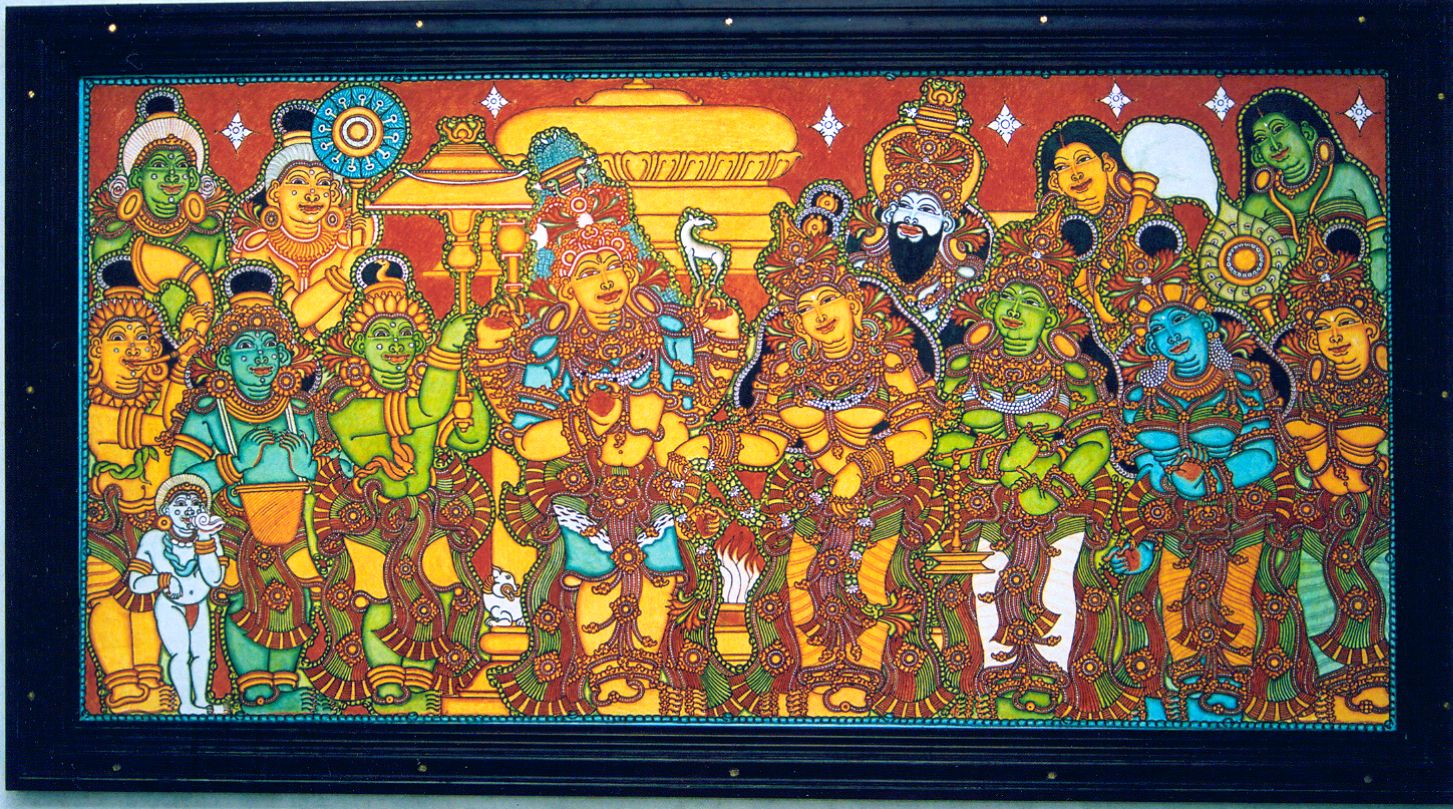
You see, the god of your salvation in Daam Rajya is Kubera. He happens to be the brother of Ravana. And he strikes a handsome pose. See the picture at the top.

Happy Nirvana!

Beedi Basava Bhimplas


On many a weekend I find
A colourful visitor on our streets.
It's a bedecked Basava or bull(ock) behold!
Strolling along with his master playing his beguiling pipe-
Nadaswaram - the happy music of temples and weddings.

I won't call it begging although some coins are expected from every onlooker.
Because
the piper charms with his music, and the beast is indeed a beauty.
I am reminded of our star musicians, with their spouses in tow.
The spouse seems nonchalant, without a care-
Unmoved by the music, or our stare.

Thursday, July 21, 2011

When did we Indians become greedy?


Today's Hindu features an inspiring interview with the surviving king of Travancore, who calls himself Padmanabha Dasa. He explains that being a king, like Henry VIII, confers enormous acquisitive powers and one can excuse greed by adducing the title to himself as the Defender of the Faith. The other extreme attitude, which goes even beyond trusteeship, is to call oneself the servant of God. Even Gandhi was impressed with the utter simplicity of Travancore kings, and their temple was the first to allow all castes to enter its precincts.

These days we read only about two things. The greedy thieves who become our politicians, and how rich are our temples and god-men. For a yoga guru to own an inland off Scottish shores and declare a mere Rs.1100 crores ($2B and change) as his assets seems passé. After all, we have always called God Ishwara (possessor or riches) or Sri Devi (the goddess of wealth).

But juxtapose this with our idea of sannyasa, the stories of Buddha, Ashoka, and Gandhi, and even this story of Padmanabha Dasa, and we arrive at a conundrum. Indians worship poverty, and yet show immense greed. Perhaps the two go together, as fasting and feasting are both endemic to our culture!

But all this discovered temple wealth (the recently catalogued wealth of Rs.100,000 crores and more in Padmanabhaswamy Temple vaults) and hoary fables of Vijayanagara where precious stones were weighed in scales like common commodities raise one key question. It does seem that India had immense wealth once. Like in Somnath temple looted and ravaged by Ghazni; and the Kohinoor diamond and the Peacock throne, which invited invasions and pillage. It is well documented how the East India Company methodically stole the jewels from our crown, as it were. Now, can we relate the three together, our historic wealth, our historic spirit of worshipping self-abnegation, and our recent symptoms of untrammelled greed?

My theory is this. In a land of plenty, man starts to aspire to higher things. Hence wealth becomes a mere means to an end. Sacrificing lower wealth to aspire to higher ends (witness the Story of Puran Bhagat as narrated by Kipling). But when Indians have lost our higher moorings and also been bitten by the fear of losing all to invaders and thieves, we become victims of lobha. That is the Sanskrit word for greed.

And perhaps in the past we worshipped God as not a symbol of lucre, but a higher value of bliss or Ananda. So we went to Badrinath and Padmanabhaswamy temples, not known for their wealth.

But having lost bliss, we now settle for $$$$. So the greatness of a god-man and the popularity of a temple are to be a function of their wealth, measured in tons of gold and dollars in billions.

Monday, July 18, 2011

The first ten days in Bangalore


Bangalore is busy, dug up, smelly in spots, and quite tough to navigate on any given day, especially Saturdays and Sundays. Everyone is on the verge of road rage given the missed meetings and wasted hours.

A million eateries have sprung up offering every kind of regional fare as well as fancy international cuisine.
Most waiters are clueless what the dishes are and can't speak your language, whatever it may be.

People are lovely, wanting to help and trying to make a living.

The TV is full of Bollywood Khans, godmen and marauding newsmen.

Mosquitoes have become extra-powerful and bite at all times of the day and night.

Come to Bangalore, the 24/7 city with all action funda:

The Khans sear my screen all day.
Godmen hop and mosquitoes don't stop.
Stuck in traffic, I don't care.
I have a date with my favourite buffet.


Monday, June 20, 2011

God's Syllabus


Exam time, admission time, tension for everyone. When we choose different subjects, do we know who their presiding deities are? It will surely help if we can assign each god or goddess to our favourite or not so favourite subject. So here is a simple way to classify.

Ganesha - Physics
Saraswati - Chemistry
Lakshmi - Maths
Durga - Biology
Shiva - Medicine
Brahma - Engineering and Technology
Vishnu - Management.

Of course, one should say this in Sanskrit to sound truly impressive:


Friday, June 17, 2011

Saraswati in Medhaa Sukta


Thanks to Chinmaya Balavihar, our daughter Sumana chanted this sitting on the banks of  Nachiketa Tal near Uttarkashi in the year 2000. She was ten. Nachiketa Tal celebrates the spot where Nachiketa, the famous aspirant of Kathopanishad, meditated. It is high in the hills, is a beautiful lake surrounded by a lovely forest full of  rhododendrons. 

Wednesday, June 15, 2011

What's wrong with Husain's Saraswati


After reading reams of regret expressed by artistic admirers of Husain as to how he was hounded for his 'Saraswati' and other paintings, I decided to find out what the fuss was about. Here is his sketch. I am afraid my sympathy for this great artist has dimmed after seeing this sketch. Here are the reasons.

An artist is first and foremost in search of a viewer to see his art. Some artists like Husain sell their paintings for good money. Therefore an artist needs to have a sensibility and a sensitivity to the viewer. For example, if I were to paint a sketch of Husain eating crap along with a pig in a gutter, however famous an artist I might be, I would not be serving art or respecting the sensitivity of the viewer, even if he were himself a liberated artist like Husain.

Because the fundamental principle of art is not to cause revulsion or disgust in the viewer but a sense of beauty or wonder. On this score this painting fails the test...since it is meant for people who know who Saraswati is. For such people Saraswati represents grace, wisdom, art, knowledge and enlightenment. Just putting together a woman, a peacock, a veena, a lotus and a fish does not become a painting of Saraswati. For those who detest Saraswati, it may have some appeal. But such an intention would be perverse.

Second, from those tributes to Husain, it seems he researched Hinduism. I am afraid his knowledge of Saraswati is dismal. Saraswati is a Vedic goddess, the mother of Vedas, who is pictured as seated in the middle of a lake (saras), is also identified with the mythical river of knowledge and as one who imparted Vidya or the ultimate knowledge to mankind. She is clad in white, seated on a White lotus, plays a veena, carries prayer beads and a book of scripture. There is no fish or lotus in her hand mentioned. Husain's woman is holding up a lotus and a fish is gurgling bubbles(!!). Looks incongruous.

The woman is sitting voluptuously and has let the veena slip from her grasp. Why? To hold aloft a lotus. And then the left hand is busy holding up an invisible load...

The veena itself seems abandoned, whereas all Hindu imagery of Saraswati extols how beautifully she holds the veena, with grace and dignity. The lotus held aloft seems disjointed, maybe Husain's depiction of the optical principle of refraction.

Now let us grant Husain all artistic liberties. Is this sketch truly art? Here is a wanton woman, who has let slip her veena so she can hold up a lotus and gesture something. It is the image of a senseless woman. It calls for stupidity or perversity to call it Saraswati, as Husain did. What a far cry from the depiction of the Vedic goddess! What a shame compared to Kalidasa's Shyamala Dandakam!

I think Husain's repeated attempts to scandalise Hindus with his imagery of gods and goddesses would give rise to only two options. Either pronounce him mad, or lock him up. Driving him out of India wasn't perhaps a nice thing.

Wednesday, June 8, 2011

Dakshinamurti - the God who guides spiritual aspirants

I began the day listening to a soul-stirring rendering of this great Dikshitar kriti in Shankarabharanam sung perhaps by Semmangudi and accompanied by K.S. Narayanaswamy on the veena, without any mridangam. What an experience! Wanted to share it... pieced together from many Internet sources. I sincerely thank these anonymous benefactors...


dakshiNA mUrtE - rAgaM SankarAbharaNam - tALaM jhampa


pallavi
dakshiNA mUrtE vidaLita dAsArtE
cidAnanda pUrtE sadA mauna kIrtE

anupallavi
akshaya suvarNa vaTa vRksha mUla sthitE
raksha mAM sanakAdi rAja yOgi stutE
(madhyama kAla sAhityam)
rakshita sadbhaktE Sikshita duryuktE
aksharAnuraktE avidyA viraktE

caraNam
nikhila saMSaya haraNa nipuNa-tara yuktE
nirvikalpa samAdhi nidrA prasaktE
akhaNDaika rasa pUrNArUDha SaktE
aparOksha nitya bOdhAnanda muktE
(madhyama kAla sAhityam)
sukha-tara pravRttE svAjnAna nivRttE
sva-guru guhOtpattE svAnubhOga tRptE

Friday, June 3, 2011

Bhutan


They call it the land of the thunder dragon
But the people are always smiling.
The Tiger's Nest is where Rimpoche flew in to settle.
But a hard trek was needed to reach his high abode.
Gangtey receives the black-necked crane every winter.
We heard its stories whispered in the misty green hills.
Punakha's Fortress is formidable for the enemy
But it gave us a flowery welcome.
Takin is a fierce and wild half cow and half goat. 
But it ate baby bamboo shoots out of our hand.
The bronze Buddha sits atop Thimphu's hill.
Showering his benevolence on king and country.

Sunday, May 15, 2011

Coming Home to the Chilly


Dear home here I come
To savour my favourite chilly.
Redder than ever, sharper it's been never.
No pet would wag his tail as lovingly,
No cherubic smile would charm so willingly.
Your warmth, your glow, your welcome smile on show,
All make it worth my journey home.
At last, to my peaceable state. My seepable taste.


(my daughter gave me this welcome gift- the chilly grown by my co-bro Murthy in his lovely kitchen garden- his home is named Siri).


Friday, May 13, 2011

Wednesday, May 11, 2011

Bhaavayaami


What a brilliant confluence of all that is best in our literature, music and artistic dedication is this immortal song, Bhaavayaami Raghuraamam, composed by a prince among composers Maharaja Swati Tirunal. Many texts are in circulation, with many errors (just my opinion). But I found an excellent resource here to read and understand this song: Dr. Narayanaswami's translation and notation at carnatica.net. I have copied the lyric in transliteration script here:


bhAvayAmi raghurAmaM
bhavyasuguNArAmam ||

bhAvuka vitaraNaparA pAN^ga lIlA lasitam ||

dinakarAnvayatilakaM divyagAdhisutasavanA-
vanaracitasubAhumukhavadhaM ahalyApAvanam
anaghamIshacApabaN^gaM janakasutAprANEshaM
ghanakupitabh.rghurAmagarvaharamitasAkEtam ||

vihitAbhiSekamathavipinagatamAryavAcA
sahitasItAsaumitriM shAntatamashIlam
guhanilayagataM citrakUTAgatabharatadatta-
mahittaratnamayapAdukaM madanasundarAN^gam ||

vitatadaNDakAraNyagatavirAdhadaLanaM
sucaritaghaTajadattAnupamitavaiSNavAstram
patagavarajaTAyunutaM
pa~ncavaTIvihitAvAsaM
atighOrashUrpaNakhAvacanAgatakharAdiharam ||

kanaka m.rga rUpadhara khalamArIcaharam iha
sujana vimata dashAsya h.rtajanaka jAnvESaNam
anaghapaMpA tIrasaN^gatA~njanEya nabhOmaNi-
tanuja sakhyakaraM vAlitanudaLanam Isham
||

vAnarottama sahita vAyusUnukarArpita-
bhAnushata bhAsvara bhavyaratnAN^guLIyam
tEna punarAnIta nyUnacUDAmaNI darshanaM
shrInidhim udadhitIrA shritavibhISaNa miLitam ||

kalitavarasetubhandhaM khalanissImapishitAshana-
dalanamurudashakaNThavidaraNamatidhIram
jvalanapUtajanakasutAsahitaM yAtasAkEtaM
vilasitapaTTAbhiSekaM vishvapAlaM padmanAbham
||

You can listen to the immortal MSS sing it here. I was told that the music was actually set by Semmangudi Srinivasa Iyer.

Saturday, May 7, 2011

The Ideal South Indian Restaurant


This is purely my opinion. You are reading it at the risk of wasting your time and mentally disputing my ideas. In any case if this starts a debate well and good.

The universal appeal of the tangy taste and fresh flavour of south Indian cuisine makes one search with earnest intent for Southie joints everywhere in the world. Bombay and Delhi restauranteurs have gotten savvy about this and dish out Madrassi items like Badha Sambhur and Massala Dossa. But at the cost of curbing cultural exchanges, I insist that only a south Indian gourmet and restauranteur gets it right. At the same time our Idli Dosa joints are notorious for their poor service quality and noisy, cramped and somewhat dirty ambience. The waiters want to get rid of you fast, like a Sulabh Shauchalay attendant. And then the debate whether Sambar and Rasam should have a touch of sugar, or Dosa should be thick and brown like in Bangalore or white and thin-crisp like in Chennai. So I thought I should also venture my opinion, basking in the glorious feeling of a brunch at Murugan's on Saturday morning.

The Menu
Idli, Vada, Dosa round the clock
Coconut, coriander, gongura and tomato chutneys
Sambar - fresh, flavoursome and free-flowing (same goes for chutneys)
Fresh chutney power(podi) with til oil and ghee
Mysore Rasam
Lemon rice
Avial, Mor Kuzumbu
Poriyal not with bogus vegetables like beet root, but beans, carrots, ladies finger etc.
A dal-based curry (is it called thoyil?)
A tangy Gojju like pineapple
Puliyogare
Crisp vadams appalams, sandige
Real filter coffee and also good tea for the less fortunate.
Rava Idli, Pongal, and uppma
Poori with saagu and potato curry
Kosambri
Good mango and lemon pickles
Curd rice not dry or sour
Badam Milk, Butter Milk
Fresh juices
Carrot Halwa, Jamoon, good Kesaribath, Ras Malai
Kulfi, Ice Cream
Thali at lunch and light buffet at dinner. A la carte tiffin.

Service and Ambience
Decent seating with walking space
No smelly carpets or dingy corners behind moldy curtains
No street noises
Well lit
Banana leaf on stainless steel plates, silver tumbers for coffee etc.
Good clean filtered cold water
Clean and polite waiters
No noisy talk among staff
No din of stainless steel utensils being washed or stacked

A lobby like waiting area with a small handicraft shop

Good betel-nut, Beeda

Credit card payment
Generous tips allowed
Clean toilets, discreetly located clean wash basins
Parking not too cumbersome
Separate urchin play area
No noisy TV
Soft good instrumental Carnatic music

Must not cost more than Starbucks or Pizzahut for a meal.


Location:Murugan's Idli Shop


Friday, May 6, 2011

Amazing Race


A lovely day spent in a bounty hunt race, chasing clues and hunting for stuff all over VivoCity and Harbourfront Centre as a team-building activity after our 300 strong office moved from Tiong Bahru. Over 15 teams. Our ten-strong team sang Jai Ho as our anthem.
Table Tennis, GE jig, locate five ATMs in five minutes, find and eat the traditional soybean dessert ice kacang.

It helped that we won a prize finally too.


Location:Harbourfront Centre

Saturday, April 30, 2011

Jerusalem - sung at the Royal Wedding

This is a great poem by William Blake:

Blake's poem

And did those feet in ancient time.
Walk upon England's mountains green:
And was the holy Lamb of God,
On England's pleasant pastures seen!

And did the Countenance Divine,
Shine forth upon our clouded hills?
And was Jerusalem builded here,
Among these dark Satanic Mills?

Bring me my Bow of burning gold;
Bring me my Arrows of desire:
Bring me my Spear: O clouds unfold!
Bring me my Chariot of fire!

I will not cease from Mental Fight,
Nor shall my Sword sleep in my hand:
Till we have built Jerusalem,
In England's green & pleasant Land

You can read more about it in Wikipedia.

This was recited in the Westminster Abbey yesterday at the royal wedding. Enjoy it on You Tube:


Saturday, April 23, 2011

Ten symptoms of Dhoni-ism


Ranchi Mental Hospital

Time 100 of 2011 named Mahendra Singh Dhoni one of the most influencial persons in the world. The List shows many names most Indians are not aware of. But in the last 24 hours PTI pretty much implied that Dhoni, rated above Obama, Ambani, Premji and neuro-scientist Ramachandran, is the biggest thing that happened to India since Mahatma Gandhi.

I call this syndrome Dhoni-ism. Its symptoms include and go beyond cronyism and crazy-ism. To recognize a victim of Dhoni-ism, you need to listen carefully for statements like the following:

  1. Give Dhoni Bharat Ratna right now.
  2. Ask Anna Hazare to shut up. Dhoni could win the ICC World Cup without saying a word about the billions of corruption allegations in Indian Cricket.
  3. India needs cricket more than education and politics. Did you watch Lagaan?
  4. India invented cricket. (search elsewhere in the blog for that piece).
  5. The Indian GDP growth rate is directly linked to the IPL 4 run rate.
  6. Poor people should not pray for rain or government tax concessions. Self belief, combined with some cricket, will deliver results.
  7. We should make Dhoni and other such heroes act in movies to improve our Oscar chances.
  8. Dhoni will win the next 3 World Cups also and show India is better than 3-time winners Australia. This is crystal clear in his horoscope where the Sun and Jupiter are housed together in the seventh house favourably.
  9. Dhoni should be the joint CM of Bihar, Jharkhand, UP and MP.
  10. Dhoni should sing the national anthem and that should become our official track.

Life is Beautiful - Soprano Cheryl Barker's Portrait

Just listening to ABC Classic FM featuring this soprano singer Cheryl Barker. Her famous rendering of Puccini's classic operatic pieces in Madame Butterfly inspired the artist Yin to paint her portrait, 'Hearing Meditation' which has become a finalist at the 2011 Archibald Prize.


Friday, April 15, 2011

Going fancy-tech

I went to the Marina Bay Sands at last. It was the team dinner. I did not explore all the sights, shoppes and splurges (casinos et al) but already got a flavour of it.

1. MBS is the happening place for all those who feel young and rich.
2. It is big. You will feel as if you are an ant crawling in a bowl of honey.
3. The food is plenty in a restaurant called Rise. But not much for an Indian palate.
4. After Maria Bay Sands the next happening place is Clark Quay. It is full of young starry-eyed skimpily clad girls and men.
5. You will feel a warm glow for a couple of days after MBS+CQ. Especially if you can blog about it via an iPad gifted by the team at dinner to you, as I was.

Tuesday, April 5, 2011

India invented Cricket


Prof. Thirunavakkarasu and Pandit Vishwanatha Shastri have submitted a secret paper to the Prime Minister which proves India invented cricket during Mahabharata times.

This sensational discovery could not be revealed earlier as it would have unnecessarily distracted India's World Cup campaign.

Tracing a lead in Shilappadikaram, the scholars researched rare manuscripts in Bhandarkar Institute Pune and discovered that during Mahabharata,  Bhima and Arjuna invented cricket when they got a sabbatical trip to Swargaloka. Everyone knows how Arjuna spurned Urvashi's advances and in turn was cursed to behave like a eunuch and teach dance later on to Uttara. During the same visit to Swarga, a bored Bhima used his gada to play left arm spin bowling from Arjuna on an idle sunny afternoon. Sage Agasthya spotted them and said lo, we have the makings of a grand game here!

Vishnu and Shiva led the two teams.  Bhima, Manmatha, Vashishta, Narada, Indra and Vayu were in Vishnu's team. Shiva had Kumara, Ganesha, Agni, Nandi, Arjuna and Vishwamitra. VIshwamitra opened the pace attack. Arjuna like Gary Sobers could bowl left arm and bat right-handed. Bhima hit many sixes. Vishnu played a captain's knock down the order and ran cheeky singles. You can even now see he needs Lakshmi's leg massage often. Brahma, who was trikala gyani, was the umpire who needed no referral system.

Just when the match was going great Durvasa appeared. He was livid that Ashwini kumaras were not included in the teams. He cursed that the game should be forgotten forever. Narada interceded and won a concession that the game's heavenly origins would come to light when India won a world competition on home soil.

Incredible!? Kreekata in Sanskrit means a game played with girded loins (they had to tie their flowing angavastra around the waist). Vaara was one 7 ball cycle which became 'over'. When a batsman was caught (the only way to get out) he had to untie the waist cloth - vikata.

A British scholar took the idea from the Pune library in 18th century.

Sunday, April 3, 2011

The Hindu : Sport / Cricket : India are World Champions!

Our Lifetime's Greatest Sports Moment in India


From Lagaan to Lagan

Once  outsiders that flashed the World Cup aloft at Lord's
Called Devils as they were truly unknown to the world as winners;
To the world centre-stage of cricket here, back home, in amchi Mumbai;
A glorious tournament, full of happy crowds and healthy rivalry-
No shadowy fixers, no skirmishing fans, no bad-mouthing leaders, no ignominious losers.
Wearing lightly the heavy mantle of expectation of 1.2102 billion people,
Soaking up a million sagely words of caution, concern and criticism;
Beyond propitiating Sehwag and Sachin to fire up and notch up hundreds,
Gambhir in confidence, Mahendra when the moment demanded-
Worthy victors over a great rival team, India have arrived.


Sunday, February 27, 2011

What's great music?

I was treated to a wonderful presentation of this world famous piece "Bolero"by Ravel on Australia Network - Sydney Symphony, conducted by Gianluigi Gelmetti. I found a variation on You Tube:


Enjoy!

Friday, February 25, 2011

What's in a Word?


We call things in our language 'padArtha'. That means literally word-meaning. in other words, things seem to take on an existence because we choose to identify and label them! What an advaitic thought indeed since we are imputing to ourselves the power of making our own reality. Whereas at one level it is true, in reality (!), we often substitute our words and concepts for the actual reality. It is a bit like a mathematical transform function that maps from one domain into another. In the process, the interrelationships and properties may change.

Sri Ramakrishna used to say that wringing an almanac which has a prediction of rainfall today does not produce rain drops!

I just came upon this quote:
'I am not so lost in lexicography as to forget that words are the daughters of earth, and that things are the sons of heaven.'- Samuel Johnson, in his preface to his Dictionary of the English Language.

The great man Johnson conveys how creation and existence precede our endeavours to label them with our words: ours is a very 'human' activity not shorn of sentiment (hence words are daughters!?)

Without words there would be no conversation, let alone thoughts.
And without thoughts man would either descend to animal status or rise to the fourth state of consciousness and become a meditative and radiant Buddha.

Wisdom begins where Knowledge ends.


Saturday, February 12, 2011

Purandara Dasa - Music and Philosophy


 I had a delightful evening in Singapore devoted to this great saint and grand-father of Carnatic music recently. The celebration was held in the beautiful Sempaga Vinagar temple.

 The opening song sung by Mrs. Bhagya Murthy and her disciples (including Mrs. Lata Vishwanath whose family had so kindly taken me there), was "Ura Devara" - audio linked here MusicIndiaOnline (M.S.Sheela)


I was at once struck by the profundity of meaning and how one can relate to this song at many levels.
I can see how Purandara is summing up the devotional yoga extolled down the ages.

To a casual listener, the words convey that Purandara is advising a villager to find a way to bring the village temple with animal sacrifice etc. into his own mind and worship God to get rid of his troubles. But at a different level, he is referring to a number of great concepts. These are beautifully covered in the Bhagavadgita, and he refers to ideas there in several places.

sarva-karmAni manasA sannyasyAste sukhaM vaSI
nava-dvAre purE dehI naiva kurvan na kArayan  (Bhagavadgita V.13)
When the embodied living being controls his nature and mentally renounces all actions, he resides happily in the city of nine gates [the material body], neither working nor causing work to be done.

And then, the need to meditate on the chosen deity by focussing on the inner eye ( bhruvor madhye prANamM AvESya samyak sa tam param puruSham upaiti divyam BG VIII.10).

 Purandara is also referring to worship of the deity in the eight-petalled lotus in Sri Chakra. He also hints at the spiritual progress by traversing upward through the Kundalini chakras.

Also, when he refers to the inevitability of Death and the need to develop detachment to the external world (symbolised by the dearest ones in life - wife and children) he is in fact recalling the words from the Gita:

asaktir anabhiSvangah putra-dArA-gRhAdiSu
nityaM ca sama-cittatvaM iShThAniShThOpapattiSu
mayi cAnanya-yogena bhaktir avyabhicAriNI
vivikta-deSa-sevitvaM aratir jana-saMsadi  ( BG XIII. 10,11)
Nonattachment to children, wife, home and the rest, and evenmindedness amid pleasant and unpleasant events; constant and unalloyed devotion to Me, resorting to solitary places, detachment from the general mass of people.

The final words in the song beautifully describe the devotional path. Purandara Dasa says that by forgetting the hardships of the past, and not being swayed by the promise of  future glories, we need to focus now on the worship of the Real and Absolute, the abiding principle that guides our lives and liberates us.

Sunday, January 30, 2011

Ayurveda vs. Modern Medicine

(Read WSJ on Narayana Hrudayalaya, Bangalore - Photo: Lord Dhanvantari statue in the hospital lobby)


Of late, I am the odd man out in discussions where my Indian colleagues and friends quote godmen, gurus and medical men who propound that moden medicine is very immature, treats only symptoms in an attempt to fight disease and is nowhere as developed as ancient Ayurveda which helped men to live healthy and long - up to 120 years and more, as it was a holistic system.

I have problems with this type of thinking. Let me first state that I have been in the medical equipment industry for 30 years and have dealt with the best surgeons and physicians in India and abroad. But I have also seen the crass commericialisation of modern medicine by the unscrupulous. I am aware of how industry and trade has been hell-bent on pushing unwanted and unnecessary scanners and pills, and how doctors have been harvesting their investments by exploiting hapless patients.

I am also often a witness to cynical patients and families who avoid treatments and accuse doctors of malpractice whenever they advise someone to undergo angioplasty or surgery. There are also associations and doctors who conduct camps to "Treat your Heart without Surgery" and who strenuously advocate life-style change and natural methods to resolve heart ailments. So I am not surprised by everyone's urge to go back to ancient Ayurveda. In fact I also tried it a few times before.

Ayurveda, purportedly given to us by Lord Dhanvantari and practised successfully for thousands of years by Indians for longevity and good health, has seen a resurgence now. Today's pollution, adulteration and pills-for -every-symptom approach are pointed to be the reason for the explosion of cardiovascular diseases and diabetes in India. Now we all long to go back to pure and natural and wise Ayurveda!

In this context, I am an upholder of modern medicine. Here are my reasons:

  1. To judge medicine, we have to see its best proponents and practitioners, rather than the over-commercialised version. Like everything around us, there are good doctors and bad doctors.

  2. Modern medicine is the evolution of a science and is not opposed to Ayurveda, Chinese Medicine, Yunani or anything else. Down the ages, the science has been growing through cross-fertilizing ideas. Greeks surely learnt from ancient Indian sages during Alexander's travels.

  3. The language of science is mathematics. The Greek and Roman terminology employed in modern medicine, coupled with medical statistics, is a robust scientific platform. Perhaps this level of rigour is missing in most traditional methods.

  4. Modern medicine believes firmly in tried and tested methods. It believes in data-driven diagnoses. There has been no real data-driven research in tradional methods. Thus they are unable to submit the required data for US FDA or international patents.

  5. The key to successful Ayurveda practice is standardisation of training, medicine production, and
    "peer-reviewed" professionalism. That will go a long way in proving its success.

  6. The first principle of medicine is "do no harm". So like Ayurveda, modern medicine in its pure form is conservative. Life-style changes and food habits are to be addressed first before medication. It is unfortunate that we run after doctors who dish out instant remedies.

  7. The body cures itself. That is the power of life. The will power to cure oneself works wonders. That can also be called the placebo effect. Psychology functions particularly in life-style diseases and chronic diseases where more than a cure, we want alleviation and management of symptoms.

  8. Yoga is totally focussed on psycho-physical activity. It is the peak of human endeavour to heal oneself and evolve. It is the method for achieving well-being here and hereafter. But Yoga should not be confused with Ayurveda.

  9. Yoga has four elements - Asana, Pranayama, Mudra and Bandha. It can always be combined with modern medicine without any issue.

  10. If holistic medicine and life-style management as propounded by Yoga is adopted, this is NOT AGAINST modern medicine. Just as the ancients believed in Aushadi, Pathya, and Kriya, medicine can absorb and benefit from the wisdom of "healing oneself".

  11. As I said before, the body can be helped to heal itself rather than dump treatment and medication. That is an important attitude we can cultivate within the context of any school of medicine. Today's "good" Ayurveda practioners are doing this and their positive results are based on that holistic approach.

  12. Health and Well-being are goals. We set goals as a part of our modern lives. That is no different from the old philosophy of yuktaahara-vihaarasya...yogo bhavati dukkhahaa ( Bhagavadgita Ch. 6)

    Let me finally quote a Sanskrit shloka we had in our school text. It is purported to be an ancient sholka, when doctors were practising only Ayurveda. It states that Yama, the God of Death, takes away only our lives, but the doctor takes away our lives as well as our wealth!


      Friday, January 28, 2011

      Bharata - a true hero of Ramayana


      I went to Chitrakoot.

      After Rama's banishment to the forest, he wanders with Sita and Lakshmana and arrives at Valmiki's ashrama. He requests the sage to suggest a suitable place for his sojourn in the forest. The sage suggests the beautiful, hilly forest of Chitrakoot. And while staying there, Rama receives Bharata and his entourage. The story of Bharata's encounter with Rama, his entreaties for Rama to come back to Ayodhya, Rama's conversations with king Janaka, sage Vasishta, and Rama's unshakeable resolve, are very touching parts of the story. But the most touching and abiding images are those of Bharata's asking and taking the padukas, and later enthroning them in Ayodhya. And Bharata dwells as a hermit in Nandigrama, living on roots and shoots much like Rama, for fourteen years, running the kingdom in trusteeship and devotion.This entire episode is called Bharat Milap.

      Rama, after Hanuman returns successfully from Lanka with Sita's Choodamani, embraces him with tears and says "Bharata hi sama Bhayi"!"( a brother as close as Bharata!)

      I went to the spot where Rama receives Bharata. Travelling to Chitrakoot and dealing with the priests there is a hassle. But the hill where Rama stayed and the Bharat Milap spot are sacred to devotees, who circumambulate the hill for 5 kilometers. The hill lies on the border of Uttar Pradesh and Madhya Pradesh and both states claim that Bharat Milap is their heritage.

      Bharata is the true hero of Ramayana according to me. The epics are full of stories where people like us encounter and deal with life's challenges in a special way,with sacrifice, devotion and courage. Of all such stories, Bharata's story is incomparable. Let me summarise:
      1. Bharata did not take shelter in the parental diktat to occupy the throne. He used his buddhi (wisdom).
      2. His act of trusteeship was not merely politically astute, preserving Rama's inheritance and the family unity - he did it with love and devotion.
      3. He need not have lived as a hermit. He need not have worshipped the sandals of Rama. He need not have gone to such lengths to persuade Rama to return. All this shows how he lived out of his heart, and his righteousness and devotion to truth. 
      4. Bharata was singularly handicapped in his situation. His heart said the kingdom belonged to Rama, and the turn of events had to be corrected. He was a prince too, and all princes want to become kings. His mother had extracted a monster gift of Ayodhya for him, at the cost of his father's death. But he did not succumb to political expediency.
      5. The way he marched to the forest, with Janaka and Vasishta, and tried to right the historical wrong to Rama shows true statesmanship. There is perhaps no other example of such an act in history. We hear of brothers killing each other, and cousins causing the death of hundreds of thousands for the kingdom. But this man was different.
      6. In Mahabharata, when faced with "duty" and devotion to the throne as opposed to fighting for what is right, Bhishma and Drona came up short. They are not heroes. They did not fight for what is right. They went by expediency and convenience. They wanted to preserve their "name".  Bharata did something crazy in comparison.
      If Ramayana is about righteousness, sacrifice, love, and steadfastness, its true hero is Bharata.

      Let me share with you a link to a great song..Sada Enna Hrudayadalli... by the late Bhimsen Joshi. What music!

      Sada Enna Hrudayadalli by Bhimsen Joshi


      Friday, January 14, 2011

      Marvellous Narmada

      I travelled to Jabalpur recently. The river Narmada, even after being dammed a couple of times, flows majestically. She has gouged a deep marble ravine and you can go in a lovely boat ride and watch pink marble rocks running to several hundred feet high, just as cool and crystal clear Narmada flows majestically, in places up to 600 ft. deep. Up a few miles away is a mini Niagara- like fall at Bheraghat. It is called Dhuadhar or Dhauldhar. Watch it here!

      Monday, December 13, 2010

      If you liked Baghban


      I saw this movie la Tete en Friche ( titled in English, My Afternoons with Marguerite). There is this 96 year-old actress acting as a 95 year-old lady left in an old age home by her nephew in a small French town. He is already complaining that he can't afford to keep her there, but the lady is still full of life as she is very well-read  and loves to go sit in the park watching pigeons and reading her books (like Albert Camus's Plague). Sitting one day on her favourite bench, she meets a middle-aged man Germain, who is also a regular there. He comes to watch over the pigeons. He has in fact given each one a name like Thief and Crabster, having closely watched and discerned their personae.

      Germain ( enacted by Gerard Depardieu)  is a simpleton but with green fingers. He grows and sells vegetables. He also does odd jobs. Germain was abused as a child and often remembers how he never felt loved by his mother. She also drove out his father, a waster. She is now old and crazy and Germain simply shakes his head in mild irritation during her frequent outbursts when she uproots his plants and screams hell.

      Germain was ridiculed at school as he never could read well. But he  has a very likeable child-like nature. Sitting on the park bench on languid afternoons, he is all good-humoured attention as the old lady reads and explains the classics to him. Their friendship develops beautifully as Germain really cares for the lady. One day she brings over a huge dictionary as a gift, and tells Germain how the dictionary is a fascinating journey from the world of one word to the world of the next. But Germain finds the dictionary a tough read, unable to spell words like labyrinth or Anette. He is also unhappy that the dictonary mentions only one type of tomatoes.

      The town's social life revolves around a small restaurant, and you can tell that the folks there like Germain for a steady fellow. Germain is also dating young Anette who drives the local bus. They are a sweet and simple couple and Anette wants to have a child.

      When the old lady tells Germain that her eye-sight is going down rapidly due to macular degeneration, Germain feels terribly for her, and at Anette's suggestion decides to learn to read to her. He goes to the library, and in a really humorous scene, succeeds in explaining what kind of a book he would like to borrow- not too thick, with a story of adventure, with pictures. Sitting up late in bed, word by word he struggles through the book with Anette's help, and gets to a point when he can indeed read to the old lady!

      One day Germain's mother reveals that his real father was not her useless husband but a charming young man. In the next scene Germain comes home to see his mother dead. Sadly bewildered by the turn of events, Germain discovers a photo of his parents in a box of knick-knacks left behind for him. soon his mood changes to astonishment when he learns how his mother had finally been able to express her love in her own way -she had actually saved up her meagre pension and bought for Germain the house they lived in. Doubly happy to know that his girl friend Anette has gotten pregnant, Germain wants to share the news with the old lady. Alas, he finds out at the nursing home that her nephew has taken her away to Belgium, saying this place is too expensive.

      The story ends with Germain rushing in a borrowed van to Belgium. He confronts the nephew, discovers where the lady is stowed away in a depressing old-age home, and rushes there to find her sitting like a faded picture in her wheel chair. He simply rushes out pushing her wheelchair, bundles her into the van and drives her back to his world. They are both happy that she can live with him and Anette and he will now read to her her favourite books. Life's truly happy moments are about sharing and caring.

      Friday, December 3, 2010

      YADA YADA – a call to God


      “Hello, God, may I have a word with You please?” India's Prime Minister, Dr. Manmohan Singh, looks all frazzled and bleary-eyed behind his spectacles as he croaks into the phone.

      You see, it's not only Obama who has a Red Telephone on his desk. The Indian PM's office too has one in South Block. This antique phone instrument has in the Mahatma's own handwriting the famous motto of India, “Satyameva Jayate”. The Mahatma gave it to Nehru just before he was assassinated for his unfashionable beliefs. Nehru knew it was a hot-line to God, but actually he didn't care much for the Fellow and did not trust Him too much - not sure whether he would buy Nehru's patented Panchsheela. Later PMs had never till date felt so stressed out as to reach out to God, being quite able to manage the nation and survive wars, government collapses, gold auctions and of course scams.

      “Yes, Manmohan, what's it?” God does not seem to be in the mood for a friendly chat.

      “You see, God, it's this $40B scam of 2G. Yes I know God, these days everyone talks of 4G, but You should know that in India we have a policy of calibrated progress. So it's 2G that's hurting me, and I am at my wit's end how to manage this crisis and I need Your help”.

      “Why, Manmohan, didn't your coalition partner dismiss the whole thing as a purely “notional” loss?”

      “But God, only Tamil movie-goers will swallow that bit. Remember I was at Harvard”.

      “But then Manmohan, why don't you do what Obama did – he printed a trillion dollars of green-backs and gave it out to all those who were involved in defrauding pensioners and home owners. In fact, you can give 1.77 Lakh Crore rupees in crisp 1000 Rupee notes to your coalition partners”.

      “God, this is no time to be sarcastic. Need I remind you that you have promised in the Bhagavadgita that,
      “ Yada yada hi dharmasya glanirbhavati Bharata/Abhyutthanam adharmasya tadatmanam srujamyaham!”? Righteousness is in a crisis in India and there is no better time to come down and help me, God!”

      God bursts out testily. “Don't quote Me back to Myself! That Gita is one thing I regret the most. All of you down there constantly misquote Me out of context to justify your actions!

      “Just the other day I confronted a serial floor crosser of a politician. You know what he said? “Vasamsi jirnani yatha vihaya, navani gruhnati naroparani/Tatha shareerani vihaya jirnani anyani samyati navani dehe!” No wonder politicians travel from losing parties to greener pastures all the time in their politics of convenience, not conscience. They say they only follow my Gita!

      ''And then there is this billionaire tycoon who goes for Tirupati grand darshan every time he gyps someone of a billion or more, sometimes even his brother, and quotes My words:
      “Sarva dharman parityajya mamekam sharanam vraja/Aham tvam sarva papebhyo mokshaishyami ma shuchah!”meaning that I have Myself advised him to forsake all righteous paths and simply surrender to Me at Tirupati and everytime I will absolve him of all sins, so no worries!

      “And do you know what the Chief Justice quoted to the public interest litigant about the scams?
      He quoted My Gita: “Ishavarah sarvabhutanam hruddesherjuna tishthati/Bhramayan sarvabutani yantrarudhani mayaya!” meaning that it's God alone who resides in everyone's heart and makes people go around doing what they do, through His own maya!”

      “But God, only YOU can make THIS shloka come true: Yada Yada...”

      God says with irritation, “Don't go yaDa yaDa quoting me. Do you know the complete quotation at least? The next stanza completes what you recited. “Paritranaya sadhunam vinashaya cha dushkrutan/Dharma samshtapanarthaya sambhavami yuge yuge!”

      “I would come down only to save the righteous. I am looking for them and for a reason to come down, but I don't see anyone or anything so pristine that they are worth saving.

      “To tell you the truth, Manmohan, I have almost given up. I came as Rama, and I spent most of My time wandering in the forest; there was no improvement in anything. Then I came down as Krishna, and people thought I was there for a dance party. Recently I came down as Buddha and told them to abandon meaningless ritual and meditate, and they simply created an industry to make and worship my statues.

      “After my recent MBA, I started delegating. And what happened? All these god-men I sent down are busy buying up prime real-estate, erecting temples to themselves, or cooking up some sacred magic potions, or getting caught on video doing any kind of hanky panky. There are umpteen TV channels showing their tamasha with disco-style bhajans.

      “I tell you, Manmohan, go cook your own 2Goose!”

      Wednesday, December 1, 2010

      Mahavishnu - a great balancing job


      Here at the Suvarnabhumi airport in Bangkok, just after immigration, before you enter the duty-free shops, you're reminded of the cultural heritage of this region, with a huge golden tableau of Samudra Manthan, coming from the Hindu scriptures describing the churning of the ocean. In India it is believed that this primeval event occured just off the Puri Jagannatha coast in the Bay of Bengal. Across the sea of course is Thailand.

      This churning was to acquire Amruta, the nectar of immortality. Vishnu became the Kurma or Turtle who balanced the churner mountain Meru, and devas and asuras tried a coalition effort using Vasuki, the snake, as the rope. The churning produced many great items, good and bad, including the Haalahala poison which Nilakantha Shiva drank up to save the world. And finally, when the Amruta came out, it was cleverly held back from the unreliable asuras or rakshasas by Vishnu. He felt only the good but feeble devas deserved to drink it. For this to be accomplished, He of course had to become Mohini, the ultimate female temptress.
      I have also loaded my video on YouTube showing the full tableau:

      Sunday, November 28, 2010

      Kartikeya - an interesting god

      First thing : it is Karttikeya. Double t, and it comes from Krittika. The other spellings, Kartikeya and Karthikeya, can be condoned as common errors. Similarly the name Shanmuga comes from Shat-mukha (six heads), and SaravaNan comes from Sharavana-bhava ( meaning one born in a forest of shara grass).

      This interesting deity is the darling of people from the South, with many lovely temples and rituals. Every Tamilian home has a Murugan (aaru-muga) picture day wall-calendar and many articles especially cloth-bags with the word Murugan.

      This Hindu god is unique. He combines masculine valour, a boyish precociousness and also grace. He is in fact the military chief of the gods, and is considered the God of War, like Mars in Greek mythology (devasenapati). He is esoteric, and hence called "Guha', living in forested hills.

      There are several Carnatic compositions of Muthuswami Dikshitar whose chosen deity was Guruguha or Karttikeya. But my favourite is the Todi piece Karttikeya Gangeya Gauri Tanaya, by Papanasam Sivan. It is a majestic composition with alliterative beauty, metrical grandeur, lyrical profundity, and to cap it all, the musical element does, in my opinion, justice to this unique raga which is a challenge to any musician, especially a vocalist. It is a raga that plumbs the depths of the lower notes and sets up edifices at Ga and Ma, with lovely glides along other notes. Somewhat like the glorious mountain peaks inhabited by Karttikeya, with delightful valleys and rivers. The above picture from an Internet website is charming in many dimensions.

      Did you know that Karttikeya was born out of the fire, and nourished by Ganga, and breast-fed by six celestial deities called Krittikas (the star cluster)? And in only one stream of mythology was he born of Gauri as Kumara, in the story so well told by Kalidasa in Kumarasambhavam. The rest of the iconography showing him as the younger brother of Ganesha etc. is of popular value.

      That Karttikeya is worshipped by forest and mountain dwellers is appropriate, and in all probablity he was the earliest male god in the Hindu pantheon, stemming from early man's idolatry of young war heroes.

      Here are links to two great renderings of the Todi masterpiece:

      M.S. Subbulakshmi

      Lalgudi G. Jayaraman

      Now, let me show you the entry under Karttikeya in A Classical Dictionary of Hindu Mythology and Religion by John Dowson, published first sometime about the middle of the 19th century and quite well-researched, like most European compilations (for that matter the most authoritative dictionary of Sanskrit is by Sir Monier Williams, as much as other Indian language reference dictionaries are by European scholars!)

      So let us join in worshipping this wonderful deity, Karttikeya!

      Friday, November 19, 2010

      The Flute-player of Brindaban


      The Flute-player of Brindaban

      Sarojini Naidu


      Why didst thou play thy matchless flute
      'Neath the Kadamba tree,

      And wound my idly dreaming heart
      With poignant melody,

      So where thou goest I must go
      My flute-player with thee?

      Still must I like a homeless bird

      Wander, forsaking all
      The earthly loves and worldly lures

      That held my life in thrall,
      And follow, follow, answering

      Thy magical flute-call.

      Wednesday, November 17, 2010

      Bauls sing of the Beloved

      I knew about the Bauls from the Gospel of Sri Ramakrishna. But the experience of reading Osho's words on Bauls was profound (The Beloved Vols. 1 and 2) Here are some of his words:
      The Bauls are called Bauls because they are mad people. The word 'Baul' comes from the Sanskrit root VATUL. It means: mad, affected by wind. The Baul belongs to no religion. He is neither Hindu nor Mohammedan nor Christian nor Buddhist. He is a simple human being. His rebellion is total. He does not belong to anybody; he only belongs to himself. He lives in a no man's land: no country is his, no religion is his, no scripture is his. His rebellion goes even deeper than the rebellion of the Zen Masters -- because at least formally, they belong to Buddhism; at least formally, they worship Buddha. Formally they have scriptures -- scriptures denouncing scriptures, of course -- but still they have. At least they have a few scriptures to burn.
      Bauls have nothing -- no scripture, not even to burn; no church, no temple, no mosque -- nothing whatsoever. A Baul is a man always on the road. He has no house, no abode. God is his only abode, and the whole sky is his shelter. He possesses nothing except a poor man's quilt, a small, hand-made one-stringed instrument called AEKTARA, and a small drum, a kettle-drum. That's all that he possesses. He possesses only a musical instrument and a drum. He plays with one hand on the instrument and he goes on beating the drum with the other. The drum hangs by the side of his body, and he dances. That is all of his religion. Dance is his religion; singing is his worship. He does not even use the word 'God'.
      There is a great Baul singer, performing and travelling a lot these days, Parvathy Baul. She is one of rare female Baul singers, and has a presence that locks you in. This You Tube video is a good one:

      then, there is an hour-long interview, very well done, in English. You can watch this, and please don't mind the marketing clutter around the video. It is a good interview that brings out the authentic Baul singer that she is.
      One final word. When asked how she handles people who want to surrender to her and wish her to lead them spiritually, she shrugs off that onerous responsibility... she says she's after all a singer. That is the reality of life. There is no "One", whether a musician, a dancer, an artist or a master, or a self-proclaimed guru, to whom you can surrender and hope to move ahead. Finally your guide is within yourself.. at the centre of your being, and not at the circumference which is our sensory world. But surrendering to anyone or anything is a vital first step... it cuts off your head!
      Here is the video interview link... and happy watching!
      http://video.webindia123.com/interviews/dancers/parvathybaul/index.htm

      Sunday, November 14, 2010

      Winter in Finland - music that cheers

      I watched last night a wonderful DVD produced in Australia, capturing Vivaldi's Four Seasons on video with great musicians performing the respective portions in Japanese spring, Australian summer, New York's autumn and Finnish winter.
      The music and the filmography leave you with wonderful imagery. But I was most impressed with the music performed by a young violinist Pekka Kuusisto in a warm farmhouse in the middle of winter.
      I was lucky to find two You Tube clips of the Winter scene... so here you are, and I give the one with the folk song!

      Tuesday, November 9, 2010

      Sea Lions and Orchids - Singapura!

      Here are two videos we shot in the Orchid Garden and the Singapore Zoo... beauty and the beast - both thrilling!


      Sunday, November 7, 2010

      The signs of human nature


      + - X ÷=
      Have you thought of this - the entire gamut of human evolution and spectrum of human emotions can be depicted using the basic symbols of math!?
      + The Book says that God created Adam. Adam was lonely, and so God made Eve. They fell in love and the rest of mankind happened. And that love was surely a positive, additive, collaborative, communicative phenomenon. No wonder it was exactly what the PLUS sign says. And then the community organized itself in its activities, the most significant being prayer and religion. That profoundly influenced society and eventually controlled it. No wonder PLUS is the Greek Cross!
      - The first effect of organized religion was to categorize believers and non-believers. That created distance between any two men more emphatically than anything else before. Now came a distance between two people which was not visible, but which was conceptual. That distance became the first major negative influence on mankind, the symbol of distance and reducing the total of happiness, emphasizing differences rather than commonality. That is the symbol MINUS...
      X Then men organized themselves into groups, clans, countries and fought to expand their group or clan or country. They crossed swords and hoped to multiply their own at the expense of others and grow more powerful. Nothing can describe this expansionism better than the symbol X. MULTIPLY or die it was!
      ÷ Once wars were fought, they ended when there was a victor and a vanquished. The Victor ruled over the vanquished, and that was the most divisive social structure of high and low. That cannot be better symbolized than the symbol of DIVIDED BY ..
      = Finally came the peace-makers, who went around saying everyone is equal and let there be peace. The EQUALS sign is very significant.... two equal lines, that never meet......


      Thus has mankind moved through the signs.... Five signs that tell the story of man.

      Friday, November 5, 2010

      Happy Deepaavali!

      Happy Deepaavali! May your life be full of light and delight!

      The Sentosa Songs of the Sea, full of light, laser, fire, fountain, laughter and music made our Deepaavali!
      (Photo by Sumana Sachi)