Showing posts with label Third Skandha. Show all posts

Tuesday, October 25, 2022

Srimad Bhagavatam III.33 - 25 October 2022


॥ ॐ नमो भगवते वासुदेवाय ॥

Tuesday, 25 October 2022 III.33 - Devahuti prays to Bhagavan Kapila and attains liberation.

***
Concluding his narration of the avatara of Bhagavan Kapila and His instruction to His mother Devahuti, Sage Maitreya narrated how Devahuti became freed from all ignorance concerning Bhakti and Jnana. She prayed to Bhagavan Kapila:
 
“Lord, even Brahma, born in the lotus from Your navel, prayed to You. You are indeed beyond any need for activity, but out of Your own will, you take avataras. This is indeed inconceivable."

स त्वं भृतो मे जठरेण नाथ कथं नु यस्योदर एतदासीत् ।
विश्वं युगान्ते वटपत्र एक: शेते स्म माया-शिशुरङ्‌घ्रिपान: ॥
तं त्वामहं ब्रह्म परं पुमांसं प्रत्यक्स्रोतस्यात्मनि संविभाव्यम् ।
स्वतेजसा ध्वस्तगुणप्रवाहं वन्दे विष्णुं कपिलं वेदगर्भम् ॥

T: “Oh, Lord, You, in whose abdomen all universe resides, have deigned to be born in my womb! What a wonder! At the end of the Yuga, you will lie down on a banyan leaf as a small baby, holding and sucking your little foot!”

“You are Maha Vishnu Himself born as Kapila. You are the Para Brahman on whom sages of purified minds meditate. You remove their ignorance by Your lustre. I pray to You!”

Bhagavan Kapila spoke most lovingly to His mother.

“Mother, practise as I have told you, and you will surely attain self-realisation. You will be freed from the fearful attachments to the body. Those who do not know this path of Bhakti cannot escape the cycle of birth and death.”

Bhagavan took leave and left, His mission accomplished.

***

Devahuti practised Bhakti Yoga assiduously and entered Samadhi in her husband Kardama’s cottage, which was bedecked with flowers and looked like a garland for the holy river Saraswati.

Her austerities rendered her frail and aged. Her home was luxurious and decorated with gold and jewels. It needed no external light to shine. Its gardens attracted singing birds.  The whole atmosphere spoke of Nature’s grace. She was still attended upon by the heavenly damsels Sage Kardama had appointed. This ensured Devahuti’s body was not in distress.

Devahuti constantly recalled her son and missed him. The luxuries and beauty all around meant nothing to her. She pined like a cow would her dead calf.

Devahuti began to meditate constantly upon the Supreme Lord, Maha Vishnu. She realised the Absolute Truth. All her material bonds disappeared.
The place where Devahuti achieved her self-realisation is known all over the three worlds as Siddhapada. Devahuti’s body has merged into the river. 

***
Bhagavan  Kapila proceeded north-eastward from the hermitage when He took His leave. Even now He dwells in the northeastern region, out of grace towards the siddhas and rishis who pray to Him as the preceptor of Sankhya.

***

“Oh, Vidura, whoever listens to this narration of Bhagavan Kapila’s incarnation will be redeemed and attain the Lord’s lotus feet. (उपलभते भगवत्पदारविन्दम् )”

***

॥ ॐ नमो भगवते वासुदेवाय ॥

This concludes the third Skandha of Srimad Bhagavatam.


Monday, October 24, 2022

Srimad Bhagavatam III.32 - 24 October 2022


॥ ॐ नमो भगवते वासुदेवाय ॥

Monday, 24 October 2022 III.32 - Kapila describes the two divergent paths of self-seeking persons and devotees of the Lord.

***

कपिल उवाच
अथ यो गृहमेधीयान्धर्मानेवावसन्गृहे । काममर्थं च धर्मान्स्वान्दोग्धि भूय: पिपर्ति तान् ॥
तच्छ्रद्धयाक्रान्तमति: पितृदेवव्रत: पुमान् । गत्वा चान्द्रमसं लोकं सोमपा: पुनरेष्यति ॥
निवृत्तिधर्मनिरता निर्ममा निरहङ्कृता: । स्वधर्माप्तेन सत्त्वेन परिशुद्धेन चेतसा ॥
T: Kapila said, “ A householder pursuing Artha (economic goals), Kama (sense pleasures) and Dharma (prescribed duties for earning merit) acts consistently out of a worldly interest. Such people lack true devotion and detachment and worship the gods/deities (who preside over worldly gains) and their forefathers. They go in their afterlife to the Moon sphere ( a place of pleasures earned through Punya) but return to this world again once the rewards are exhausted. Their condition is eventually one of dissolution and not liberation. This path of the householder is the dark path.”

“In contrast, there are devotees who discharge worldly responsibilities as Svadharma, without attachment, fully immersed in the Lord with purified minds. They reach liberation and do not come back. Their afterlife is spent in Satya Loka, with continued spiritual evolution until the great dissolution when they merge with the Lord. This path of the devotee is the illumined path.”


“Therefore, My dear mother, by devotional service take refuge in the Lord who is seated in everyone’s heart.”

“My dear mother, one may worship the Lord with a special self-interest. Such people are no different from Brahma, or the Kumaras, or sages like Marichi. They all have to come back to the material world again by the Lord’s will at the time of the next cycle of creation. The interplay of Gunas and the effect of Kala is such. That is how the creation cycle repeats.”

“Then there are those who are too worldly, discharging their prescribed duties well, but all with an eye on the fruitive result. They exhibit Rajas and pursue sense-gratification. They worship their forefathers and engage themselves day and night in improving the economic condition of “I” and “Mine” (कामात्मानोऽजितेन्द्रिया: गृहेष्वभिरताशया:). They lack true devotion and ignore the Lord (विमुखा हरिमेधस:). Such people easily descend to lowly acts and suffer the consequences.”

“My dear mother, the best path is one of Bhakti, because it purifies the mind and fosters a true detachment.”

ज्ञानमात्रं परं ब्रह्म परमात्मेश्वर: पुमान् । द‍ृश्यादिभि: पृथग्भावैर्भगवानेक ईयते ॥
T: “The Lord alone is Supreme Knowledge. He is Paramatma, Ishwara. He incarnates in many forms. For one without a proper realisation of this truth, duality and relativity do not disappear.”

“Indeed all creation has emanated from the Supreme Being.”

यथेन्द्रियै: पृथग्द्वारैरर्थो बहुगुणाश्रय: । एको नानेयते तद्वद्भगवान्शास्त्रवर्त्मभि: ॥
T: “Just as an object is perceived and sensed differently by different senses, the same Lord Bhagavan is perceived and interpreted differently in different scriptures.”

“My dear mother, if anyone enters into ignorance or forgetfulness, he is unable to understand where his path will take him. Spiritual instruction like what I have been telling you is not meant for those who suffer from jealousy, who lack purity, or hypocrites or materialists.”

य इदं श‍ृणुयादम्ब श्रद्धया पुरुष: सकृत् । यो वाभिधत्ते मच्चित्त: स ह्येति पदवीं च मे ॥
T: “Anyone who meditates upon Me with faith and affection even once, who hears this about Me, surely goes back home, back to My state.”

***

॥ ॐ नमो भगवते वासुदेवाय ॥


Sunday, October 23, 2022

Srimad Bhagavatam III.31 - 23 October 2022


॥ ॐ नमो भगवते वासुदेवाय ॥

Sunday, 23 October 2022 III.31 - Kapila explains how the Jiva develops in the womb and gets into the cycle of suffering again.

***
Providence pushes the Jiva into another human birth when he is cleansed after suffering in hell and other lower life forms. The Jiva enters the mother’s womb through the seed of his father.

Kapila explains how the foetus develops, first as Kalala, then becomes disc-like after five days, called Budbuda. Then in ten days like an eggplant, called Karkura. In three months, progressively, his head, bones, limbs, hair and genitals are formed. (Modern ultrasound imaging can determine the gender with 98% accuracy after 12 weeks!)

By the sixth month, the baby can be felt by the mother kicking. He can feel hunger and thirst. Kapila says that the foetus is most uncomfortable, cramped, and in dirty surroundings. What the mother eats affects him. By divine will, the baby remembers his past lives and what Karma has brought him here. He begins to pray in a condition of utter suffering to the Lord.

जन्तुरुवाच
तस्योपसन्नमवितुं जगदिच्छयात्तनानातनोर्भुवि चलच्चरणारविन्दम् ।
सोऽहं व्रजामि शरणं ह्यकुतोभयं मे येनेद‍ृशी गतिरदर्श्यसतोऽनुरूपा ॥
यस्त्वत्र बद्ध इव कर्मभिरावृतात्मा भूतेन्द्रियाशयमयीमवलम्ब्य मायाम् ।
आस्ते विशुद्धमविकारमखण्डबोधम् आतप्यमानहृदयेऽवसितं नमामि ॥
T: The baby cries, “I seek shelter at the feet of the Lord, who incarnates on earth divinely to redeem its inhabitants. It is His grace that I am here and now. Bound by my Karma, surrounded by His creation, I, as the Jiva, salute the Lord who is pure, immutable, indivisible, and omniscient, and dwells in every heart!”

“The Supreme Being is beyond Purusha and Prakriti. My Karma is due to His Maya. Only by His grace can I be redeemed. As a human, I have an understanding of the Lord’s creation and also my body-sense. I am most averse to being borne into the world again, although this womb is so uncomfortable! I know that the moment I am born, I shall be trapped in total ignorance. I therefore shall strive to avoid future births by remembering the Lord always!” 

Come the tenth month, the baby is born. Head first he plunges into the world of ignorance. He cries aloud in distress. He cannot express himself, and those around him do to him what they think he needs. He can’t even resist what they do to him. In his cradle, he is bitten by mosquitoes and insects. 

He grows up Into youth, proud of his body, going after his desires, pushing aside all opposition, totally unaware that what he gets as pleasure and pain is all the play of Karma. 

All the Jiva’s actions from this point only accumulate more Karmas and prepare for hell and future births. Evil company destroys virtues like modesty, truth, kindness and self-restraint. He becomes a pet of womenfolk. Women’s enticements are Pramada, the door to the greatest fall for a man. Only Narayana in His avatara as Nara-Narayana has been able to resist the temptation of a woman.

A woman is the embodiment of Maya. Kapila makes it clear that whatever effect a woman has on a man is true the other way too. A woman falls for the man’s promise of wealth, children and a home, not knowing these are all the ruses used by Maya for her fall.

***

The Jiva transmigrates in the subtle body called Linga Sharira when he leaves the material body. The Linga Sharira carries all Karmas and Samskaras. Birth and death are said to happen when the Linga Sharira gets a human body or leaves a human body.

Even when the physical eye is gone, the Jiva can see through the Linga Sharira. It just does not have a body with eyes. Therefore man need not fear physical death. He is also not in a pitiable state of victimhood, because he can always make his own destiny! Knowing what is explained here, as the Jiva, he should strive for betterment. 

सम्यग्दर्शनया बुद्ध्या योगवैराग्ययुक्तया । मायाविरचिते लोके चरेन्न्यस्य कलेवरम् ॥
T: “Endowed with the right outlook, fortified by Bhakti, Yoga and Vairagya, a realistic understanding of the gloom of physical bondage, one should relegate his body to this illusory world through his reason. Thus one can live with detachment in this material world.”

***

॥ ॐ नमो भगवते वासुदेवाय ॥


Saturday, October 22, 2022

Srimad Bhagavatam III.30 - 22 October 2022


॥ ॐ नमो भगवते वासुदेवाय ॥

Saturday, 22 October 2022 III.30 - Bhagavan describes the hellish life of a worldly man.

***
We have seen enough so far to understand that Srimad Bhagavatam emphasises that the only way to escape worldly misery is the path of devotion. But how bad is this worldly misery? Trust Bhagavan Kapila to paint a realistic picture of our unending troubles in this world, as long as we are bound to the body and its aspirations.

***
Whenever we meet a realised master or a saint, we often take along our earthly troubles and seek their solutions. The holy men are full of compassion and help us to reduce our suffering. But when they say that the only way out is the process of detachment and devotion to the Lord, do we take them seriously? To give us a rude wake-up call, Bhagavan Kapila now describes the hellish life we all lead.

“Man is heedless of the inexorable force of Time as clouds are unmindful of the gale force blowing them away. He witlessly pursues what he considers his material good, when nothing truly happy is lasting as everything is robbed  by Time.”

“Man indiscriminately considers that bodily possessions like his wealth, his house, and his people, are his permanent assets. Why does he not see that this body itself is most impermanent!?”

“The Jiva is born time and again in various Yonis (species), and revels in the pettiest enjoyments, unmindful of all the suffering heaped on him. He is so confused that even in hell, he doesn’t understand the scope of his misery!”

‘Finding himself in a healthy body, man begins to build his life around his near and dear ones and his material possessions. Soon, he descends into unrighteous acts too. He is enticed by foul women who exploit his weakness. He is carried away by the prattle of children. But Time is waiting in the wings, and soon, he loses youth, energy, health, and even the respect of people around him. As an old man nobody cares for, he leads a dog’s life but still does not see what hell he is going through. Sick and decrepit, he dies, and Yama’s men drag him to hell most distressingly. In hell, his यातन देह (the astral body which suffers pain) is subjected to the most violent acts of burning, his flesh is clawed away, and so on. This fate is the same for men and women. This torture goes on till all his sins are paid for, only for him to return again into another womb, either an animal or a human, to undergo the same process repeatedly!”

अत्रैव नरक: स्वर्ग इति मात: प्रचक्षते । या यातना वै नारक्यस्ता इहाप्युपलक्षिता: ॥
एवं कुटुम्बं बिभ्राण उदरम्भर एव वा । विसृज्येहोभयं प्रेत्य भुङ्क्ते तत्फलमीद‍ृशम् ॥
अधस्तान्नरलोकस्य यावतीर्यातनादय: । क्रमश: समनुक्रम्य पुनरत्राव्रजेच्छुचि: ॥
T: “Mother, it is said that whatever hell we describe is indeed present in this very life on earth if only we care to see it. All kinds of suffering can be perceived around us.”

"Therefore, a man engaged solely in filling his stomach and taking care of his family and possessions will suffer here. On dying, he will suffer in hell too for his misdeeds. After that life in hell, he is cleansed and ready to be born again in the womb his Karma takes him to, either that of a lowly animal or as a human. This cycle goes on, under the watchful eye of Kala or Time.”

***

॥ ॐ नमो भगवते वासुदेवाय ॥


Friday, October 21, 2022

Srimad Bhagavatam III.29 - 21 October 2022


॥ ॐ नमो भगवते वासुदेवाय ॥

Friday, 21 October 2022 III.29 - Bhagavan explains how universal love is the hallmark of a true devotee.

***
Devahuti thanks her son, Bhagavan Kapila, for having explained the interplay of Purusha and Prakriti. She now wants more elucidation on the supreme path of Bhakti. She also wants to understand this repeated birth-death cycle of bondage. How does Kala, or Time, operate? She compares Kapila to the effulgent Sun who dispels the darkness of doubt and ignorance.

These questions please Bhagavan Kapila immensely. He now elaborates on Bhakti and its effect, especially the universality of the outlook of a true devotee. He then explains how Kala is the cause of all fear.

***
“Dear mother, oh noble lady, there are many types of devotees. A Tamasic devotee is envious, proud, violent and angry, and thinks the Lord is separate from existence. A Rajasic devotee worships the Lord thinking again that He is separate, and is driven by a motive for material enjoyment, fame and opulence. But the Sattvic devotee offers the fruits of his actions to the Lord and prays only for the Lord to end the bondage of Karma.”

मद्गुणश्रुतिमात्रेण मयि सर्वगुहाशये । मनोगतिरविच्छिन्ना यथा गङ्गाम्भसोऽम्बुधौ ॥
लक्षणं भक्तियोगस्य निर्गुणस्य ह्युदाहृतम् । अहैतुक्यव्यवहिता या भक्ति: पुरुषोत्तमे ॥
सालोक्यसार्ष्टिसामीप्यसारूप्यैकत्वमप्युत । दीयमानं न गृह्णन्ति विना मत्सेवनं जना: ॥
स एव भक्तियोगाख्य आत्यन्तिक उदाहृत: । येनातिव्रज्य त्रिगुणं मद्भावायोपपद्यते ॥
T: “The proof of unadulterated Bhakti is that one is attracted instantly, wherever and whenever, to the names and glories of the Lord being sung, and the devotee knows that the Lord dwells in every heart. Such a devotion flows towards the Supreme as the holy Ganga flows into the ocean. That bliss of Bhakti is uninterrupted and unconditional. That is Nirguna Bhakti Yoga.”

“Interestingly, such a devotee rejects things commonly appreciated - an invitation by the Lord to reside in His proximity, gain His vision, assume a form like Him, and even union with Him! These when offered by the Lord as rewards to such a Bhakta are rejected because the Bhakta considers his highest cherished state is the one when he is serving the Lord! Such a Bhakta or devotee is beyond the three Gunas by his sheer immersion in devotion to the Lord.”


How should a devotee live? 

“He should perform his prescribed duties as sacrosanct, but without expecting rewards. Avoiding violence, he should continually worship the Lord in the images in temples, by adorning the image, touching the feet, offering the paraphernalia of prayer, and so on, but in a spirit of renunciation.”

“Service to the preceptors, compassion for the poor and friendliness towards equals - all these are to be present, but in a spirit again of detachment.”

“The only use of any time on hand for such a devotee is to chant the Lord’s names and listen to spiritual matters.  He is straightforward in all dealings. His friendship has no envy. He avoids the company of non-devotees.”

मद्धर्मणो गुणैरेतै: परिसंशुद्ध आशय: । पुरुषस्याञ्जसाभ्येति श्रुतमात्रगुणं हि माम् ॥
अहं सर्वेषु भूतेषु भूतात्मावस्थित: सदा । तमवज्ञाय मां मर्त्य: कुरुतेऽर्चाविडम्बनम् ॥
T: “Such a perfectly purified evotee instantly responds to the mention of the Lord’s name. He has realised that I am equally present always in all creatures. The prayer of one who doesn’t know or see this is indeed paradoxical, as it will not reach Me!”

यो मां सर्वेषु भूतेषु सन्तमात्मानमीश्वरम् । हित्वार्चां भजते मौढ्याद्भस्मन्येव जुहोति स: ॥
T: “Indeed, the one who doesn’t recognise the presence of the Lord - Paramatma Ishwara - in every being prays to no avail, like someone who is pouring Yajna oblations into a pit of ashes and not into the sacrificial fire.”

“The Lord is never pleased by the worship of one who has jealousy or hatred towards anyone.”
 
Kapila goes so far as to say, “The Lord causes fear like an all-consuming inferno in those who practise discrimination of any kind.”

***

Kapila now quickly categorises the hierarchy of living entities.

Living beings are superior to inanimate objects. Sentient beings are superior to the insentient. Beings with only the sense of touch (like a tree) are excelled by those who also have the faculty of taste (insects etc.) Those entities with smell and hearing are progressively better. Those who have shape and form perception are even better, and those with many legs, and four legs and humans with two legs are higher and higher still.

Brahmins are the best among humans as they are the most intelligent. Among them, those who know the Vedas, and those who know the meanings of the Vedas, are higher still. But the best of all is the pure devotee, who performs devotional service without expectation of any reward. The Lord finds him to be the highest who has no other interest in life except the Lord and engages and dedicates all his activities and all his life — everything — unto the Lord unceasingly. Such a perfect devotee offers regard to every living entity being convinced that the Lord is in every single living entity as the Paramatma or controller.


***

What is Kala or Time?

Kala is just another manifestation of the Lord, making all the creational transformations happen in a constant state of flux. One who sees Kala as different from the Lord is naturally afraid, as Kala spells death. But Kala is just a form of Bhagavan Maha Vishnu Himself. In His play, one entity kills another entity! No one is indeed nearer to or more distant from the Lord, but those who remember Him derive inspiration, and those who pay no attention to Him are destroyed.

All the phenomena under the various gods function smoothly out of the “Fear of Kala.” So whatever regulation of this universe we see, whether they are planetary motions or the life cycles of plants and animals, is the stern influence of the inexorable Kala.

Kala or eternal Time has no beginning and no end. It is the representative of the Lord that causes birth and death. The Lord as Kala can destroy even the god of Death.

***

॥ ॐ नमो भगवते वासुदेवाय ॥


Thursday, October 20, 2022

Srimad Bhagavatam III.28 - 20 October 2022


॥ ॐ नमो भगवते वासुदेवाय ॥

Thursday, 20 October 2022 III.28 - Bhagavan gives some important meditation tips.

***

Any good lesson in meditation has three components.

A. Preparation B. Process C. Outcome

Bhagavan Kapila lays them out beautifully in this chapter,

Why is the spiritual path, particularly, meditation, so difficult? As ordinary mortals, buffeted by the forces of worldliness, we can hardly get to ourselves, being distracted all the time by our outgoing minds. Therefore the preparation for meditation becomes crucial to achieve any kind of progress.

Preparation

श्रीभगवानुवाच
योगस्य लक्षणं वक्ष्ये सबीजस्य नृपात्मजे । मनो येनैव विधिना प्रसन्नं याति सत्पथम् ॥
T: Bhagavan said, "My dear mother, Princess, Let me explain the features of this Yoga of meditation on the Lord "with form" that confers a happy outcome for the mind in the true way."

" The preliminary step is that one should efficiently discharge one's duties, without going overboard in work or running after rewards except those graciously given by the Lord. One should worship the feet of the realised masters. Instead of rituals, one should engage in spiritual activities. It is important to eat frugally, live in solitude, practising nonviolence and truthfulness. Never steal. Never covet. be satisfied. Abstain from sex indulgence. Be austere, clean and study the scriptures, worshipping the Lord."

मौनं सदासनजय: स्थैर्यं प्राणजय: शनै: । प्रत्याहारश्चेन्द्रियाणां विषयान्मनसा हृदि ॥
स्वधिष्ण्यानामेकदेशे मनसा प्राणधारणम् । वैकुण्ठलीलाभिध्यानं समाधानं तथात्मन: ॥
T: "Practise silence. Master yogic asanas. Be steady in practice and achieve a stable posture, and mastery over the Pranas. Indrawing the mind into your heart, achieve abstinence from sense objects.  Focus the mind on one of the six chakras of Prana and constantly contemplate on the pastimes of the Lord of Vaikuntha. This will result in Samadhi." 

"Once you have mastered the posture and breath, choose and sit in a secluded spot with spiritual vibes, spreading a suitable seat. Inhale, hold your breath, and exhale slowly and steadily. Repeat this cycle for stabilising the mind and body and becoming immune to external disturbances."

This preparation of the mind and body enables the actual process of meditation on the Lord.

Meditation on The Form of the Lord

There is now a beautiful description of the Lord, Bhagavan Maha Vishnu. All the idols, pictures and so on we see around us in Hinduism are originating from such descriptions, made by the greatest of sages time and again. Here, this is described by Bhagavan Kapila, an incarnation of the Lord Himself!

I am reminded of the ancient hymn worshipping Narayana in His form as Surya too:
ध्येयः सदा सवितृमण्डलमध्यवर्ती नारायणः सरसिजासन-सिन्निविष्टः।
केयूरवान् मकरकुण्डलवानद किरीटी हारी हिरण्मयवपुः धृतशङ्खचक्रः॥

Kapila describes the Lord thus:

The Lord has a cheerful, lotus-like face with eyes hued like the inner petal of a lotus. His darkish body resembles a blue lotus. He bears a conch, discus and mace in three of His hands. He wears a cloth
yellowish like the filaments of a lotus. On His breast, He bears the mark of Srivatsa, a curl of white hair. The brilliant Kaustubha gem is suspended from His neck. A garland of lovely wildflowers, swarmed by bees, is around His neck, along with a magnificent pearl necklace. He also wears a crown and pairs of armlets, bracelets and anklets.

काञ्चीगुणोल्लसच्छ्रोणिं हृदयाम्भोजविष्टरम् । दर्शनीयतमं शान्तं मनोनयनवर्धनम् ॥
अपीच्यदर्शनं शश्वत्सर्वलोकनमस्कृतम् । सन्तं वयसि कैशोरे भृत्यानुग्रहकातरम् ॥
कीर्तन्यतीर्थयशसं पुण्यश्लोकयशस्करम् । ध्यायेद्देवं समग्राङ्गं यावन्न च्यवते मन: ॥
T: "With a lovely girdle round his waist, He stands on the lotus of His devotee’s heart. He is most charming to look at, and His serene aspect gladdens the eyes and souls of the devotees who behold Him. The Lord is eternally very beautiful, and He is worshippable by all the Lokas. Ever youthful, He is always eager to bestow His blessing upon His devotees. The glory of the Lord is always worth singing, for His glories enhance the glories of His devotees. One should therefore meditate upon the Lord and upon His devotees. One should meditate on the eternal form of the Lord until the mind becomes fixed."

The yogi meditates thus on the Lord, and envisions Him standing, lying down, and moving, for all His pastimes are attractive. The meditator has to meditate on each part of the Lord steadily and progress from His lotus-like feet upwards. Those feet gave rise to the holy Ganga, who sanctified the three Lokas! The Lord's feet have markings too - a thunderbolt, a goad, a banner and a lotus. His toenails are like the moon's orb, dispelling gloom instantly.

As he moves up, the yogi meditates on the goddess Sri Lakshmi, who tenderly massages the Lord's feet. As the yogi comes to the Lord's thighs, he remembers how the Lord rides majestically on Garuda. The Lord's arms remind of when He lifted the Mandara mountain. His navel reminds the yogi of Brahma, born in that primordial lotus from there, the centre of the universe. The Lord bears the blazing Sudarshana chakra and the swanlike Shankha. He holds the Gada (mace) Kaumodaki and the lotus in His lower two hands. 

Kapila points to the Lord's eyes, brows, glances ever so sweet and His bewitching smile. Those are enough to dispel all distractions and fixate the devotee on the Lord.

The Outcome

Thus the devotee develops an abiding meditative state, with the Lord enshrined in his heart and mind. He is no longer affected by any outside experience or thing just like a drunkard who doesn't care if his cloth has slipped off. This is the state of Samadhi. The devotee now knows he is different from his body and all the worldly attachments drop off. The Lord Himself then takes care of the devotee's body until his physical time is up.

भूतेन्द्रियान्त:करणात्प्रधानाज्जीवसंज्ञितात् । आत्मा तथा पृथग्द्रष्टा भगवान्ब्रह्मसंज्ञित: ॥
सर्वभूतेषु चात्मानं सर्वभूतानि चात्मनि । ईक्षेतानन्यभावेन भूतेष्विव तदात्मताम् ॥
स्वयोनिषु यथा ज्योतिरेकं नाना प्रतीयते । योनीनां गुणवैषम्यात्तथात्मा प्रकृतौ स्थित: ॥
तस्मादिमां स्वां प्रकृतिं दैवीं सदसदात्मिकाम् । दुर्विभाव्यां पराभाव्य स्वरूपेणावतिष्ठते ॥
T: "The Lord, who is known as Parabrahma, is the Seer. He is different from the Jiva, or individual living entity, who is combined with the senses, the five elements and consciousness. A yogi should see the same spirit in all manifestations, for all that exists is a manifestation of different energies of the Supreme. "

"In this way, the devotee should see all living entities without distinction. That is the realisation of the Paramatma. As fire is inherent in all different forms of wood, so, under different conditions of Gunas, the pure spirit Paramatma manifests Himself in different bodies. Thus the yogi can be in the self-realised position after conquering the insurmountable spell of Maya, who presents herself as both the cause and effect of this material manifestation and is therefore very difficult to understand."

***

॥ ॐ नमो भगवते वासुदेवाय ॥


Wednesday, October 19, 2022

Srimad Bhagavatam III.27 - 19 October 2022


॥ ॐ नमो भगवते वासुदेवाय ॥

Wednesday, 19 October 2022 III.27 - Bhagavan Kapila continues His spiritual instruction to His mother, Devahuti. 

***

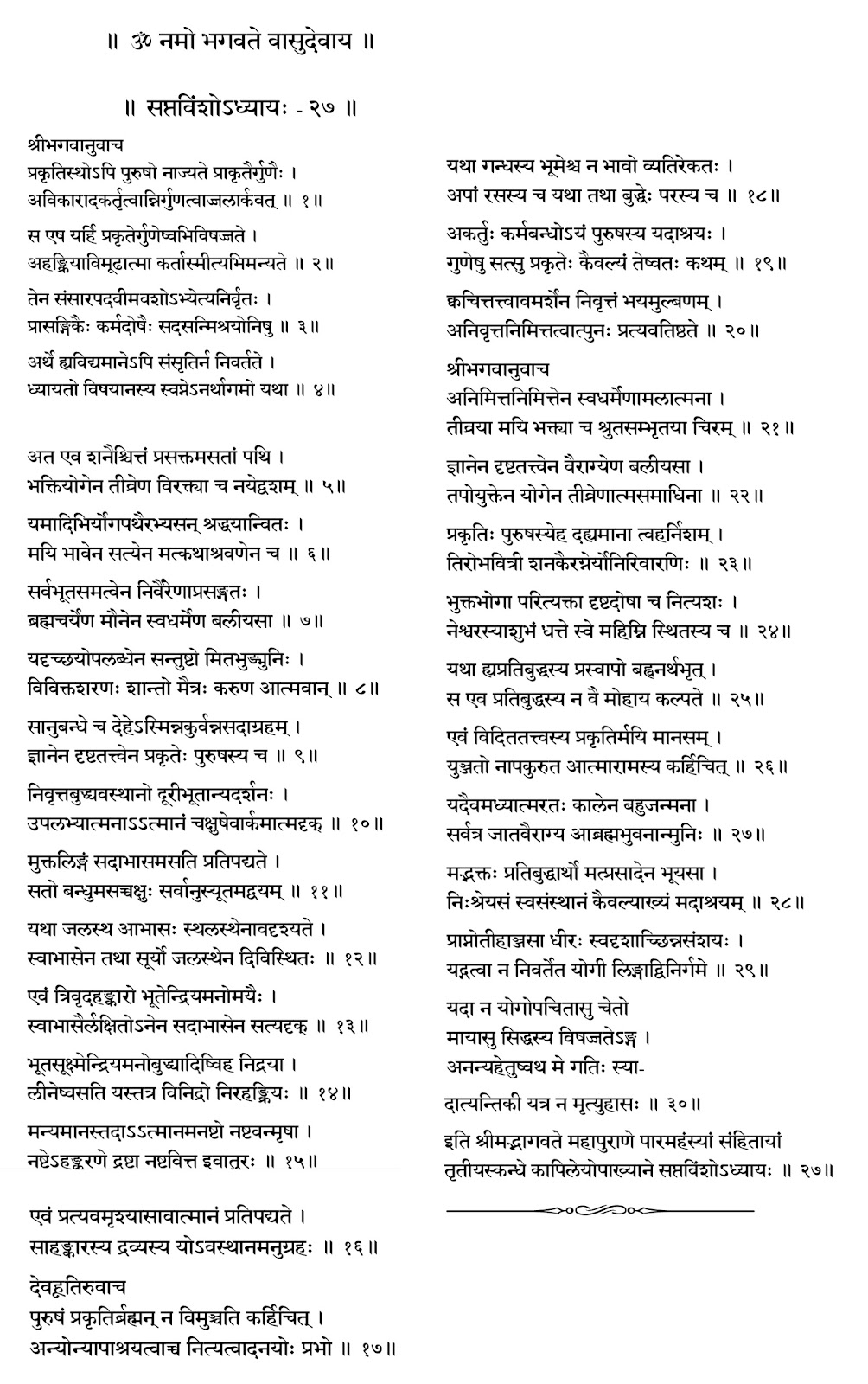
Like me, you too will be struck by the concordance of instructions in this short chapter and the message of Bhagavan Sri Krishna in the Srimad Bhagavadgita. Many shlokas are so similar, using the exact words in many places. I share a scan of the entire chapter below for you to read and enjoy.

̨


The cardinal idea in Sankhya philosophy is the eternity of Purusha and Prakriti, crudely translatable as spirit and matter. Without Purusha, there is no life. Without Prakriti, there is no creation. But what is the relationship between the two? What is meant by liberation?

Bhagavan Kapila explains.

Just as the sun, even when reflected in the rippling surface of the water, seems to shimmer and shake but is indeed constant and unaffected, the Purusha is immutable within Himself and can remain aloof from the forces of Prakriti. But in creation, he voluntarily gets caught up in Prakriti's play of the three Gunas, becoming the Jiva, and identifies Himself with the Guna-dominated existence of modifications, dualities and attachments. Thinking of "I" and "Mine", the Jiva (the conditioned Purusha) has to be reborn again and again to work out the accumulated Karma and Samskara. This cycle of birth and death and conditioned life every time is a dream-like experience for the unattached Atma who imagines he is bound and suffering the dualities just like the man thinks in his dream. The only way out for him is to make a real effort to get out of this bondage.

अत एव शनैश्चित्तं प्रसक्तमसतां पथि । भक्तियोगेन तीव्रेण विरक्त्या च नयेद्वशम् ॥
यमादिभिर्योगपथैरभ्यसन्श्रद्धयान्वित: । मयि भावेन सत्येन मत्कथाश्रवणेन च ॥
सर्वभूतसमत्वेन निर्वैरेणाप्रसङ्गत: । ब्रह्मचर्येण मौनेन स्वधर्मेण बलीयसा ॥
मन्यमानस्तदात्मानमनष्टो नष्टवन्मृषा । नष्टेऽहङ्करणे द्रष्टा नष्टवित्त इवातुर: ॥
T: "Thus the Jiva should by degrees withdraw the mind from the path of attachments. Intense Bhakti Yoga and the assiduous practice of self-abnegation will help in controlling the mind. Through the dedicated practice of Yoga with its components of Yama (self-control) and so on, combined with meditating on the Lord and listening to the stories of His avataras and Lilas, the mind will become regulated."

"Slowly, the sense of duality dissolves, making one free from love and hate towards individual beings. One should be balanced in one's response to all beings and things around, with abstinence from sex and other lower tendencies, and performing sincere service in one's chosen field (स्वधर्म) with all the power at one's command."

"Then what happens is similar to the case of a man who, in his dream, mourns any loss of fortune. But on waking up, the man is nonchalant because he now knows it was just a dream. Similarly. the Jiva will lose his sense of pain caused by material losses and setbacks in this world. Through this, the false ego is replaced by true self-awareness as the Witness or Seer."

***

Devahuti has a pertinent question. Why and how does Prakriti ever release the Purusha from her clutches? After all, she wants the play to go on forever! Can the earth and its fragrance, water and its taste, and intelligence and consciousness, be ever separated mutually? Even if the Jiva thinks he is only the Witness, he will continue to be bound and experience life's dualities imposed by Prakriti! Is this not so? Can fear be got rid of by mere mental speculation? The cause of bondage seems thus irremovable!

Bhagavan Kapila loves this question and replies that the answer is to make one's work one's worship of the Lord.

श्रीभगवानुवाच
अनिमित्तनिमित्तेन स्वधर्मेणामलात्मना । तीव्रया मयि भक्त्या च श्रुतसम्भृतया चिरम् ॥
एवं विदिततत्त्वस्य प्रकृतिर्मयि मानसम् । युञ्जतो नापकुरुत आत्मारामस्य कर्हिचित् ॥
यदैवमध्यात्मरत: कालेन बहुजन्मना । सर्वत्र जातवैराग्य आब्रह्मभुवनान्मुनि: ॥
T: The Bhagavan spoke: "Combined with a pure attitude, performing ceaseless and intense devoted service through Svadharma to the Lord and revelling in His glories will establish a crystal clear understanding of what is eternal and what is transitory. A Jiva who has attained this understanding cannot be harmed by Prakriti. His exulting in his own pure Atma cannot be shaken. Engaged thus for long years, birth after birth, such an advanced seeker loses any craving for any enjoyments, even if it is the highest heaven of Brahmaloka."

मद्भक्त: प्रतिबुद्धार्थो मत्प्रसादेन भूयसा । नि:श्रेयसं स्वसंस्थानं कैवल्याख्यं मदाश्रयम् ॥
प्राप्नोतीहाञ्जसा धीर: स्वद‍ृशाच्छिन्नसंशय: । यद्गत्वा न निवर्तेत योगी लिङ्गाद्विनिर्गमे ॥
T:" My devotee attains self-realization by My boundless compassion. He attains the most exalted state of Kaivalya, under My protection, which is the Atma's abiding destination. All his bonds and doubts are gone. When he leaves this body in such an exalted state, he does not return to the birth-death cycle ever."

"Mother, you have raised your  question about insecurity and fear in this existence of bondage of the Purusha as Jiva under the force of Prakriti. Let me tell you that such a perfect soul as the Yogi I have described now has neither an attraction for mystical Siddhis (which are another way for Prakriti to extend her hold) nor does he have any fear, and even death cannot overcome him."

***

॥ ॐ नमो भगवते वासुदेवाय ॥


Tuesday, October 18, 2022

Srimad Bhagavatam III.26 - 18 October 2022


॥ ॐ नमो भगवते वासुदेवाय ॥

Tuesday, 18 October 2022 III.26 - In this chapter, Bhagavan Kapila explains the nature of creation which is an interplay of Purusha (Spirit) and Prakriti (Matter). This is a cardinal concept of Sankhya Yoga (pronounced as saankhya yoga). 

The word Sankhya means number. In Sankhya, it states that Ourusha is one. Prakriti coexists with 24 components in a hierarchical creation through the interplay of Gunas. Kala or Time is an expression of Purusha Himself to be a controller of experiences. 

Purusha allows Himself,  although beyond Prakriti or Maya, to become a part of her play and becomes the conditioned soul or Jiva, experiencing everything with a sense of "I" and "Mine."

There are 72 shlokas and make heavy reading in terms of detail. For those interested, I have created a PDF and embedded it here for easy reading of the original. I shall satisfy myself by quoting and translating some key verses below.

***

Bhagavan Kapila now expounded on the detailed components of creation and experience. A knowledge of this would surely liberate the knower.

स एष प्रकृतिं सूक्ष्मां दैवीं गुणमयीं विभु: । यद‍ृच्छयैवोपगतामभ्यपद्यत लीलया ॥
T: "As a sport, Purusha, the Supreme Being, accepted Prakriti, the subtle material energy, which is invested with three Gunas, and is nothing but an expression of Vishnu Maya."

"Continuing the sport, the Purusha forgot His immutable nature, embedded Himself in Prakriti's living entities, and experienced a conditioned existence as Jiva."

Devahuti wanted to know more about Purusha and His energy, Prakriti, as they both account for the manifest and unmanifest creation.

"The Unmaifest Prakriti is called Pradhana. When manifested, it has 24 components. namely the five gross elements, the five subtle elements, the four internal senses, the five senses for gathering knowledge and the five outward organs of action.

The four internal senses are Manas, Buddhi, Chitta and Ahankara, making up what we loosely call Mind.

Manas helps in identifying experiences of the senses, Buddhi is the decision-making power, Chitta is the sum total of collective impressions that form a personality with likes and dislikes, and Ahankara is the sense of "I" and "Mine."

Bhagavan Kapila then explains in detail the elements of Mahattatva, the original golden egg, how the Lord entered into it and enlivened it, how it then became the Virat Purusha, and extended the creation. 

Kala is the catalyst that enables the combination of Purusha with Prakriti for carrying on this experiential existence.

Thereafter, great detail is provided about each sense experience, its presiding deity and so on. For example, Fire is appreciated by its light and by its ability to cook, digest, destroy cold, evaporate, and give rise to hunger, thirst, eating and drinking. Fire and sight give rise to the subtle element taste which then evolves under a superior arrangement. From taste, water is produced, and the tongue, which perceives taste, is also manifested. Although originally one, taste becomes manifold as astringent, sweet, bitter, pungent, sour and salty due to contact with other substances. Similarly, odour becomes variegated as mixed, offensive, fragrant, mild, strong, acidic and so on — according to the proportions of associated substances.

Human emotions like passion, lust, desire and so on all have their basis in the hierarchical interaction of Prakriti and Purusha, the Eternal Experiencer.

I am leaving out a lot of detail which can be read by anyone interested in the referenced books mentioned at the beginning of the readings.

यथा प्रसुप्तं पुरुषं प्राणेन्द्रियमनोधिय: । प्रभवन्ति विना येन नोत्थापयितुमोजसा ॥
T: To understand how all creation functions only under the direction of Bhagavan, Kapila says that 
when a man (Jiva) is sleeping, all his material assets — namely the vital energy Prana, the senses for recording knowledge Jnanendriyas, the senses for working Karmendriyas, the mind Manas and the intelligence Buddhi — all these cannot arouse him. He can be aroused only when Bhagavan or Paramatma helps him!

तमस्मिन्प्रत्यगात्मानं धिया योगप्रवृत्तया । भक्त्या विरक्त्या ज्ञानेन विविच्यात्मनि चिन्तयेत् ॥
T:"Therefore, oh Mother, that Paramatma or Bhagavan has to be worshipped with one's intelligence and devotion constantly, taking advantage of the knowledge I have imparted. That constant meditation within one's own being is the key to liberation."

***

॥ ॐ नमो भगवते वासुदेवाय ॥


Monday, October 17, 2022

Srimad Bhagavatam III.25 - 17 October 2022


॥ ॐ नमो भगवते वासुदेवाय ॥

Monday, 17 October 2022, III.25 - On Devahuti’s request, her son Lord Kapila Muni begins his instruction about Sankhya and its path of devotion.

***
As we have seen before, having the urge to seek and find the ultimate truth is a voluntary choice. We are all swimming in the ocean of Time and Space, birth after birth, carrying our tendencies and subconscious memories. Only by the Lord’s grace do we begin to seek the higher goals of life. A seeker, when ready, will always be found by a Guru who will guide him. This is an inviolable principle enunciated in Sanatana Dharma. The Srimad Bhagavatam is full of stories of many seekers in this way. Devahuti, daughter of the world’s first king, Svayambhuva Manu, married to Sage Kardama, a realised master, is now ready, and lo and behold, her seeking is answered by Kapila Muni, none other than her own son! Indeed, this is a rare kind of fortune. 

***
I must say here that the structure of Srimad Bhagavatam is that of a conversation between a wise one and the seeker. Each episode is narrated by someone to someone else. I am leaving out those kernels of names every time as I have already introduced that the Bhagavatam we are reading is what the Suta told Shaunaka and other sages in Naimisharanya, and he is currently reporting the stories given by Sage Maitreya to Vidura. 

***

At this juncture, Shaunaka asks the Suta eagerly what Lord Kapila Muni did next, a question that had been asked by Vidura to Sage Maitreya. In reply, Maitreya replied as follows.


After Kardama left for the forest, Lord Kapila stayed near the Bindu Sarovara to please His mother, Devahuti.

Devahuti recalled what Lord Brahma had told her. She decided to obtain spiritual instruction from Lord Kapila Muni.

देवहूतिरुवाच
निर्विण्णा नितरां भूमन्नसदिन्द्रियतर्षणात् । येन सम्भाव्यमानेन प्रपन्नान्धं तम: प्रभो ॥
तस्य त्वं तमसोऽन्धस्य दुष्पारस्याद्य पारगम् । सच्चक्षुर्जन्मनामन्ते लब्धं मे त्वदनुग्रहात् ॥
य आद्यो भगवान् पुंसामीश्वरो वै भवान् किल । लोकस्य तमसान्धस्य चक्षु: सूर्य इवोदित: ॥
अथ मे देव सम्मोहमपाक्रष्टुं त्वमर्हसि । योऽवग्रहोऽहंममेतीत्येतस्मिन् योजितस्त्वया ॥
T: Devahuti said: “Lord, I am tormented by the bondage of the senses. I am in absymal ignorance. You are my only saviour, my transcendental eye. I have gained my proximity to You only by Your grace. You are the Supreme Being. You are the sun to dissipate the darkness of ignorance in the universe. Therefore, oh, Lord, kindly dispel my delusion. I am caught in Your own Maya play and have identified myself with the falsity called  “I” and “Mine”, this body and its attachments.”

“Lord, You are my only shelter. You are the axe to cut down this tree of material existence in me. Kindly tell me the relationship between man and woman and between spirit and matter.”

Lord Kapila Muni answered in words filled with compassion and love for His mother.

श्रीभगवानुवाच
योग आध्यात्मिक: पुंसां मतो नि:श्रेयसाय मे । अत्यन्तोपरतिर्यत्र दु:खस्य च सुखस्य च ॥ 
तमिमं ते प्रवक्ष्यामि यमवोचं पुरानघे । ऋषीणां श्रोतुकामानां योगं सर्वाङ्गनैपुणम् ॥
T: “ The yoga system which relates to the Lord and the individual soul, which is meant for the ultimate benefit of the living entity, and which removes attachments to all happiness and distress in the material world, is the highest Yoga. My blessed mother, I shall gladly teach you this Yoga, as I taught it long before to great sages. It is most practical.”

“The state when the Jiva is attracted by the three Gunas is called the conditional life. When the same Jiva is attached to the Supreme Being, that state is liberation!”

“When one is completely cleansed of the impurities of lust and greed produced from the false identification with the body as “I” and bodily possessions as “mine,” one’s mind becomes purified. In that pure state, the Jiva transcends the stage of so-called material happiness and distress. At that time the Jiva can see himself as transcendental to material existence and always self-effulgent, never fragmented, a drop in the ocean. In that position of self-realization, by the practice of knowledge and renunciation in devotional service, one sees everything from the right perspective; the Jiva becomes indifferent to material existence, and the material influence acts less powerfully upon him.”

न युज्यमानया भक्त्या भगवत्यखिलात्मनि । सद‍ृशोऽस्ति शिव: पन्था योगिनां ब्रह्मसिद्धये ॥
प्रसङ्गमजरं पाशमात्मन: कवयो विदु: । स एव साधुषु कृतो मोक्षद्वारमपावृतम् ॥
तितिक्षव: कारुणिका: सुहृद: सर्वदेहिनाम् । अजातशत्रव: शान्ता: साधव: साधुभूषणा: ॥
T: “For any Yogi to attain Brahman. there is no path comparable to the auspicious path of Bhakti to the Lord who dwells in all. Every wise seeker knows very well that material attachment is the greatest entanglement of the Jiva. But that same attachment when directed towards Sadhus, or holy men of wisdom, opens the door of liberation. This is Satsang. The characteristics of a Sadhu are that he is tolerant, merciful and friendly to all living entities. He has no enemies, is peaceful, abides by the scriptures, and all his characteristics are sublime.”

मय्यनन्येन भावेन भक्तिं कुर्वन्ति ये द‍ृढाम् । मत्कृते त्यक्तकर्माणस्त्यक्तस्वजनबान्धवा: ॥
T: “Such a Sadhu has a single-pointed devotion to Me. He thus renounces all else- worldly, family relationships and friendly attachments.”

“Sadhus constantly engaging in chanting and hearing about Me are indifferent to any worldly miseries. Oh, My mother, oh, virtuous lady, these are the qualities of great devotees who are free from all attachment. You must seek attachment to such holy men, for this counteracts the pernicious effects of material attachment.”

“Listening to the pastimes and glories of the Lord from Sadhus will please the ear and the heart. Thus one advances spiritually and experiences a firm connection with the Lord. Then the real Bhakti dawns. This path to Bhakti is the most efficacious to get rid of worldly miseries.”

Devahuti now had a request.

तदेतन्मे विजानीहि यथाहं मन्दधीर्हरे । सुखं बुद्ध्येय दुर्बोधं योषा भवदनुग्रहात् ॥
T: “ Lord, I am dull-witted. Kindly explain to me in a way that I can understand this path better.”

मैत्रेय उवाच
विदित्वार्थं कपिलो मातुरित्थं जातस्‍नेहो यत्र तन्वाभिजात: । तत्त्वाम्नायं यत्प्रवदन्ति सांख्यं प्रोवाच वै भक्तिवितानयोगम् ॥
T: Maitreya tells Narada, “ The Lord had great understanding and love towards His mother. He therefore slowly and clearly elucidated for her, as handed down to disciples over ages, the Sankhya system, which is a combination of mystic realisation and the Bhakti path.” 

“The senses are under the control of the gods. The mind is under the control of the Lord. The mind can naturally be attracted to the Lord in Bhakti. Bhakti is a state of selfless devotional service to the Lord that is considered far superior to salvation.”

नैकात्मतां मे स्पृहयन्ति केचिन् मत्पादसेवाभिरता मदीहा: । येऽन्योन्यतो भागवता: प्रसज्य सभाजयन्ते मम पौरुषाणि ॥
T: “Those devoted in Bhakti to Me and placing My lotus feet in their hearts never wish to become one with Me. They revel in exchanging stories of My glories with other devotees.” 

“Oh, My mother, My devotees always see the smiling face of My form, with eyes like the rising morning sun. They like to see My various transcendental forms.”

“Upon seeing the charming forms of the Lord, smiling and attractive, and hearing His very pleasing words, the pure devotee’s senses are freed from all other engagements, and he becomes absorbed in Bhakti. Although it is not his priority, he attains liberation without any separate endeavour.”

“The devotee never hankers after the higher heavens and their pleasures and comforts. By virtue of his single-pointed Bhakti, this very life is full of felicity.”

नङ्‍क्ष्यन्ति नो मेऽनिमिषो लेढि हेति: । येषामहं प्रिय आत्मा सुतश्च सखा गुरु: सुहृदो दैवमिष्टम् ॥

T: “Nothing can change or damage their state of transcendental bliss because the devotees accept Me as their friend, their relative, their son, preceptor, benefactor and Supreme Lord.”

“The terrible fear of death is gone for such a devotee. I am the Supreme Being, the cause of all causes. My supremacy is such that the wind blows, the sun shines, there is rain, the fire burns, and Death acts, all out of fear of Me.”

“The Yogis who practise Bhakti go beyond death and fear of death.”

“Bhakti is the only means for the attainment of the final perfection of life.”

Bhagavan's instruction continues in the next chapter.

***

॥ ॐ नमो भगवते वासुदेवाय ॥


Sunday, October 16, 2022

Srimad Bhagavatam III.24 - 16 October 2022


॥ ॐ नमो भगवते वासुदेवाय ॥
Sunday, 16 October 2022, III.24 - After Devahuti's daughters are married to great sages, Bhagavan takes the Kapila Muni avatara and gives liberation to Sage Kardama.

***
Sage Kardama addressed his wife Devahuti’s anxiety:

मा खिदो राजपुत्रीत्थमात्मानं प्रत्यनिन्दिते। भगवांस्तेऽक्षरो गर्भमदूरात्संप्रपत्स्यते॥
धृतव्रतासि भद्रं ते दमेन नियमेन च। तपोद्रविणदानैश्च श्रद्धया चेश्वरं भज॥
स त्वयाऽराधितः शुक्लो वितन्वनात्मकं यशः। च्छेत्ता ते हृदयग्रन्थिमौदार्यो ब्रह्मभावनः॥

T: “My dear Princess Devahuti, sorrow not, stop blaming yourself. Indeed Bhagavan Akshara (immutable Lord) will Himself take birth in your womb! You have undertaken vows, so stay blessed. Practise self-control, abnegation, Tapas, and give away in charity your wealth. Thus, with dedication, worship Ishwara. The Lord thus worshipped by you will spread our name and fame by becoming our son. He will destroy your feelings of insecurity and inadequacy, and indeed impart, by His grace, Brahma Jnana to you!”
 
Devahuti, devoted to her husband, complied with his instructions and observed all the vows. After a long time, the Lord chose to enter her womb through the seed of Sage Kardama.

This occasioned great celebrations and singing and dancing by Gandharvas and Apsaras. Flowers were showered from the heavens. Brahma himself, along with Sage Marichi and others, arrived at the Kardama hermitage on the bank of the Saraswati. Brahma knew that the Lord was coming with a portion of Himself to teach Sankhya Yoga.

Saying a prayer within himself to the Lord, Brahma addressed Kardama.
“My dear son Kardama, I am indeed most pleased with you that you have faithfully carried out all my instructions.”

एतावदेव सुश्रूषा कार्या पितरि पुत्रकैः। बाढमित्यनुमन्येत गौरवेन गुरोर्वचः॥
T: “The highest service to a father by sons is to ask for instructions and carry them out with reverence.” 

“Your daughters are indeed meritorious. They shall fulfil a vital role in creation. Kindly give them in marriage to the rishis who have come with me.”

वेदाहमाद्यं पुरुषमवतीर्णं स्वमायया। भूतानां शेवधिं देहं बिभ्राणं कपिलं मुने॥
T: “Know, my son, that the Supreme Lord Himself, more ancient than all, by His Maya, is taking birth here as Kapila, who will be a cherishable treasure for all.”

ज्ञानविज्ञानयोगेन कर्मणामुद्धरञ्जटाः। हिरण्यकेशः पद्माक्षः पद्ममुद्रापदाम्बयजः॥
एष मानवि ते गर्भं प्रविष्टः कैटार्दनः॥ अविद्यासंशयग्रन्थिं च्छत्त्वा गां विचरिष्यति॥
अयं सिद्धगणाधीशः साङ्ख्याचार्यैः सुसम्मतः। लोक कपिल इत्याख्यां गन्ता ते कीर्तिवर्धनः॥
T: “Dear Devahuti, daughter of Manu, know that the Lord, endowed with supreme Jnana and Vijnana (gamut of knowledge and self-knowledge) and Yoga, purifying all Karmas, will be born as your child with Jatas (matted locks), with a golden head of hair, lotus-like eyes, and lotus marks on his lotus-like feet.  This child has entered your womb, and he is none other than Narayana Himself, who vanquished the demon Kaitabha who once tried to steal the Vedas. He will destroy the knots of ignorance and doubt by travelling around the world. He will be hailed as their preceptor by all Siddhas as the ultimate Sankhya exponent. Known worldwide as Kapila, he will bring great fame to you as his mother.”

Thus assuring them, Lord Brahma travelled back on his swan heavenward along with Sage Narada and the Kumaras.

Thus instructed by Lord Brahma, Sage Kardama and Devahuti gladly married their daughters off to the sages who had come, as follows:
Daughter Kala was married to Sage Marichi.
Anasuya, to Sage Atri.
Shraddha, to Sage Angiras.
Havirbhu, to Sage Pulastya.
Gati, to Sage Pulaha.
Kriya, the noble one, to Sage Kratu.
Khyati, to Sage Bhrigu.
Arundhati, to Sage Vasishtha.
Shanti, who expands the Yajna karmas, to Sage Atharva.

Sage Kardama and Devahuti celebrated the wedding and honoured generously all their sons-in-law, viz. the great sages, as well as their daughters.

Happily married thus, the sages took leave along with their brides and went back to their hermitages.

***

Sage Kardama now had intimate communion with Lord Narayana taking birth as his son.

Bowing down deeply to the Lord, he said,
“Oh Lord, indeed I think the gods have been kind to the suffering souls. Sages after many births full of intense penance get Your Darshan. By overlooking the shortcomings of householders like us, you appear in our homes purely out of Your infinite compassion, to give true wisdom. That is how You have come to our home.”

“Lord, although You are beyond form, You mercifully take the form your devotee adores!

त्वां सूरिभिस्तत्त्वबुभुत्सयाद्धा सदाभिवादार्हणपादपीठम् । ऐश्वर्यवैराग्ययशोऽवबोधवीर्यश्रिया पूर्तमहं प्रपद्ये ॥
परं प्रधानं पुरुषं महान्तं कालं कविं त्रिवृतं लोकपालम् ।आत्मानुभूत्यानुगतप्रपञ्चंस्वच्छन्दशक्तिं कपिलं प्रपद्ये ॥ 
आ स्माभिपृच्छेऽद्य पतिं प्रजानां त्वयावतीर्णर्ण उताप्तकाम: । परिव्रजत्पदवीमास्थितोऽहं चरिष्ये त्वां हृदि युञ्जन् विशोक: ॥
T: “Oh, Lord, Your lotus-feet are worshippable by all the sages seeking true knowledge! You are full of Aishvarya, Vairagya, Yashas, Jnana and Sri (prosperity of all kinds) (note: remember we read before these are the attributes of Bhagavan)! I bow down to You!”

“Oh Lord, You are Supreme, the most crucial part of all existence, the Ultimate Purusha, the Knower of everything, Master of the three Gunas, Protector of the Universe. You created this universe out of Your own Powers and Experience, and You thus function with total independence. I worship You, oh, Lord, who will be known as Kapila!”

“Oh, Lord, I have something to ask of You. I have fulfilled my duties to my father, Brahma. All my desires are fulfilled. I now seek permission to take up sannyasa, and wander about only with total immersion in You!”

Lord Kapila replied.

“Oh Sage, whatever I declare, directly or through the scriptures, is the Final Truth. I promised to take birth as your son, which I have done. This birth is to explain the Sankhya philosophy which is highly extolled as the path to liberation and freedom from desires. This path of self-realization, which is difficult to understand, has now been lost in the course of time. Please know that I have assumed this body of Kapila to introduce and explain this philosophy to human society again.”

“Now, being sanctioned by Me, go as you desire, surrendering all your activities to Me. Conquering insurmountable death, worship Me for eternal life. In your own heart, through your intellect, you will always see Me, the supreme self-effulgent soul dwelling within the hearts of all living entities. Thus you will achieve the state of eternal life, free from all lamentation and fear.”

“I shall also describe this sublime knowledge, which is the door to spiritual life, to My mother, so that she too can attain perfection and self-realization, ending all reactions to desire-driven activities. Thus she too will be freed from all material fear.”

After this most fulfilling conversation with the Lord, Sage Kardama circumambulated the Lord and left at once for the forest. Observing silence, he was in total surrender. He neither lit a fire nor took shelter. Meditating on the Lord, he gradually became totally detached, egoless, undisturbed, beyond like and dislike. His mind was turned inward and was perfectly calm, like an ocean unagitated by waves. He thus became liberated from a conditioned life and merged in Vasudeva, the Bhagavan who is omniscient and is the Paramatma. वासुदेवे भगवति सर्वज्ञे प्रत्यगात्मनि ।

Kardama saw the Lord in all and finally reached the Lord.

***
॥ ॐ नमो भगवते वासुदेवाय ॥


Saturday, October 15, 2022

Srimad Bhagavatam III.23 - 15 October 2022


॥ ॐ नमो भगवते वासुदेवाय ॥
Saturday, 15 October 2022 - III.23 - Devahuti serves Sage Kardama with love and diligence. In return, he gives her a heavenly time and they beget nine daughters. But Devahuti is still anxious.

***

मैत्रेय उवाच
पितृभ्यां प्रस्थिते साध्वी पतिमिङ्गितकोविदा । नित्यं पर्यचरत्प्रीत्या भवानीव भवं प्रभुम् ॥
T: Maitreya continued: “After the departure of her parents, Devahuti was a model wife of devotion and service to her husband Sage Kardama, much like Bhavani (Parvati), the wife of Lord Shiva, serves her husband.”

Devahuti controlled her senses, working diligently to cater to her husband’s every need. He was given to meditation and austerities, and after a long time, he noticed how withered and dull his wife had become.

कर्दम उवाच
तुष्टोऽहमद्य तव मानवि मानदाया: शुश्रूषया परमया परया च भक्त्या ।
यो देहिनामयमतीव सुहृत्स देहो नावेक्षित: समुचित: क्षपितुं मदर्थे ॥
T: Kardama spoke: “Dear lady, I am very pleased today by your service to me full of affection and devotion.But I notice that you have let your body grow weak and emaciated, which is unlike any normal person who loves this body. It seems you have suffered all for my sake.”

“Devahuti, by the Lord’s grace, I have attained a high state of consciousness beyond fear and sorrow, unattached to any material enjoyments. I can give you the same experience.”

Devahuti replied, somewhat bashfully, “My Lord, I know your attainments. Thank you for offering to share your experience. But at the time of our marriage, you promised that our physical union would beget children. Having children is a great thing for any chaste woman, especially with such a glorious husband.” 

“Oh, Lord, kindly do what it takes to restore my body that has grown emaciated through unfulfilled passion, and make it fit for you. Also, kindly arrange for a suitable house for us to live in as husband and wife.”

Maitreya narrates that the sage understood at once what was to be done. He used his mystical powers to create an unbelievable aerial mansion that Vyasa paints a most fantastic picture of. I shall quote only two verses.

दिव्योपकरणोपेतं सर्वकालसुखावहम् । पट्टिकाभि: पताकाभिर्विचित्राभिरलंकृतम् ॥
स्रग्भिर्विचित्रमाल्याभिर्मञ्जुशिञ्जत्षडङ्‌घ्रिभि: । दुकूलक्षौमकौशेयैर्नानावस्रैर्विराजितम् ॥
T: The fully furnished mansion was heavenly in all seasons, fitted with Festoons and artistic decorations, floral arrangements that attracted humming bees, and fabulous tapestries. It was a seven storied affair. Imagine something like the luxury cruise QEII as an aerial vehicle not sparing any beautification.

Understanding what was in her mind, Kardama asked Devahuti lovingly to go and wash herself in the Bindu Sarvoara, blessed by Maha Vishnu himself. It was fed by the cool and crystalline waters of Saraswati.

As Devahuti went into the water, she was surrounded by a thousand beautiful young damsels who had emerged to serve her as handmaids. They gave her a wonderful bath that got rid of all the accumulated dirt in her body and hair. They anointed her, dressed her up, and she emerged as a divinely attractive woman. They fed her some divine food and drink too. Looking at herself in the mirror, Devahuti was astonished. Her countenance shone, with beautiful teeth and charming eyebrows. Her eyes, distinguished by lovely moist corners, defeated the beauty of lotus buds. Her face was surrounded by dark curling tresses.

Devahuti went to her husband. Boarding the aerial mansion, Sage Kardama Muni his consort shone as charmingly as the moon amid the stars in the sky, which causes rows of lilies to open in ponds at night. They thus went on a long overdue honeymoon and enjoyed themselves thoroughly. They circumambulated the globe and saw many sights, enjoying every moment intensely.

प्रेक्षयित्वा भुवो गोलं पत्‍न्यै यावान् स्वसंस्थया । बह्वाश्चर्यं महायोगी स्वाश्रमाय न्यवर्तत ॥
T: After travelling around the globe and seeing great sights full of many wonders, the great Sage Kardama returned with Devahuti to their hermitage.

Kardama now cloned himself into nine personalities and impregnated Devahuti with nine seeds which bore her nine beautiful daughters. Vyasa says that their period of physical union and joy lasted a hundred autumns.

Devahuti now saw that Kardama was preparing to leave. She approached him and looking down, scratching the earth with her toe, she spoke.

देवहूतिरुवाच
सर्वं तद्भगवान्मह्यमुपोवाह प्रतिश्रुतम् । अथापि मे प्रपन्नाया अभयं दातुमर्हसि ॥
ब्रह्मन्दुहितृभिस्तुभ्यं विमृग्या: पतय: समा: । कश्चित्स्यान्मे विशोकाय त्वयि प्रव्रजिते वनम् ॥
साहं भगवतो नूनं वञ्चिता मायया द‍ृढम् । यत्त्वां विमुक्तिदं प्राप्य न मुमुक्षेय बन्धनात् ॥
T: Devahuti said, “My Lord, you have fulfilled your promise. How time has fled in our long period of joyful cohabitation! But I am surrendered to you, and you need to address my insecurity. Our daughters will soon grow up and go away with their husbands. Who will give me solace after you take up sannyasa? It seems Maya has engulfed me and I have failed to pursue liberation from material bondage, despite being so close to you.”

***

॥ ॐ नमो भगवते वासुदेवाय ॥