Thursday, March 9, 2023

Srimad Bhagavatam IX.08 - 9 March 2023


॥ ॐ नमो भगवते वासुदेवाय ॥

Thursday, 9 March 2023 - IX.08 - The story of Sagara. his sons and grandson.
***
The dynasty of Sri Rama is called Ikshwaku, Raghu and so on. Many famous kings ruled in this dynasty and uniformly, they exemplified Dharma. That is why we have the famous line,
रघुकुलरीति सदा चलि आयि, प्राण् जाये पर् वचन् न जायि

In this chapter is described briefly the story of King Sagara.

King Sagara was born to his mother, the queen of an ageing monarch who was doing Vanaprastha as an atonement for some offence. Sage Aurva (another great sage in the Bhrigu line) had blessed the king and queen that they would beget a son  although the monarch died before she delivered. Indeed the Sage prevented the queen from doing Sati.

Comng to know this secret of a successor on the way, the other queens of the king poisoned the pregnant queen to see that she would die and abort the baby. Not only did she not die, her child, by the blessing of Sage Aurva, was born hale and hearty! He was thus named by the sage Sa-Gara = One born despite being poisoned!

King Sagara was famous. He undertook a big Ashwamedha Yajna under the guidance of Sage Aurva. As usual, a jealous Indra stole away the horse and hid him in the deep hinterland where Sage Kapila, the famous Avatara, was in deep meditation.

Sagara's sixty thousand sons were tasked to search for the Yajna horse. They were most diligent and dug up every spot on earth as they suspected that the horse had been hidden away. Indeed, their excavation was so deep, far and wide that the earth later was filled with rain waters and river floods aptly named after Sa-Gara as Saagara! In Sanskrit, सागर means the ocean or sea.

When the sixty thousand sons of Sagara saw Kapila Muni in meditation, they suspected that he was a charlatan who had stolen the horse and was pretending to be in meditation. They shouted abuses at him. Kapila opened his eyes. He was the personification of Bharman consciousness. He had no reaction to their abuse. But the Karma of abusing such a holy sage took its effect immediately and they were all instantly reduced to ashes. Kapila calmly continued his meditation.

King Sagara was plunged in sorrow with no idea of his sons or his Yajna horse. He had another son by the name of Asamajasa. The word means one who is illogical and unpredictable. Asamanjasa was true to his name as he would wantonly drown babies in Sarayu. This evil conduct was the effect of his past birth Karma. In fact, he had been a great Yogi in that birth but had done some uncharacteristic wrong. 

Sagara banished Asamanjasa from the kingdom to the jungle. There, Asamanjasa recalled his past Yogic powers. he at once regretted his evil acts. He used his power to bring back to life all the infants he had drowned and restored them to the citizens of Ayodhya. 

Asamanjasa's son was Prince Anshuman. He took upon himself the task of searching for the whereabouts of his uncles who had disappeared, and also to locate the Yajna horse. Indeed that horse had been given as a boon by Maha Vishnu himself to Sagara after the king had done prayers as taught by Aurva.

Finally, Anshuman saw the horse roaming near a hermitage where Sage Kapila was in meditation. When saw the big heap of ashes, he was intelligent enough to understand that his uncles had been burnt down. He at once prayed to Sage Kapila:

अंशुमांश्चोदितो राज्ञा तुरङ्गान्वेषणे ययौ । पितृव्यखातानुपथं भस्मान्ति ददृशे हयम् ॥
तत्रासीनं मुनिं वीक्ष्य कपिलाख्यमधोक्षजम् । अस्तौत्समाहितमनाः प्राञ्जलिः प्रणतो महान् ॥

अंशुमानुवाच
न पश्यति त्वां परमात्मनोऽजनो न बुध्यतेऽद्यापि समाधियुक्तिभिः ।
कुतोऽपरे तस्य मनःशरीरधीविसर्गसृष्टा वयमप्रकाशाः ॥
ये देहभाजस्त्रिगुणप्रधाना गुणान् विपश्यन्त्युत वा तमश्च ।
यन्मायया मोहितचेतसस्ते विदुः स्वसंस्थं न बहिःप्रकाशाः ॥
तं त्वामहं ज्ञानघनं स्वभावप्रध्वस्तमायागुणभेदमोहैः ।
सनन्दनाद्यैर्मुनिभिर्विभाव्यं कथं हि मूढः परिभावयामि ॥
प्रशान्तमायागुणकर्मलिङ्गमनामरूपं सदसद्विमुक्तम् ।
ज्ञानोपदेशाय गृहीतदेहं नमामहे त्वां पुरुषं पुराणम् ॥
त्वन्मायारचिते लोके वस्तुबुद्ध्या गृहादिषु । भ्रमन्ति कामलोभेर्ष्यामोहविभ्रान्तचेतसः ॥
अद्य नः सर्वभूतात्मन् कामकर्मेन्द्रियाशयः । मोहपाशो दृढश्छिन्नो भगवंस्तव दर्शनात् ॥

श्रीशुक उवाच
इत्थं गीतानुभावस्तं भगवान् कपिलो मुनिः । अंशुमन्तमुवाचेदमनुगृह्य धिया नृप ॥ 

श्रीभगवानुवाच
अश्वोऽयं नीयतां वत्स पितामहपशुस्तव । इमे च पितरो दग्धा गङ्गाम्भोऽर्हन्ति नेतरत् ॥

T: The great Anshuman saw Sage Kapila, the saint who is an incarnation of Vishnu, sitting there by the horse. Anshuman offered Him respectful obeisances, folded his hands and offered Him prayers with great attention. Anshuman said:
"My Lord, even Lord Brahma is to this very day unable to understand Your position, which is far beyond himself, either by meditation or by mental speculation. So what to speak of others like us, who have been created by Brahma in various forms as gods, animals, human beings, birds and beasts? We are completely in ignorance. Therefore, how can we know You, who are the Transcendence?
My Lord, You are fully situated in everyone’s heart, but the living entities, covered by the material body, cannot see You, for they are influenced by Your Maya, conducted by the three modes of material nature. Their intelligence being covered by Sattva Guna, Rajo Guna and Tamo Guṇa, they can see only the actions and reactions of these three modes of material nature. Because of the actions and reactions of the mode of ignorance, whether the living entities are awake or sleeping, they can see only the workings of material nature; they cannot see Your Lordship.
Oh my Lord, sages freed from the influence of the three modes of material nature — sages such as the four Kumaras [Sanat, Sanaka, Sanandana and Sanatana] — are able to think of You, who are embodied Realisation. But how can an ignorant person like me think of You?
 Oh, Lord who exemplify eternal peace, although material nature, fruitive activities and their consequent material names and forms are Your creation, You are unaffected by them. Therefore, Your transcendental name is different from material names, and Your form is different from material forms. You assume a form resembling a material body just to give us instructions like those of the scriptures, but actually You are the supreme original person, Parama Purusha. I therefore offer my respectful obeisances unto You.
Oh my Lord, those whose hearts are bewildered by the influence of lust, greed, envy and illusion are interested only in false hearth and home in this world created by Your Maya. Attached to home, wife and children, they wander in this material world perpetually.
O Paramatma of all living entities, Oh Bhagavan, simply by seeing You I have now been freed from all lusty desires, which are the root cause of insurmountable illusion and bondage in the material world."

Sage Shuka continue to Parikshit: When Anshuman had glorified the Lord, Bhagavan Kapila, in this way, the great sage Kapila, the powerful incarnation of Vishnu, the originator and preceptor of Sabnkya Yoga, being very merciful to him, explained to him the path of knowledge.

Bhagavan Kapila said: "My dear Anshuman, here is the Yajna horse, the animal sought by your grandfather for Ashwamedha Please take it. As for your forefathers, who have been burnt to ashes, they can be delivered only by Ganga water, and not by any other means.""

तं परिक्रम्य शिरसा प्रसाद्य हयमानयत् । सगरस्तेन पशुना क्रतुशेषं समापयत् ॥
राज्यमंशुमते न्यस्य निःस्पृहो मुक्तबन्धनः । और्वोपदिष्टमार्गेण लेभे गतिमनुत्तमाम् ॥
T: A most grateful Anshuman circumambluated Sage Kapila and proceeded to take the horse home. Sagara completed the Yajna as prescribed. Then King Sagara anointed Anushman as the ruler of the Ikshwaku kingdom and proceeded to the forest under guidance from sage Aurva to attain his liberation.

***

॥ ॐ नमो भगवते वासुदेवाय ॥


Wednesday, March 8, 2023

Soup Maker - A wonderful solution to hunger pangs


>
My children presented this Wonderchef soupmaker to me last birthday. It is the best gift and gadget in the kitchen I think! Thank you! 
  1. I have made my favourite soups many times in the past six months.
  2. It takes 5 minutes of preparation and the soup happens automatically in the next 20 min.
  3. I don't need to add any garnish or flavour once it is done. 
  4. The steps are VERY SIMPLE 
    1. Cut all the vegetables you like. 
    2. Saute them with Tadka, chillies, coriander, curry leaves, mango/tamarind, salt, turmeric, asofoetida etc. 
    3. Put them in the soup maker. 
    4. Add water up to the mark. 
    5. Run the soup maker. 
  5. You can work out, watch TV, work on your computer, make a call, whatever next 20 min. 
  6. It beeps its "Welcome to your favourite soup!" 
  7. I have a large bowl of soup around 600-700 ml with sides like papad etc. No guilt.
  8. You can serve six people in one go with it. So much soup so easy so fast! 
  9. You can completely avoid rice, wheat, carbs this way. 
  10. You can add boiled dal to the soup. Perhaps you can soak and add dal with veggies. Haven't tried it.
  11. Soup = Taste + Low Calories + Satiation + Hot Meal. 
What more DO I WANT? 

Bless the soup maker! 

Srimad Bhagavatam IX.07 - 8 March 2023


॥ ॐ नमो भगवते वासुदेवाय ॥

Wednesday, 8 March 2023 - IX.07 - The story of Trishanku, Harishchandra, Rohita,  and Sunashepa.

***
Continuing the narrative about Ikshwakus, we read about how Mandhata's son was the great Ambarisha. 

Another great king was Purukutsa, son of Mandhata, who married Narmada of the Vasuki clan of serpents, and established himself by glorious deeds in the netherworld. 

Trishanku's story is famous, but narrated very briefly here. Harishchandra himself begot a son by the grace of Varuna, but he had to work very hard to see he did not sacrifice his own son. These stories have some import for us. I reproduce below in its entirety the summary given by Srila Prabhupada. (Diacritical marks retained).

***
In this chapter, the descendants of King Māndhātā are described, and in this connection, the histories of Purukutsa and Hariścandra are also given.

The most prominent son of Māndhātā was Ambarīṣa, his son was Yauvanāśva, and Yauvanāśva’s son was Hārīta. These three personalities were the best in the dynasty of Māndhātā. 

Purukutsa, another son of Māndhātā, married the sister of the snakes (sarpa-gaṇa) named Narmadā. The son of Purukutsa was Trasaddasyu, whose son was Anaraṇya. Anaraṇya’s son was Haryaśva, Haryaśva’s son was Prāruṇa, 

Prāruṇa’s son was Tribandhana, and Tribandhana’s son was Satyavrata, also known as Triśaṅku. When Triśaṅku kidnapped the daughter of a brāhmaṇa, his father cursed him for this sinful act, and Triśaṅku became a caṇḍāla, worse than a śūdra. Later, by the influence of Viśvāmitra, he was brought to the heavenly planets, but by the influence of the demigods he fell back downward. He was stopped in his fall, however, by the influence of Viśvāmitra. 

The son of Triśaṅku was Hariścandra. Hariścandra once performed a Rājasūya-yajña, but Viśvāmitra cunningly took all of Hariścandra’s possessions as a dakṣiṇa contribution and chastised Hariścandra in various ways. Because of this, a quarrel arose between Viśvāmitra and Vasiṣṭha. Hariścandra had no sons, but on the advice of Nārada he worshipped Varuṇa and in this way got a son named Rohita.

Hariścandra promised that Rohita would be used to perform a Varuṇa-yajña. Varuṇa reminded Hariścandra repeatedly about this yajña, but the King, because of affection for his son, gave various arguments to avoid sacrificing him. 

Thus time passed, and gradually the son grew up. To safeguard his life, the boy then took bow and arrows in hand and went to the forest. Meanwhile, at home, Hariścandra suffered from dropsy because of an attack from Varuṇa. When Rohita received the news that his father was suffering, he wanted to return to the capital, but King Indra prevented him from doing so. Following the instructions of Indra, Rohita lived in the forest for six years and then returned home. Rohita purchased Śunaḥśepha, the second son of Ajīgarta, and gave him to his father, Hariścandra, as the sacrificial animal. In this way, the sacrifice was performed, Varuṇa and the other demigods were pacified, and Hariścandra was freed from disease. (Later we read that indeed, Śunaḥśepha survived by the grace of Prajapatis, and became an adopted son of Viśvāmitra!)

In this sacrifice, Viśvāmitra was the hotā priest, Jamadagni was the adhvaryu, Vasiṣṭha was the brahmā, and Ayāsya was the udgātā. King Indra, being very satisfied by the sacrifice, gave Hariścandra a golden chariot, and Viśvāmitra gave him transcendental knowledge. Thus Śukadeva Gosvāmī describes how Hariścandra achieved perfection.

***

॥ ॐ नमो भगवते वासुदेवाय ॥


Tuesday, March 7, 2023

Srimad Bhagavatam IX.06 - 7 March 2023


॥ ॐ नमो भगवते वासुदेवाय ॥

Tuesday, 7 March 2023 - IX.06 - A narrative of several kings like Ikshwaku, Mandhata and Kakutstha (ancestor of Sri Rama). The story of Sage Saubhari.

***
Amabarisha's lineage stalled a few generations later until Sage Angiras interceded like Sage Vyasa did in the Mahabharata and gave them children.

The son of Manu was Ikshwaku. He was succeeded by his son Vikukshi who had in fact been banished by the father for a misdemeanour but was anointed later as his successor. Sage Vyasa says Ikshwakus ruled large parts of Bharata Desha. King Ikshwaku himself was blessed by his Guru Sage Vasishtha and attained liberation.

Vikukshi's son was Kakutstha, who was hailed for his assistance to Indra in fighting Asuras. Down the lineage was Dhundhumara, who vanquished an asura called Dhudhu.

Born in the Ikshwaku line was king Sravasta, who created Sravasti Puri.

Mandhata was another descendant of the Ikshwakus, born strangely, who had to be fed by Indra himself as no one was around to breastfeed him. Indra simply nourished him with nectar by putting his finger in the baby's mouth.

Sage Shuka then narrated the history of Sage Saubhari, whose excessive carnal desires were aroused when he saw fish mating in the waters. By using his Tapas power to become young and attractive, he became most desirable and was wedded by all of Mandhata's fifty daughters. Later on, after a prolonged life of pleasure and comfort in the palace, Saubhari became a true renunciate.

एवं वसन् गृहे कालं विरक्तो न्यासमास्थितः । वनं जगामानुययुस्तत्पत्न्यः पतिदेवताः ॥

तत्र तप्त्वा तपस्तीक्ष्णमात्मदर्शनमात्मवान् । सहैवाग्निभिरात्मानं युयोज परमात्मनि ॥

ताः स्वपत्युर्महाराज निरीक्ष्याध्यात्मिकीं गतिम् । अन्वीयुस्तत्प्रभावेण अग्निं शान्तमिवार्चिषः ॥

T: Sage Saubhari, who had fallen into a life of domestic pleasures, later became disinterested. He went to the forest, but his loyal retinue of wives followed him. He realised the Self by performing severe Tapas there. He ended his mortal existence allowing the homa fire itself to unite him with Paramatma. His wives were inspired by his emancipation to follow suit, in a way that Sage Vyasa describes as the way the tongues of flame in a Yajna fire seem to dissolve into it as it quietens down.

***

॥ ॐ नमो भगवते वासुदेवाय ॥


Monday, March 6, 2023

Srimad Bhagavatam IX.05 - 6 March 2023


॥ ॐ नमो भगवते वासुदेवाय ॥

Monday, 6 March 2023 - IX.05 - Durvasa prays to Ambarisha and Ambarisha prevails on Sudarshana to stop burning Durvasa.

***

Sage Shuka continued: When thus advised by Lord Vishnu, Durvasa, who was very much harassed by the Sudarshana Chakra, immediately approached King Ambarisha. The distressed Sage fell down and clasped the King’s lotus feet. When  Durvasa touched his lotus feet, King Ambarisha was very much ashamed, seeing  Durvasa offering him prayers, his compassion was immense. He immediately began offering prayers to the great weapon of Bhagavan.

King Ambarisha said: 
"Oh Sudarshana Chakra, you are fire, you are the most powerful sun, and you are the moon, the master of all luminaries. You are water, earth and sky, you are the air, you are the five sense objects [sound, touch, form, taste and smell], and you are the senses also.
 Oh, the favourite weapon of Achyuta (means infallible!), my Lord! You have thousands of spokes. O master of the material world, destroyer of all weapons, Indeed embodiment of Bhagavan Himself, I offer my respectful obeisances to you. Kindly give shelter and be auspicious to this Brahmin! You ggive the original Darshan of the Lord, and therefore you are known as Sudarshana! You are the upholder of all Dharma, and you are just like an inauspicious comet for the Adharmic demons. Indeed, you are the maintainer of the three worlds, you are full of transcendental effulgence, you are as quick as the mind, and you are able to work wonders. I can simply utter the word नमः offering all obeisances to you! 
Oh, protector of the universe! You are deployed by  Bhagavan as His all-powerful weapon in killing the envious enemies. For the benefit of our entire dynasty, kindly favour this poor Sage Durvasa. This will certainly be a blessing for all of us. If our family has given charity to the proper persons, if we have performed ritualistic ceremonies and Yajnas, if we have properly carried out our duties, and if we have been guided by learned sages, I wish, in exchange, that this Brahmin be now freed from the burning caused by you, the Sudarshana Chakra.
If Bhagavan, who is one without a second, who is the reservoir of all transcendental qualities, and who is the life and soul of all living entities, is pleased with us, we wish that this Sage Durvasa, be freed from the pain of being burned.”


When the King offered prayers to the Sudarshana Chakra and Lord Vishnu, the Sudarshana Chakra became peaceful and stopped burning Durvasa. Durvasa, the greatly powerful mystic, was indeed satisfied when freed from the fire of the Sudarshana Chakra. Now he praised the qualities of King Ambarisha and offered him the highest benedictions.

दुर्वासा उवाच
अहो अनन्तदासानां महत्त्वं दृष्टमद्य मे । कृतागसोऽपि यद्राजन् मङ्गलानि समीहसे ॥
दुष्करः को नु साधूनां दुस्त्यजो वा महात्मनाम् । यैः सङ्गृहीतो भगवान् सात्वतामृषभो हरिः ॥
राजन्ननुगृहीतोऽहं त्वयातिकरुणात्मना । मदघं पृष्ठतः कृत्वा प्राणा यन्मेऽभिरक्षिताः ॥
T: Sage Durvasa said: “My dear King, today I have experienced the greatness of devotees of  Bhagavan, for although I have committed an offense, you have prayed for my good fortune.
For those who have achieved communion with Bhagavan, the master of the pure devotees, what is impossible to do, and what is impossible to give up? Oh, King, overlooking my offences, you have saved my life. Thus I am very grateful for your mercy.”

Expecting the return of Durvasa, the King had not taken his food. Therefore, when the sage returned, the King fell at his lotus feet, pleasing him in all respects, and fed him sumptuously.
 
Durvasa, after eating varieties of palatable food was so satisfied that with great affection he requested the King to eat also, saying, “Please take your meal.”
 
Sage Durvasa said: "I am very pleased with you, my dear King. At first, I thought of you as an ordinary human being and accepted your hospitality, but later I could understand, by my own intelligence, that you are the most exalted devotee of the Lord. Therefore, simply by seeing you, touching your feet and talking with you, I have been pleased and have become obliged to you. All heavenly beings and the people of this world will chant your glories continuously."

Sage Durvasa left the palace of King Ambarisha. 

संवत्सरोऽत्यगात्तावद्यावता नागतो गतः । मुनिस्तद्दर्शनाकाङ्क्षो राजाब्भक्षो बभूव ह ॥
T: During this episode, as long as Durvasa had not returned — for one complete year — the King had fasted, maintaining himself simply by drinking water. 

After one year, when Sage Durvasa had returned, King Ambarisha sumptuously fed him all varieties of pure food, and then he himself also ate. When the King saw that Durvasa had been released from the great danger of being burned, he could understand that by the grace of the Lord, he himself was also powerful, but he did not take any credit, for everything had been done by the Lord.

In this way, because of devotional service, King Ambarisha, who was endowed with varieties of transcendental qualities, was completely aware of Brahman, Paramatma and Bhagavan, and placed Bhakti Yoga above all.

Finally, Ambarisha retired from active family life. He divided his property among his sons, who were equally as qualified, and he himself took the order of Vanaprastha and went to the forest. Anyone who chants this narration or even thinks of this narration about the activities of King Ambarisha certainly becomes a pure devotee of the Lord and attains liberation without delay.

***

॥ ॐ नमो भगवते वासुदेवाय ॥


Sunday, March 5, 2023

Srimad Bhagavatam IX.04 Part 2 - 5 March 2023


॥ ॐ नमो भगवते वासुदेवाय ॥

Sunday, 5 March 2023 - IX.04 Part 2 - Bhagavan's Sudarshana chases Durvasa when he tries to destroy Ambarisha.

***
These are powerful shlokas. I have reproduced the entire text here and also given you the audio. This is the drama of someone who has acted wrongly against a devotee of Bhagavan and how he realises his mistake.


***

After accepting the warm welcome of Ambarisha, Durvasa said he would first go and bathe in the Yamuna, finish his prayers and then come for his meal. 

Ambarisha waited for the Sage’s return. In the meanwhile, the golden hour for his breaking the fast as per the scriptural injunctions was about an end. He was deeply distressed that his entire Yajna and the one-year austerity and fast which needed to be concluded well now in the Dwadashi Muhurta was about to be jettisoned if he did not break his fast.  But he could not have his food until fully satisfying Sage Durvasa with his hospitality and serving him food to his satisfaction!
He consulted the priests and sages present and they all advised him that he should nominally break his fast by drinking a sip of water and then await to serve Sage Durvasa before eating food. The king did so, despite his own misgivings.
Durvasa returned. His Tapas power revealed at once that King Ambarisha had taken a sip of water to break his fast. True to his reputation, Durvasa flew into a rage.

मन्युना प्रचलद्गात्रो भ्रुकुटीकुटिलाननः । बुभुक्षितश्च सुतरां कृताञ्जलिमभाषत ॥
अहो अस्य नृशंसस्य श्रियोन्मत्तस्य पश्यत । धर्मव्यतिक्रमं विष्णोरभक्तस्येशमानिनः ॥
यो मामतिथिमायातमातिथ्येन निमन्त्र्य च । अदत्त्वा भुक्तवांस्तस्य सद्यस्ते दर्शये फलम् ॥
एवं ब्रुवाण उत्कृत्य जटां रोषविदीपितः । तया स निर्ममे तस्मै कृत्यां कालानलोपमाम् ॥
तामापतन्तीं ज्वलतीमसिहस्तां पदा भुवम् । वेपयन्तीं समुद्वीक्ष्य न चचाल पदान्नृपः ॥
प्राग्दिष्टं भृत्यरक्षायां पुरुषेण महात्मना । ददाह कृत्यां तां चक्रं क्रुद्धाहिमिव पावकः ॥
Translation:
Still hungry,   Sage Durvasa, his body trembling, his face curved and his eyebrows crooked in a frown, angrily spoke to King Ambarisha, who stood before him with folded hands.

“ Alas, just see the behaviour of this cruel man! He is not really a devotee of Lord Vishnu. Being proud of his prosperity and kingship, he considers himself God. Just see how he has transgressed the laws of religion.”

“King Ambarisha, you have invited me to eat as a guest, but instead of feeding me, you have eaten first. Because of your misbehaviour, I shall act to punish you.”

 As Sage Durvasa said this, his face became red with anger. Uprooting a bunch of hair from his matted locks, he created a demon resembling the blazing fire of devastation to punish King Ambarisha. Taking a trident in his hand and making the surface of the earth tremble with his footsteps, that blazing creature rushed towards King Ambarisha. 

But the King, upon seeing him, was not at all disturbed and did not move even slightly from his position. By the previous order of Bhagavan Maha Vishnu, His Sudarshana chakra, which was invisibly guarding Ambarisha, now manifested itself. It immediately burnt to ashes the created demon, as fire in the forest immediately burns to ashes an angry snake, to protect the Lord’s devotee.

Now the Sudarshana turned towards Durvasa. He was very frightened and started to run. Hardly able to keep ahead of that blazing infallible discus spinning menacingly, Durvasa rushed to all parts of the world including Sumeru caves, oceans and far-off lands. No heavenly king could protect him. Finally, he barely managed to go and fall at Lord Brahma’s feet. But Brahma surprised him.

‘Durvasa, by a mere twitch of His eyebrows, Bhagavan Maha Vishnu ends all creation at the great dissolution.”

अहं भवो दक्षभृगुप्रधानाः प्रजेशभूतेशसुरेशमुख्याः । सर्वे वयं यन्नियमं प्रपन्नाः मूर्ध्न्यर्पितं लोकहितं वहामः ॥
T: “I, Lord Shiva, Daksha, Bhrigu, all the gods and men are but subjects surrendered to Bhagavan’s will! We merely discharge our duties for the welfare of creation, with our heads bowing at His feet.”

Hoping for more support from Lord Shiva, Durvasa rushed to Kailasa. Lord Shiva shook his head. ‘Durvasa, it is true that I, Brahma, and other deities know the past, present and future. But we all act as per Bhagavan’s will. We are all subdued by His Maya!”

तस्य विश्वेश्वरस्येदं शस्त्रं दुर्विषहं हि नः । तमेवं शरणं याहि हरिस्ते शं विधास्यति ॥
T: “Durvasa, this infallible Sudarshana of Bhagavan Vishnu is far beyond our abilities to tame. Your only hope is to go and surrender to Him! Sri Hari will take care of you.”

Sage Durvasa went to Vaikuntha, where Bhagavan Maha Vishnu Narayana resides with His consort Sri Lakshmi. 

Imagine this. Sage Durvasa, the great mystic, scorched by the heat of the Sudarshana chakra, relentlessly pursued, fell at the lotus feet of Narayana. 

His body trembling, Durvasa spoke as follows: “Oh infallible, unlimited Lord, protector of the entire universe, You are the only desirable goal to attain for all devotees. I am a great offender, my Lord. Please give me protection. O my Lord, O supreme controller, without knowledge of Your unlimited prowess I have offended Your most dear devotee. Very kindly save me from the reaction of this offence. You can do everything, for even if a person is fit for going to hell, You can deliver him simply by awakening within his heart the holy name of Your Lordship!”

श्रीभगवानुवाच
अहं भक्तपराधीनो ह्यस्वतन्त्र इव द्विज । साधुभिर्ग्रस्तहृदयो भक्तैर्भक्तजनप्रियः ॥
(This is a famous shloka. It establishes where a true devotee stands.)

नाहमात्मानमाशासे मद्भक्तैः साधुभिर्विना । श्रियं चात्यन्तिकीं ब्रह्मन् येषां गतिरहं परा ॥ 
ये दारागारपुत्राप्तान् प्राणान् वित्तमिमं परम् । हित्वा मां शरणं याताः कथं तांस्त्यक्तुमुत्सहे ॥
मयि निर्बद्धहृदयाः साधवः समदर्शनाः । वशीकुर्वन्ति मां भक्त्या सत्स्त्रियः सत्पतिं यथा ॥
मत्सेवया प्रतीतं च सालोक्यादिचतुष्टयम् । नेच्छन्ति सेवया पूर्णाः कुतोऽन्यत्कालविद्रुतम् ॥
साधवो हृदयं मह्यं साधूनां हृदयं त्वहम् । मदन्यत्ते न जानन्ति नाहं तेभ्यो मनागपि ॥
उपायं कथयिष्यामि तव विप्र श‍ृणुष्व तत् । अयं ह्यात्माभिचारस्ते यतस्तं यातु वै भवान् ।                                    साधुषु प्रहितं तेजः प्रहर्तुः कुरुतेऽशिवम् ॥

तपो विद्या च विप्राणां निःश्रेयसकरे उभे । त एव दुर्विनीतस्य कल्पेते कर्तुरन्यथा ॥ 

ब्रह्मंस्तद्गच्छ भद्रं ते नाभागतनयं नृपम् । क्षमापय महाभागं ततः शान्तिर्भविष्यति ॥  
Translation:
Bhagavan spoke to Durvasa:

“Durvasa, I am abjectly and completely under the control of My devotees! I am not free to act! The reason is that I am overtaken by the goodness of truly holy men. Indeed, I am the servant of the servants of My devotees!

 O best of the Brahmins, without saintly persons for whom I am the only destination, I do not desire to enjoy My transcendental bliss and My supreme opulences.

 Since pure devotees give up their homes, wives, children, relatives, riches and even their lives simply to serve Me, without any desire for material improvement in this life or in the next, how can I give up such devotees at any time?

 As chaste women bring their gentle husbands under control by service, the pure devotees, who are equal to everyone and completely attached to Me in the core of the heart, bring Me under their full control.

 My devotees, who are always satisfied to be engaged in My loving service, are not interested even in the four principles of liberation [sālokya, sārūpya, sāmīpya and sārṣṭi], although these are automatically achieved by their service. What then is to be said of such perishable happiness as elevation to the higher planetary systems?

  The pure devotee is always within the core of My heart, and I am always in the heart of the pure devotee. My devotees do not know anything else but Me, and I do not know anyone else but them.

 O Brahmin, let Me now advise you for your own protection. Please hear from Me. By offending King Ambarisha, you have acted out of envy. Therefore you should go to him immediately, without a moment’s delay.

 One’s so-called prowess, when employed against the devotee, certainly harms him who employs it. Thus, it is the subject, not the object, who is harmed.

 For a Brahmin, austerity and learning are certainly auspicious, but when acquired by a person who is not gentle, such austerity and learning are most dangerous (to himself finally!)

  O best of the Brahmins, you should therefore go immediately to King Ambarisha, the son of King Nabhaga. I wish you all good fortune. If you can satisfy King Ambarisha, then there will be peace for you.”

***

॥ ॐ नमो भगवते वासुदेवाय ॥


Saturday, March 4, 2023

Srimad Bhagavatam IX.04 Part 1 - 4 March 2023


॥ ॐ नमो भगवते वासुदेवाय ॥

Saturday, 4 March 2023 - IX.04 Part 1 - The story of Nabhaga and Ambarisha.

***

These shlokas are very evocative and I have reproduced the entire first portion of the chapter here for reading.

***
This chapter has two interesting stories. Both are devotees – Nabhaga (नाभाग)  and Ambarisha (अम्बरीष).

The son of Manu was Nabhaga, and his son Nabhaga (नाभाग) returned to the palace after long years of study as a Brahmachari in the gurukula. He found that his brothers had split all the inheritance amongst themselves, leaving nothing for him. When he asked for his share, they said that they were glad to give their father as Nabhaga’s share! He went to his father and told him about the dealings of the brothers. His father regretted the fact that the boy had been cheated. But there was nothing to do for Nabhaga except go to a famous Yajna being conducted by Sage Angiras. The father, also a great devotee, forecast that the Sage would forget in the middle of the Yajna the mantras and if Nabhaga supplied the words, his act would be apprectiated and he wiuld get a share of the Yajna reward which would be sumptuous enough to see his livelihood through.

Nabhaga did exactly that and indeed was rewarded by Sage Angiras with a share of the Yajna offering left. A glad Nabhaga was gathering the wealth when he was surprised to see a dark-lloking individual cime along. That man shooed Nabhaga away, saying the Yajna portion was indeed his and Nabhaga dare not usurp the share. 

Nabhaga was a gentle and fair person. So he dud not quarrel. The dark man then told him to go back to his father and tell him what had happened. 

When Nabhaga reported the matter, his father smiled and said that indeed that dark man was none other than Lord Shiva, who would be offered the final portion in every Yajna as decided in the Daksha Yajna. Nabhaga went back and profusely apologized to the dark man. Lord Shiva revealed himself, and showered all the wealth that remained as the offering, and even gave him Brahma Jnana since Nabhaga was a worthy seeker. 

Later, Nabhaga’s son was born, named Ambarisha. 

Ambarisha is held up as a supreme devotee of Bhagavan Vishnu. He was a true Rajarishi and had no attachment to anything of his great kingdom or wealth or family. His singe-minded focus was on Bhakti Yoga and Bhagavan. Read this shloka.

वासुदेवे भगवति तद्भक्तेषु च साधुषु ।प्राप्तो भावं परं विश्वं येनेदं लोष्टवत्स्मृतम् ॥
T: Ambarisha was immersed only in Bhagavan Vasudeva and His devotees. He considered the whole world and all possessions as trivial as a piece of stone.

Once, Ambarisha performed a great Yajna (true to his being a Rajarishi and not failing in any of his Dharmic duties) on the bank of River Saraswati in the western desert. The Ashwamedha Yajna was conducted with extreme opulence and all the Rishis and priests were honoured very well.

Indeed, Sage Vyasa says that Ambarisha created such prosperirty, peace and happiness that his citizens did not covet even heaven. They were better off here!

स्वर्गो न प्रार्थितो यस्य मनुजैरमरप्रियः । श‍ृण्वद्भिरुपगायद्भिरुत्तमश्लोकचेष्टितम् ॥
T: Ambarisha’s subjects were accustomed to chanting and hearing about the glorious activities of Bhagavan maha Vishnu. Thus they never aspired to be elevated to even heaven, which is extremely dear even to the gods!

तस्मा अदाद्धरिश्चक्रं प्रत्यनीकभयावहम् । एकान्तभक्तिभावेन प्रीतो भक्ताभिरक्षणम् ॥
T: Sage Vyasa also adds that Bhagavan was so pleased with the Bhakta Ambarisha that Bhagavan had assigned his infallible Sudarshana Chakra to protect him Ambarisha always!

Ambarisha concluded his Yajna. Then he observed austerity for one whole year. Then he offered prayers by going to Madhuvana on the bank of the river Yamuna, sanctified by Bhagavan Sri Krishna, and propitiated Him. At the end, Ambarisha fasted ritualistically for three days, subsisting only on water. The next day was Dwadashi, and at the appointed hour, Ambarisha would break his fast. He prepared on the appointed day of Dwadashi an elaborate feast and served with all reverence the Rishis and Brahmins, leaving nothing unattended. Then he prepared to take his own meal. 

Just then, the famed Sage Durvasa (दुर्वासा) appeared there. Durvasa is world-famous for his ready temper and the power to grant any boon or curse on anyone. Everyone is terrified of him. His role in shaping the events of Mahabharata is legendary.

Durvasa was received with the highest reverence by Ambarisha. He offered Durvasa the best of hospitality. Durvasa said he would first go to the Yamuna, complete his bath and rituals, and then return for the meal.

***

॥ ॐ नमो भगवते वासुदेवाय ॥


Friday, March 3, 2023

Srimad Bhagavatam IX.03 - 3 March 2023

॥ ॐ नमो भगवते वासुदेवाय ॥

Friday, 3 March 2023 - IX.03 - The story of Bhargava Maharishi Chyavana.
***
The story of Sage Chyavana and his Tapas prowess has appeared also in Mahabharata.
Here the story is told in brief.

Sharyati, another son of Manu, was a king adept in Yajnas. He once went on an expedition into the forest with his daughter Princess Sukanya and their entourage in the region where there lived the famous son of Sage Bhrigu, Sage Chyavana. The Chyavana Prasha and other elixirs of youth in Ayurveda are attributed to him.

Roaming languidly in that lovely forest with her attendants, Sukanya saw an anthill with two bright sparkles in its holes. Unthinkingly, she wanted to tease those spots and used a thorn to pierce them. Blood rushed out!

At the same time, Sharyati discovered that none in his army was able anymore to pass urine and stools. A sure sign of some Rishi's curse! He anxiously enquired if anyone had transgressed on the Ashrama and done some mischief. Sage Chyavana, true to the nature of all Bhargavas, was quite short-tempered.

Sukanya realised she had pierced the sage's eyes! She confessed to her crime. When the king was able to release the sage from the anthill and begged his forgiveness, the Rishi Chyavana indicated that the only way to atone was for Sukanya to become his wife and serve him.

Sukanya agreed readily. She was a most dutiful wife.

Shortly thereafter, the Ashwini Kumaras, the twin gods born of the Sun with magical powers of healing, arrived there. Sage Chyavana welcomed them and said he would enable them to get a share of the Soma Rasa offered to gods in the Yajna if only they could use their healing powers to make him a handsome attractive youth with a ready appeal to beautiful women. They were happy to agree to do so!

The Ashwini twins asked the sage to immerse himself in the lake nearby for some moments and emerge therefrom. When Chyavana did so, as he emerged, Sukanya saw three extremely handsome young men with great appeal, all identical in appearance, come out of the water!

Sukanya was told by Ashwinis to find out her husband from the three. She was honest. She said, "look, gods, thank you, but I am unable to find out my husband, the great Rishi Chyavana. You only have to bless me to remain faithful to my husband and point out the real one."

Ashwainis blessed Sukanya and the Sage alone remained, the others disappeared. The Rishi was most delighted to return youthful and beautiful to his life of connubial bliss with Princess Sukanya, a prospect he was most anticipating since he had been a withered old man before.

Sometime later, when King Sharyati came to visit, he was enraged to find his daughter sporting with a young man. He shouted at her, accusing her of treachery and infidelity to her aged husband Sage Chyavana! But a laughing Sukanya told him the whole story of her great husband winning over his youth from the Ashwanis, which made the king most happy.

True to his promise, at the next Yajna, Sage Chyavana offered Soma Rasa to the Ashwanis. Indra was not one to allow this. He came rushing with his raised thunderbolt, but Sage Chyavana calmly froze him in that posture, unable to move. Indra had to beg forgiveness and allow the Ashwanis henceforth a part of the Soma oblation.

Sharyati's son Kakadumi had a princess daughter Revati. He went to heaven looking for a son-in-law. He was advised by Brahma that Revati should be given in marriage to Balarama, of the Yadus, as he was an Amsha Avatara of Maha Vishnu and a most suitable one to marry her.  Thus, King Kakadumi gave his most beautiful daughter in marriage to the supremely powerful Baladeva and then retired from worldly life and went to Badarikashrama to do Tapas and win the grace of Bhagavan Nara-Narayana eternally established there.

***

॥ ॐ नमो भगवते वासुदेवाय ॥

Thursday, March 2, 2023

Srimad Bhagavatam IX.02 - 2 March 2023


॥ ॐ नमो भगवते वासुदेवाय ॥

Thursday, 2 March 2023 - IX.02 - This Second Chapter describes the dynasties of the sons of Manu, headed by Karūṣa.

***
Copied from Srila Prabhupada


After Sudyumna accepted the order of vānaprastha and departed for the forest, Vaivasvata Manu, being desirous of sons, worshipped the Supreme Personality of Godhead and consequently begot ten sons like Mahārāja Ikṣvāku, all of whom were like their father. 

One of these sons, Pṛṣadhra, was engaged in the duty of protecting cows at night with a sword in his hand. Following the order of his spiritual master, he would stand in this way for the entire night. Once, in the darkness of night, a tiger seized a cow from the cowshed, and when Pṛṣadhra came to know this, he took a sword in his hand and followed the tiger. 

Unfortunately, when he finally approached the tiger, he could not distinguish between the cow and the tiger in the dark, and thus he killed the cow. Because of this, his spiritual master cursed him to take birth in a śūdra family, but Pṛṣadhra practised mystic yoga, and in Bhakti Yoga he worshipped the Supreme Personality of Godhead. Then he voluntarily entered a blazing forest fire, thus relinquishing his material body and going back home, back to Godhead.

Kavi, the youngest son of Manu, was a great devotee of the Supreme Personality of Godhead from his very childhood. From Manu’s son known as Karūṣa, a sect of kṣatriyas known as Kārūṣas was generated. Manu also had a son known as Dhṛṣṭa, from whom another sect of kṣatriyas was generated, but although they were born of one who had the qualities of a kṣatriya, they became brāhmaṇas. From Nṛga, another son of Manu, came the sons and grandsons known as Sumati, Bhūtajyoti and Vasu. From Vasu, in succession, came Pratīka, and from him came Oghavān. Descending in order from the seminal dynasty of Nariṣyanta, another son of Manu, were Citrasena, Ṛkṣa, Mīḍhvān, Pūrṇa, Indrasena, Vītihotra, Satyaśravā, Uruśravā, Devadatta and Agniveśya. 

From the kṣatriya known as Agniveśya came the celebrated brāhmaṇa dynasty known as Āgniveśyāyana. 

From the seminal dynasty of Diṣṭa, another son of Manu, came Nābhāga, and from him in succession came Bhalandana, Vatsaprīti, Prāṁśu, Pramati, Khanitra, Cākṣuṣa, Viviṁśati, Rambha, Khanīnetra, Karandhama, Avīkṣit, Marutta, Dama, Rājyavardhana, Sudhṛti, Nara, Kevala, Dhundhumān, Vegavān, Budha and Tṛṇabindu. In this way, many sons and grandsons were born in this dynasty. From Tṛṇabindu came a daughter named Idavidā, who married Vishravas,  and from whom Kubera took birth. 

Tṛṇabindu also had three sons, named Viśāla, Śūnyabandhu and Dhūmraketu. The son of Viśāla was Hemacandra, his son was Dhūmrākṣa, and his son was Saṁyama. The sons of Saṁyama were Devaja and Kṛśāśva. Kṛśāśva’s son, Somadatta, performed an Aśvamedha sacrifice, and by worshipping the Supreme Personality of Godhead, Viṣṇu, he achieved the supreme perfection of going back home, back to Godhead.


My summary:

All were exemplary kings who were devoted to Dharma. Many attained liberation through Bhakti Yoga and performed exemplary Yajnas. Several kingdoms in the north and south of India, notably Vaishali were established. Kubera descended from his mother's side from Manu. His father was the grandson of Brahma. 

***

॥ ॐ नमो भगवते वासुदेवाय ॥

Ode to the Harmonium


हस्तिदन्त-पङ्क्ति-युक्त - endowed with a row of ivory keys
सुमधुर-ध्वनि-भामिनी -the lady with the sweet voice जित-वीणा-has overtaken the Veena भजन-वृन्द-गायक-सहधर्मिणी - as the Consort of Bhajan singer groups
वायु-स्फुरित-स्वर-मण्डल- conjures up musical patterns/designs impelled by air
सुललित-रस-वर्धिनी - enhances the free-flow of musical moods हार्दमोद-नीयमान-is heartily blissfully musical and is carried around 
गीतिका-कलापिनी - while engaged in rendering/accompanying songs.

वेणु Ode to the Flute


नादवेदसखा त्वमसि वेणुवाद्य वन्दित।
प्राणभरण ओष्ठरमण सम्मोहक वादित॥
दूरादपि रसवाहक जनगणबहुतोषण।
आबालकमनहरण कृष्णकरसुभूषण ॥

नादवेदसखा Oh beloved of Om! 
 त्वमसि You are
 वेणुवाद्य वन्दित hailed as Venu Vadya (Flute)! 
प्राणभरण Nourisher of Prana, full of wind, 
ओष्ठरमण darling of the lip
 सम्मोहक enchanter
 वादित when you are played. 
दूरादपि even from far away
 रसवाहक you bring so much emotion 
जनगणबहुतोषण - you give much joy to people 
आबालकमनहरण - you captivate the minds of even children 
 कृष्णकरसुभूषण - you adorn beautifully the hands of Sri Krishna! 

Wednesday, March 1, 2023

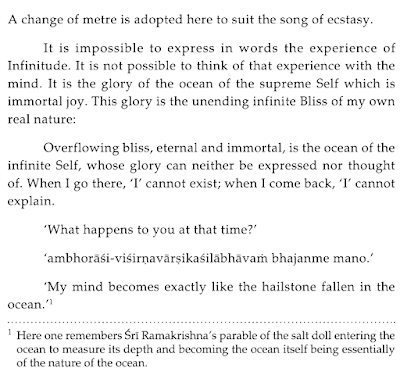
Viveka Chudamani Shloka No.481


In my daily reading, today, I read this beautiful shloka in Vivekachudamani.

वाचा वक्तुमशक्यमेव मनसा मन्तुं न वा शक्यते स्वानन्दामृतपूरपूरितपरब्रह्माम्बुधेर्वैभवम् ।
अम्भोराशिविशीर्णवार्षिकशिलाभावं भजन्मे मनो यस्यांशांशलवे विलीनमधुनाऽऽनन्दात्मना निर्वृतम् ॥

स्व-आनन्द-अमृत-पूरपूरित-परब्रह्मअम्बुधेः वैभवम् The utter magnificence of the ocean of Parabrahman which is completely filled with the ambrosia of Self-Bliss
वाचा वक्तुम्  शक्यम् एव मनसा मन्तुं न वा शक्यते - is impossible to describe in words or to conceptualise in my mind!

भजत् मे मनः - my mind is experiencing 

अम्भस्-राशि-विशीर्ण-वार्षिक-शिला-भावम् the condition like that of a hail stone fallen in the rain into the waters of the ocean and consequently fully dissolved

यस्य अंशांशलवे विलीनम् - whose dissolution has occured into smallest molecules

अधुना आनन्दात्मना निर्वृतम् -  as it is now delighted (also liberated) by the Blissful Self!

The student, having attained the supreme goal by following his Guru's instruction, by following the practices ordained in our scriptures, and having practised Samadhi, makes this statement about his condition of Brahman ecstasy, of Self-bliss or Parabrahman, which is beyond words and thoughts which are feeble faculties of the mind. So a negative statement of the most positive experience, giving such a beautiful simile too, saying his being is like a hailstone dissolved in the ocean!

॥ हरिः ॐ तत् सत् ॥


I share below a scan from Swami Chinmayananda:


Srimad Bhagavatam IX.01 - 1 March 2023


॥ ॐ नमो भगवते वासुदेवाय ॥
Wednesday, 1 March 2023 - Srimad Bhagavatam IX.01 - The birth of Ila/Sudyumna and Pururavas.
***
This chapter tells the story of how Pururavas was born and succeeded Sudyumna.

We have already read how from the mind of Lord Brahma, Marichi was generated, and his son was Kashyapa. From Kashyapa, through Aditi, Vivasvan (also called Surya, the sun god) was generated, and from Vivasvan came Shraddhadeva Manu (who was the southern Rajarshi King Satyavrata in the Matsyavatara!). He was born from the womb of Sanjna (well-known as one of the wives of Surya). Shraddhadeva’s wife, Shraddhaa, gave birth eventually to ten sons, such as Ikshvaku (Sri Rama's ancestor) and Nriga. But this chapter tells what happened earlier.

Much before these sons were born, the king Shraddhadeva was childless and requested his Guru Sage Vasishtha to perform a Yajna to beget a son. As the Yajna was being conducted, at the vital moment of Ahuti, Shraddhaa came and whispered to the assistant priest that in fact, she wanted a daughter. The assistant while offering the oblation chanted that a daughter may be granted. Thus, a female child was born to the couple named Ila (इला).

This caused much consternation in the king. On his request, Vasishtha prayed to Bhagavan Maha Vishnu that a mistake had occurred and indeed the king may kindly be granted a son. Bhagavan mercifully made the child into a boy, and the prince was called Sudyumna.

Sudyumna went once hunting in the forests in the Himalayas which were the sporting grounds of Bhagavan Shiva with Parvati. Sometime earlier, some rishis had intruded upon Shiva-Parvati's romantic love-making and Parvati was ashamed to be seen in the act of love. Bhagavan Shiva then pronounced that all those rishis would become women, and what is more, anyone who entered that forest would be turned into a woman! 

So it was Sudyumna's turn now to become a woman. Indeed even his wonderful horse from Sidhudesha became a mare and all his associates became women. This lovely princess (Ila) was most attractive and Lord Budha fell in love with her. They begot a son called Pururavas. Again, Sage Vasishtha came into the picture. He begged Lord Shiva to turn Ila back into Sudyumna. Lord Shiva was merciful to grant Vasishtha's request, but on the condition that Sudyumna would be made into Ila every other month. 

Sudyumna/Ila ruled the kingdom well until he retired and made Pururavas the king. 

***

॥ ॐ नमो भगवते वासुदेवाय ॥