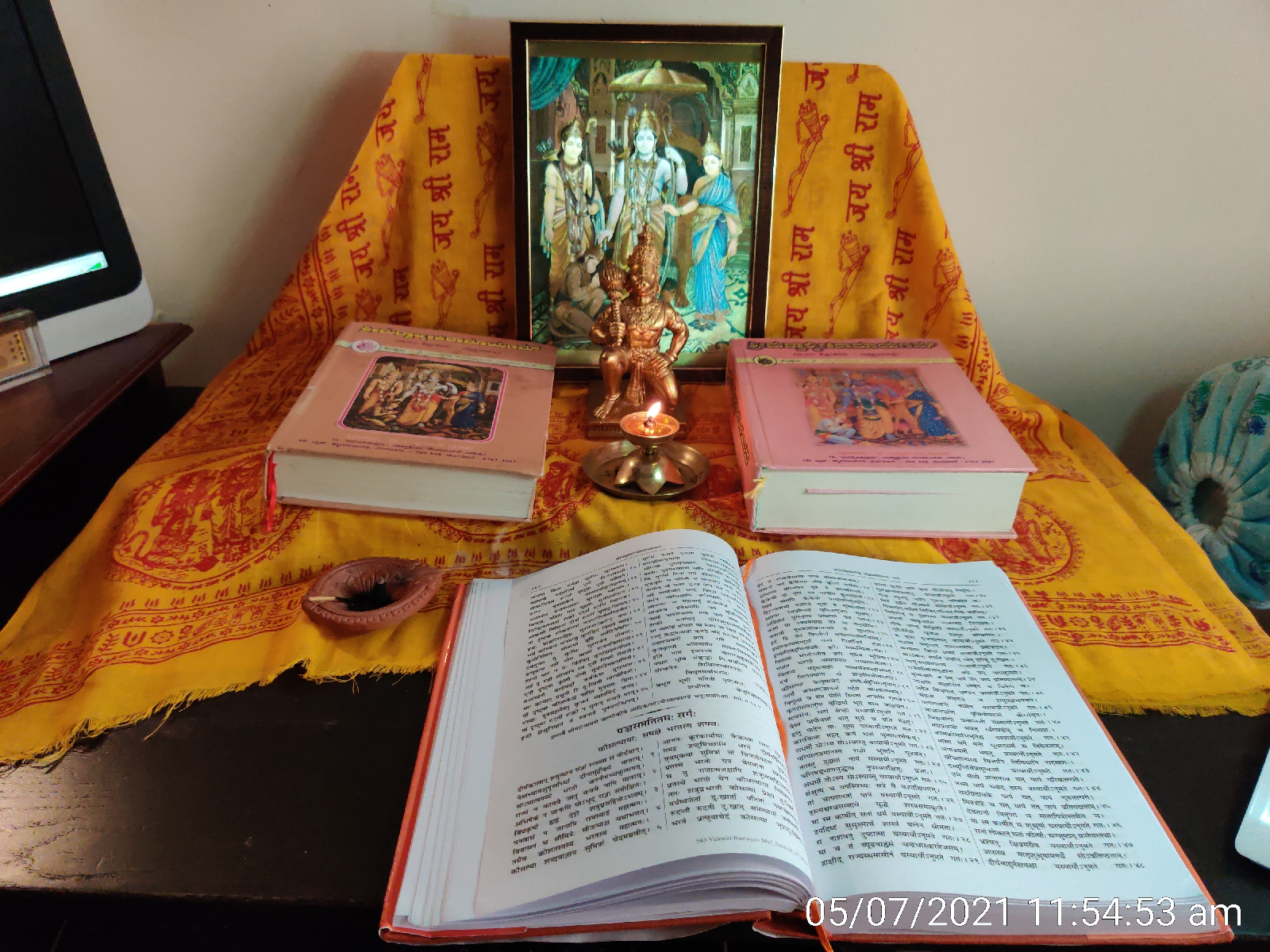
Friday, July 16, 2021

Valmiki Ramayana - July 16


July 16 - Sargas 96, 97,  and 98 of Ayodhya Kanda.

Three short chapters describing the emotions of Lakshmana, Sri Rama and Bharata respectively after realising that they are about to meet one another.

***

As Sri Rama and Sita were enjoying their lunch after their happy wandering in the forest, Sri Rama observed a huge agitation in all wild animals. 

***

हन्त लक्ष्मण पश्येह सुमित्रा सुप्रजास्त्वया                 ।
भीमस्तनितगम्भीरं तुमुलः श्रूयते स्वनः                      ॥

राजा न राजपुत्रो वा मृगयामटते वने                         ।
अन्यद्वा श्वापदं किञ्चित्सौमित्रे ज्ञातुमर्हसि                 ॥

Sri Rama tells Lakshmana, "Do you also notice anything strange, Lakshmana, a worthy son of Sumitra!?  Watch how there is a tumultuous sound all of a sudden, like a frightful rumble of clouds. 

"Either a king or a prince is out hunting around these parts. Or some strange animal of prey has intruded and scared all the wild animals to produce this uproar. Please go and investigate."

***


This forest was quite secluded and this was quite extraordinary. Lakshmana hurried and climbed a tall saal tree. What he beheld took his breath away.

उदङ्मुखः प्रेक्षमाणो ददर्श महतीं चमूम्                    ।
गजाश्वरथसम्बाधां यत्तैर्युक्तां पदातिभिः                    ॥

अग्निं संशमयत्वार्यः सीता च भजतां गुहाम्                 ।
सज्यं कुरुष्व चापं च शरांश्च कवचं तथा                     ॥

Looking northward, Lakshmana, perched atop the tall tree, saw a huge army. It was with elephants, horses, chariots, and foot soldiers. He put two and two together very quickly. He called out aloud to Rama and told him, "put out the fire at once, Rama, and let Sita go hide in the cave. Wear your armour and get ready with your bow and arrows." Sri Rama was perplexed. "Did you see properly whose army it might be, Lakshmana?"

सम्पन्नं राज्यमिच्छंस्तु व्यक्तं प्राप्याभिषेचनम्              ।
आवां हन्तुं समभ्येति कैकेय्या भरतः सुतः                    ॥

एष वै सुमहान् श्रीमान् विटपी सम्प्रकाशते                   ।
विराजत्युज्जवलस्कनधः कोवदारध्वजो रथे                  ॥

"Brother! All is crystal clear! Bharata has been crowned. He now wants to enjoy the kingdom without any opposition. So he has advanced with the army to kill both of us!

"What did I see? I saw his chariot with the insignia flag aflutter displaying the royal emblem of Ayodhya - the majestic Kovidara tree with a massive trunk!"


"Rama, prepare for war. We shall stay on top of this mountain so we can defend ourselves against the attack of this mighty army. I look forward to encountering Bharata in battle.

फूर्वापकारी भरतस्त्यक्तधर्मश्च राघव                            ।
एतस्मिन् निहिते कृत्स्नमनुशाधि वसुन्धराम्                    ॥  
  
अद्य पुत्रं हतं सङ्ख्ये कैकेयी राज्यकामुका                    ।
मया पश्येत् सुदुःखार्ता हस्तिभिन्नमिव द्रुमम्                 ॥

कैकेयीं च वधिष्यामि सानुबन्धां सबान्धवाम्                   ।
कलुषेणाद्य महता मेदिनी परिमुच्यताम्                         ॥

"Dear brother, this evil Bharata, who has already wronged you, and abandoned Dharma, shall be killed by me. That will free the whole earth for you to rule over.

"Let that Kaikeyi, terribly covetous of the kingdom, see today her son being slain by me. She will be plunged in great sorrow when I fell her son like an elephant brings down a tree (incapable of any defence against such force).

"And then I shall kill Kaikeyi also, With all her relatives and well-wishers. It is better that this earth is rid of such a despicable blot as Kaikeyi and her lot. "

Lakshmana says he will slay the entire army and the elephants and horses too. The wild animals of Chitrakuta will drag away their carcasses.

***

पितुः सत्यं प्रतिश्रुत्य हत्वा भरतमाहवे                       ।
किं करिष्यामि राज्येन सापवादेन लक्ष्मण                 ॥

श्रुत्वा प्रव्राजितं मां हि जटावल्कलधारिणम्               ।
जानक्या सहितं वीर त्वया च पुरुषोत्तम                     ॥

स्नेहेनाक्रान्तहृदयः शोकेनाकुलितोन्द्रियः                   ।
द्रष्टुमभ्यागतो ह्येष भरतो नान्यथाऽगतः                     ॥

"Dear Lakshmana, forbid! I came away to the forest to uphold the truthful word of my father. Of what interest is the kingdom to me if it is won by killing my dear brothers or anyone else despicably?

"Your construction on what brings Bharata here is quite wrong, Lakshmana! Bharata would have heard that I have come away to the forest (in exile) with matted locks and wearing tree barks and leaves, along with Sita and you, oh most valiant brother!

"That would have tormented Bharata no end. With his heart full of affection for us, his senses benumbed by the tragic events, Bharata has come here right away to meet us. I am sure there is no other explanation for his arrival."

Sri Rama goes on to chide Lakshmana for all this talk of killing. Which father will kill his son, or son father, or brothers each other, to take over a kingdom? This is a terrible thought. Indeed if Lakshmana is enamoured of kingship, Rama will ask Bharata to hand over the kingdom at once to Lakshmana and he will surely comply.

This makes Lakshmana see reason and he feels very ashamed and contrite. Then the two brothers talk that perhaps Dasharatha has himself come to meet them, perhaps to take them back to Ayodhya. But there is no sign of his white royal umbrella (the essential royal insignia for a chakravarthy like Dasharatha). 

Sri Rama asks Lakshmana to climb down from the sala tree.

Meanwhile, Bharata has asked the army to stop a reasonable distance of about 12 km behind from here and is proceeding with a small team forward.


***

यावन्नरामं द्रक्ष्यामि लक्ष्मणं च महाबलम्           ।
वैदेहीं वा महाभागां न मे शान्तिर्भविष्यति            ॥

यावन्न चरणौ भ्रातुः पार्थीवव्यञ्जनान्वितौ            ।
शिरसा प्रग्रहीष्यामि न मे शान्तिर्भविष्ति             ॥


"Dear Shatrughna, pan out with soldiers and search quickly for Rama. Guha, take a thousand men and comb the forest for Rama. As long as I have not set my eyes on my beloved and glorious brother Rama, the brave warrior Lakshmana, and the blessed lady Sita, my mind will not find any peace.

"As long as I have not put my head at the feet of dear brother Sri Rama, with marks thereon of his having been anointed as the king,  I shall find no peace."

Soon, Bharata, proceeding on foot, sees a tall column of smoke from Sri Rama's hermitage.


***


॥                    श्रीरामजयम्                     ॥ 


ATMENtec - the ultimate respirator device


Good news, folks! Thanks to all the focus in the media on the right technologies which are affordable and effective in fighting Covid-19 and also in improving our health, I have come across this ultimate device. It is named ATMENtec.

You will be amazed to know more about this!
  1. It takes care of all respiratory demand in terms of capacity and flow rate. 
  2. The system comes with pre-filtration, moisturiser, and warmer. 
  3. It triggers alarms during any malfunction. 
  4. It has 100% built-in redundancy. 
  5. It uses "bioenergy",  something of a new discovery. 
  6. It is very easy to operate for all age groups. 
  7. It gives bio-feedback for improved sense of wellness. 
  8. It has a 3X turbo mode. 
  9. It comes with a lifetime warranty. 
  10. It requires zero extra space for bedside as well as ambulatory use. 
  11. It comes with a built-in user guide which is child-friendly. 
  12. No plastic parts. 
  13. Based on open source technology. 
  14. Easily available DIY service. 

Now that you are aware of ATMENtec, you can get it same day free delivery for offline or online orders without a doctor's prescription. 


The BEST NEWS OF ALL. 

Take a deep breath, folks! 

It is free! 


It is the human respiratory system! 

Take care and be safe. 😊

Thursday, July 15, 2021

Valmiki Ramayana - July 15


July 15 - Sarga 95 and the Prakshipta sarga of Ayodhya Kanda.

Valmiki the poet paints an extremely romantic picture of Sri Rama's sporting with Sita in Chitrakuta. This is the first time we have such Sringara Rasa in our reading.

***

Sri Rama continues to direct Sita's attention to more sights. This time it is the Mandakini river. It is frequented by wild animals, birds, and is surrounded by flowering trees.

By the way there is an interesting comment from Valmiki two sargas before. Bharata while commenting on the trees in the forest ringed with flowers, tells Shatrughna that the trees look like ladies from south India who do up their hair beautifully and circle the round bun of hair with a string of flowers (शिरस्सु सुरभीः कुसुमापीडात् कुर्वन्ति दाक्षिणत्या नरा यथा) ! Valmiki surely knew a lot about the different regions and people in different parts of India!

Sri Rama points to Mandakini and says a number of wild animals like elephants have come and recently muddied the river with their splash bath. He also points to bathing spots for sages who come there for their ritual ablutions before dawn.

Sri Rama tells Sita, "we should come often here and bathe, amidst the white and red lotuses!"

Sri Rama says that life cannot get any better for them. He does not miss Ayodhya or royal living.

इमां हि रम्यां गजयूथलोडितां
       निपाततोयां गजसिंहवानरैः      ।
सुपुष्पितां पुष्पभरैरलङ्कृतां 
       न सोऽस्ति यः स्यान्न गतक्लमः सुखी ॥

"My dearest, would there be anyone who doesn't get rid of his fatigue and feel happy seeing this lovely Mandakini river, with her waters muddied by bathing elephants, water splashed upon her banks by elephants, lions, and monkeys,  bedecked with lotuses and showered with blooms by trees on her banks? "


***

The next sarga we read today is called Prakshipta. It is considered a later interpolation and not included in "critical" editions. But it serves an important purpose and so I cover it here. 

***

Sri Rama and Sita come upon a beautiful cave. It is surrounded by a garden-like patch. Sri Rama tells Sita to sit down on a lovely rock there and rest. Sita responds to his very romantic mood. Sita sits on Rama's lap. Rama picks a colourful lumpy stone and makes a powder of it and applies it as a lovely tilak on Sita. Sri Rama points to the singing birds. One young cuckoo is calling out not so musically but still Sri Rama predicts a bright future as a singer for him. 

***

Valmiki says Sita was looking bewitching. 

They got up and continued meandering. Suddenly a monkey surprised them. Sita was quick to hug Rama in fright. The vermilion coloured mark he had applied on her forehead left a smear on his chest. Sita giggled pointing it out. 

Sita saw a beautiful Ashokavana. Those trees looked very inviting. They went there. She asked Rama to bring her those lovely Ashoka flowers. He brought them gladly. They decked each other with those flowers. Indeed together, Sri Rama and Sita were themselves an adornment for Chitrakuta. 

***

When they returned, they had a delectable feast in making. Lakshmana had hunted down black buck and gathered a lot of forest roots and fruits. They offered the food to the gods and then enjoyed a lovely meal served by Sita. Sri Rama told her to offer all the left over food to crows. 

Soon Rama and Sita needed a siesta.  First Sita rested on Rama's lap. When she woke up, Rama lay down resting his head in her lap. 

Just then a crow came looking for food. He was attracted to go and nibble at Sita's breast. Sita could not shoo him away. She also didn't want to wake up Rama. After some time, Rama woke up as blood dropped on his cheek. He saw the crow tormenting Sita even when she tried to run away. Sita was very angry at being bothered by the crow. 

Rama warned the fellow. But the crow was undeterred. An angry Rama took up a blade of grass and invoked Asishikastra. The astra chased the crow even when he tried to fly away to the three worlds. The crow wasn't ordinary as he had divine boons. But the blade of grass released by Rama was an infallible divine weapon too.

Finally the crow realised he had bitten off more than he could handle. He came and surrendered to Rama. 

Rama said, 

मया रोषोपरीतेन सीताप्रियहितार्थिना      । 
अस्त्रमेतत्समाधाय त्वद्वधायाभिमन्त्रितम्  ॥

यत्तु मे चरणौ मूर्ध्ना गतस्त्वं जीवितेप्सया  । 
अत्रास्तवपेक्ष्या त्वयि मे रक्षो हि शरणागतः ॥

अमोघं क्रियतामस्त्रमेकमङ्गं परित्यज         । 
किमङ्गं शातयतुमते शरैशीकं ब्रवीहि मे      ॥


"Mr. Crow, you made me very angry by hurting Sita here who is my beloved and under my care. That is why this astra was invoked by me to kill you.

"Now you have come and taken shelter at my feet. It is in my nature to protect anyone who comes to me for refuge. 

"Therefore I shall save you. But any weapon released by me cannot go in vain. So you can live, provided the arrow destroys any one organ of yours. Tell me, which one?" 

The crow was mighty relieved. He was intelligent enough to say one of his two eyes may be struck by the arrow. And that is what happened. This crow's story is known as  "Kakasura vadha."

It comes in this Prakshipta kanda but the story is again cited in the mainstream version during Hanuman's meeting with Sita in Ashoka Vana! (Sarga 38 of Sundara Kanda.) 

***

॥          श्रीरामजयम्             ॥


Wednesday, July 14, 2021

Valmiki Ramayana - July 14


July 14 - Sargas 93 and 94 of Ayodhya Kanda.

Valmiki is not in a hurry to describe the meeting of Sri Rama and Bharata. He resorts to the device of describing nature and in turn describing Sri Rama's mindset.

***

Bharata and his huge army make considerable progress, travelling in the dense forest towards Chitrakuta. Several wild animals and birds are greatly alarmed by the noise and dust and strange sights and smells of an incomprehensibly large human invasion.

Bharata describes to Shatrughna how picturesque this forest is. Soon they come to a spot when Bharata says this must be close to Chitrakuta. 

यादृशं लक्ष्यते रूपं यथा चैव मया श्रुतम्      । 
व्यक्तं प्राप्ताः स्म तं देशं भरद्वाजो यमब्रवीत् ॥

अयं गिरिश्चित्रकूटस्तथा मन्दाकिनी नदी    । 
एतत् प्रकाशते दूरान्नीलमेघनिभं वनम्      ॥

"The appearance of this place matches what I have heard. It appears that we have reached the location described by sage Bharadwaja. 

" This mountain has to be Chitrakuta. This river has to be Mandakini. And this extremely dense forest resembles a large rain-bearing cloud." 

***

The army spots a funnel of smoke in the sky. They rush to inform Bharata that they have spotted signs of human habitation and therefore perhaps Sri Rama's cottage is close by. Bharata is delighted.

Bharata instructs the army that they should encamp here. He will proceed alone with Sumantra and sage Vasishtha to go and meet Sri Rama.

***

Valmiki now describes a beautiful scene of Sri Rama's enjoying the splendour of nature with Sita. Sri Rama is indeed a romantic hero with a happy turn of phrase to celebrate the beauty of nature. 

Altogether there are over 25 shlokas. I give you just a few samples.

पश्येमं अचलं भद्रे नानाद्विजगणायुतम्      । 
शिखरैः   खमिवोद्विद्धैर्धातुमद्विभूषितम्     ॥

पुष्पवद्भिः फलोपेतैश्छायावद्भिर्मनोरमैः      ।
एवमादिभिराकीर्णः श्रियं पुष्पत्ययं गिरिः    ॥

निशि भान्त्यचलेन्द्रस्य हुताशनशिखा   इव     । 
ओषध्यः स्वप्रभालक्ष्म्या भ्राजमानाः सहस्रशः ॥

"Dearest Sita, behold this mountain, home to such a wide variety of birds! The peaks are full of richly colourful minerals and rise up as if to pierce the sky! 

" And these tall trees, full of flowers, fruits, and casting such a luxurious shade. They look so beautiful. This mountain is abounding in such trees and is blooming with grace. 

" And these special herbal trees that emit a fragrance and glow like flames at night, as if they are worshipping the mountain lord. There are so many of them!" 

Sri Rama also describes the many waterfalls and sweet-water lakes. He describes mineral stones of an astounding variety, comparing them in their colours to many flowers. It is a long list. He describes several types of wild animals from spotted deer to antelopes to bears and elephants and many other creatures happily residing there. He describes how celestials come for romantic sport and how divine singers and dancers make merry here. 

इमं तु कालं वनिते विजह्रिवां-
     स्त्वया च सीते सह लक्ष्मणेन         । 
रतिं प्रपत्स्ये कुलधर्मवर्धिनीं 
      सतां पथि स्वैर्नियमैः परैः स्थितः   ॥

"Dearest Sita, along with you and Lakshmana, I shall happily reside here for long, observing a very regulated life-style. This is my chosen path of righteousness to further the glory of my lineage. It will confer felicity for sure."

***

॥            श्रीरामजयम्             ॥

Tuesday, July 13, 2021

Valmiki Ramayana - July 13


July 13 - Sargas 91 and 92 of Ayodhya Kanda.

Valmiki never ceases to amaze me with his story telling. This has to be the original template for all the best of kavyas that showcase the kaleidoscopic splendour of our culture and its history. 

Valmiki narrates that sage Bharadwaja offers to Bharata and his army a celestial feast that beggars description.

First of all, when Bharadwaja asks Bharata why he left behind his army some distance away and not bring them also to the ashrama, Bharata is frank : 
ससैन्यो नोपयातोऽस्मि भगवन्भगवद्भयात् 
"Revered sir, I did not bring along the army lest I incur your displeasure. After all, the army will mess up your pristine environment and litter the place as well as make a big racket."

Sage Bharadwaja smiles. He says, "Bharata, please bring over the army. I want to offer the best hospitality possible to you and your entire army tonight." Bharata remonstrates but to no avail. So he orders the army to come to the ashram.

Bharadwaja then summons the divine architect Vishwakarma and tells him that all facilities and arrangements should be made instantly to offer Bharata and his army an unforgettably grand feast and entertainment. It has to be on an unprecedented scale. Vishwakarma sets about it.

Valmiki describes the feast and entertainment in over 65 shlokas. It is beyond the dream of a hedonist. We have read of the orgiastic festivities of Roman debauchs. We have read of how Brahma comes and tempts Buddha when he is on the threshold of enlightenment. We have read how Vasishtha offers Vishwamitra, the king, and his army the best of hospitality. This scale goes above and beyond all that.

In an instant, palaces come up. The land is flattened and elaborate facilities are created. Food and drink flows limitlessly with mind-boggling variety. Drinks range from river water sweet like sugar cane juice to the best of wines. Celestial damsels that can ravish any man with just one look entertain the soldiers. Rivers and bathing ponds spring up. The soldiers are anointed, bathed, wined, and dined. Celestial musicians and heavenly dancers continue to entertain them through the night.

Even the horses, elephants, camels, donkeys and bullocks are fed their version of heavenly food made with honey and juicy ingredients. 

***

Unlike Valmiki, I don't have an appetite to describe this further. Suffice it to say that the soldiers drawled amidst swigs of the best wine:

नैवाध्योयां गमिष्यामो न गमिष्याम दण्डकान्  ।
कुशलं भरतस्यास्तु रामस्यास्तु तथा सुखम्     ॥

इति पादातयोधाश्च हस्त्यश्वारोहबन्धकाः         । अनाथास्तं विधिं लब्ध्वा वाचमेतामुदारयन्      ॥

सम्प्रहृष्टा विनेदुस्ते नरास्तत्र सहस्रशः           । 
भरतस्यानुयातारः स्वर्गोऽयमिति चाब्रुवन्      ॥

" We are not going back to Ayodhya! We don't have to go to Dandaka. We will just be in this heaven.Blessed be Bharata for giving us this. May Sri Rama whose exile has occasioned this feast be happy wherever he may be." 

Thus spoke the foot soldiers, cavalrymen, elephant riders and handlers. They woudn't ever in their lives have imagined such a good fortune. They proclaimed in thousands loudly their joy and there was a huge uproar of noise. The army that had accompanied Bharata felt that they were stationed in heaven. 

***
Pause and think. Why did Bharadwaja make this happen? I can think of two reasons. He wanted to celebrate Bharata's goodness unstintingly. More so, a king may turn down power, but sense temptations are beyond anyone's normal levels of self-control. So perhaps Bharadwaja, the divine sage, wanted to test Bharata. 

Bharata passed in flying colours.

***

Early morning, Bharata orders the army to get ready. He approaches sage Bharadwaja for permission to leave. The sage asks him, "Was the hospitality satisfactory? Were there any shortcomings?" Bharata replies that the sage has indeed given the army an unbelievable treat but it is time now for him to go and meet Sri Rama. Bharata requests detailed directions to reach Sri Rama. Bharadwaja instructs him how to reach the Chitrakuta mountain which is only three and a half yojanas (about 50 km). There lives Sri Rama in a hut, situated amidst very beautiful nature. 

Just then Kausalya, Sumitra and  Kaikeyi come hesitatingly to seek the sage's blessings. They circumambulate the sage, full of sorrow and diffidence in their widowhood. Each grasps his feet.
Bharadwaja asks Bharata to introduce them properly to him. 

Bharata that we know speaks. He says this is Kausalya, the chief queen and fortunate mother of Sri Rama. This is Sumitra, the queen in the middle and mother of the glorious Lakshmana and Shatrughna. 

And this is THE queen Kaikeyi. The wicked, self-centred, quarrelsome, queen who caused Dasharatha's death and Rama's exile. She is oversure of her own intelligence. Unfortunately, Bharata says, she is his biological mother too. 

Bharadwaja reprimands Bharata. 

न दोषेणावगन्तव्या कैकेयी भरत त्वया       । 
रामप्रव्राजनं ह्येतत् सखोदर्कं भविष्यति       ॥

देवानां दानवानां च ऋषीणां भावितात्मनाम्  । 
हितमेव भविष्यद्धि रामप्रव्राजनादिह           ॥

"Bharata, do not blame your mother, Kaikeyi, like this. Know that this exile of Sri Rama augurs well for the future well-being of all. Gods, demons, sages and pure souls will all be graced by Destiny with abundant welfare, consequent upon this banishment of Sri Rama." 

This is the very first time Bharata is hearing this. Indeed a different spin from whatever he has heard and thought so far. 

Bharata and the army begin to move towards Chitrakuta. 

***

॥        श्रीरामजयम्         ॥


Monday, July 12, 2021

Valmiki Ramayana - July 12


July 12 - Sargas 89 and 90 of Ayodhya Kanda.

Valmiki describes how Bharata and his army cross the Ganga with Guha's help. When Bharata meets Bharadwaja, he has to clear his name and clarify his intentions before the great sage Bharadwaja agrees to help him go and find Sri Rama.

***

The next morning, Bharata tells  Shatrughna that they should proceed by crossing the Ganga without delay. Just then, Guha arrives to enquire about their welfare and if they have rested well at night. Bharata replies in gratitude for all the hospitality. Now, would Guha please arrange boats for them to cross the Ganga?

Guha assures them it will be done expediently. He instructs his capable people to arrange a sufficient number of boats. Valmiki describes how the transportation occurs efficiently:

ते तथोक्ताः समुत्थाय त्वरिता राजशासनात्   ।
पञ्च नावां शतान्याशु समानिन्युः समन्ततः    ॥

अन्याः स्वस्त्तिकविज्ञेया महाघण्टाधरावराः     । 
शोभमानाः पताकिन्यो युक्तवाहाः सुसंहताः     ॥

"Thus ordered by their king, Guha, his people sprang into action and brought from every direction a total of five hundred boats in double quick time. 

" In addition, they also brought special, comfortable, boats called Swastika, built very sturdily, which had big sails, were decorated with bells and flags, and shone brilliantly." 

The priests, sages, ministers, the  principal queens and Bharata and Shatrughna board a Swastika boat. That boat is carpeted in white and decorated with finery. Everyone else quickly boards the other boats.

They citizens burn down their overnight makeshift tents in the forest and pour copius water over the entire area to ensure that man-made structures don't interfere with Nature's ways. 

Those who are unable to get passage on boats use rafts. Others use mud pots to float across. Some others swim across. 

Elephants cross like majestic mountains on wings. Horses travel in boats. All materials and equipment are safely transported. 

By even-fall, Bharata reaches the ashrama of sage Bharadwaja. As we saw earlier itself, it is situated amidst sublime nature. 

Bharata approaches the ashram on foot with sage Vaishstha and offers hia deep respects to the renowned sage Bharadwaja. After making mutual enquiries about one another's welfare, Bharadwaja comes straight to the point:

किमिहागमने कार्यं तव राज्यं प्रशासतः  । 
एतदाचक्ष्व सर्वं मे न हि मे शुद्ध्यते मनः ॥

"Bharata, you should be engaged in ruling the kingdom. What brings you here? Please tell me everything. My mind is not clear about your intentions. 

" The greatly valorous Sri Rama, known for his bringing joy to all,  whom Queen Kausalya was fortunate to give birth to, has been banished to live for long in the forest, along with his wife, Sita, and Lakshmana. This was done by his father on the demand of a woman. 

कच्चिन्न तस्यापापस्य पापं कर्तुमिहेच्छसि     । 
अकण्टकं भोक्तुमना राज्यं तस्यानुजस्य च   ॥

"Sri Rama is totally devoid of sin.  I hope you are not here, by any chance, with the intention of destroying Sri Rama and his brother, so that you can there-after rule the kingdom without any opposition or impediments?"

Bharata is deeply cut by these suggestions. In his typical way, he explains how he has come to worship Sri Rama's feet and take him back to Ayodhya to be installed as the king. Bharata has had absolutely no part in Kaikeyi's evil manoeuvres that banished Sri Rama. He begs Bharadwaja not to attribute such evil motives to him. Would the sage most kindly tell him about Sri Rama's whereabouts and how he can reach him. 

Sage Vasishtha also reinforces what Bharata has said in his defence. 

Sage Bharadwaja finally says wisely, 

जाने चैतन्मनःस्थं ते दृढीकरणमास्त्विति    ।
अपृच्छं त्वां तवात्यर्थं कीर्तिं समभिवर्धयन् ॥

"Dear Bharata, please know that, of course, I was aware already of your mindset. I asked you to disclose your plans so that your noble intentions are in the open for all to see and appreciate. This will enhance your fame greatly. 

"I know where Sri Rama resides at present. He is staying on top of Chitrakuta mountain along with Sita and Lakshmana. I shall help you to reach him. 

"Meanwhile, kindly stay for the night here. We shall extend whatever hospitality we can in the ashram to you and your entourage." 


***

॥              श्रीरामजयम्              ॥


Sunday, July 11, 2021

Valmiki Ramayana - July 11


July 11 - Sargas 87 and 88 of Ayodhya Kanda.

When Guha describes the scene of Sri Rama's departure with matted locks and being clad in tree barks, Bharata feels the enormity of what has transpired. He finds it difficult to keep his wits about. He collapses into unconsciousness. 

Guha is terrified. Shatrughna is distraught. An emaciated Kausalya comes, full of anxiety. When Bharata recovers, she says, "My dear son, Bharata, you're everything to all of us, you're my sole refuge since Rama has gone into exile. Are you ill? I am so worried. Did Guha tell you that something untoward has happened to Rama or Lakshmana? Please speak!" 

Bharata looks at Guha all teary. He asks him to narrate everything that Sri Rama, Lakshmana, and Sita, went through when they were there. 

Guha describes how the excellent dinner he had arranged for them was gracefully turned down by Sri Rama. Sri Rama told him that their Kshatriya Dharma was not to accept gifts like that. Indeed, it was proper that they instead should  give others. (This is clearly stated even in Bhagavadgita). 

"Lakshmana brought water feom the Ganga. That is all that the three consumed. They did their evening prayers. Lakshmana prepared a bed of grass under that yonder tree and Sri Rama rested there with Sita. Lakshmana stood guard along with me." 

***

Bharata goes and examines the grass bed that Sri Rama and Sita had slept on. He remarks that Sri Rama's body posture has made marks that are still visible. He spots silk threads from Sita's garment on the grass. 

Bharata, the tragic hero, bemoans the terrible condition that a prince like Rama has to suffer. For our benefit as it were, he describes the royal comforts for a king set up for his sleep and how he wakes up to chants and music and celebratory rituals of ablution. And here lay Sri Rama!

Oh cruel Fate! 

मन्ये भर्तुः सुखा शय्या येन बाला तपस्विनी । 
सुकुमारी सती दुःखं न विजानाति मैथिली   ॥

हा हतोस्मि नृशंसोऽस्मि यत् सभार्यः कृते मम। 
ईदृशीं राधवः शय्यामधिशेते ह्यनाथवत्         ॥

"Perhaps the only reason that the tender and youthful princess rested happily here would be because she slept next to her dear husband. Sita is so devoted to Sri Rama that there was no room in her heart for sorrow when she lay by his side. 

" Ah! Fie on me! On my account alone was Sri Rama pushed to this beggarly condition. A prince, no less, son of the monarch Dasharatha, beloved of all, so beautiful in his limbs, used to all royal amenities and luxuries, suffering thus!?!" 

Bharata says Ayodhya is funereal for him now. His lot is simply despicable. 

" Blessed is Lakshmana to be with Sri Rama and serving him. Blessed is Sita following her husband like a shadow in the forest. And we in Ayodhya!? We have all become objects of suspicion and contempt. In fact, Ayodhya has neither soldiers nor the spirit to defend herself against attacks. But looking at its sorry condition, even enemies would show no interest in invading Ayodhya. 

"Hear, all, my proclamation now! I shall from this moment live the same way as Sri Rama. I will also wear the same attire, eat the same forest food, and sleep on the ground. I shall make Sri Rama return to Ayodhya and take his place for fourteen years in the forest. 

अभिषेक्ष्यन्ति काकुत्स्थमयोध्यायां द्विजातयः। 
अपि मे देवताः कुर्युरिमं सत्यं मनोरथम्        ॥

"The Brahmin priests will conduct the coronation of Kakutstha Sri Rama as the king of Ayodhya with all ceremony. This is my truest desire and sincerest prayer. I hope the gods will surely make this come true." 

***

॥           श्रीरामजयम्            ॥

Saturday, July 10, 2021

Valmiki Ramayana - July 10


July 10 - Sargas 85 and 86 of Ayodhya Kanda.

Guha makes sure of Bharata's intentions, and showers praise on him for not taking over the kingdom given to him on a silver platter, citing pure reasons of Dharma.

Guha then narrates Lakshmana's woeful words during the night  earlier as they kept vigil together watching over Sri Rama and Sita as they rested under the tree after meeting Guha.

***

Bharata shows great appreciation for Guha's hospitality extended readily to his very large army. Then he requests Guha that they be shown the way to reach sage Bharadwaja's ashram after crossing the Ganga.

Guha says that it can be done without any difficulty. But he comes straight to the point:

कच्चिन्न दुष्टो व्रजसि रामस्याक्लिष्टकर्मणः  । 
इयं ते महती सेना शङ्कां जनयतीव मे      ॥

तमेवाभिभाषन्तमाकाश इव निर्मलः          । 
भरतः श्लक्ष्णया वाचा गुहं वचनमब्रवीत्     ॥

मा भूत् स कालो यत् कष्टं न मां शङ्कितुमर्हसि   । 
राघवः स हि मे भ्राता ज्येष्टो पितृसमो मतः   ॥

तं निर्वर्तयितुं यामि काकुत्स्थं वनवासिनम्   । 
बुद्धिरन्या न मे कार्या गुह स्त्यं ब्रवीमि ते      ॥


Guha asks Bharata, "I hope you do not perchance have any evil designs in your going to meet Sri Rama? Do you intend to hurt him who is so assiduous in carrying out his duties? I am asking, because you have brought this huge army! That naturally raises such doubts!"

To this, Bharata, whose mind is as clear as a cloudless sky, replies in gentle words: 

" May such a bad time never come, oh Guha, when you need to suspect my motives. I look upon my elder brother Sri Rama as my father himself. 

"I am on my way as I am determined to bring back Sri Rama from his exile in the forest. I speak truthfully, please don't suspect that I have any other thoughts." 

Guha feels relieved and glad that Sri Rama will not be put to more trouble. He is also mightily impressed by the righteous nature of Bharata, who is turning down kingship offered on a platter. 

शाश्वती खलु ते कीर्तिर्लोकाननुचरिष्यति   । 
यस्त्वं कृच्छ्रगतं रामं प्रत्यानयितुमिच्छसि  ॥

"Dear Bharata, your nobility will be extolled far and wide as long as mankind exists, given that you intend to relieve Sri Rama from his extremely difficult situation in the forest and take him back to Ayodhya." 

***
Then Guha narrates how Lakshmana stayed up all night keeping vigil on that night when Sri Rama and Sita slept under the tree after arriving at the bank of Ganga. Guha assured Lakshmana that he and his forces could deal with any attack from even a large army and they would stay up and guard them,
so Lakshmana may please retire and sleep in the comfortable bed they had set up for him. But Lakshmana said he would not be able to get a wink of sleep seeing  Sri Rama and Sita lying down on bare ground. Sri Rama was the mightiest warrior and the rightful heir to the Ayodhya throne. But look at what he was facing now! 

Lakshmana had said how Dasharatha and Kausalya were bound to give up their lives after Sri Rama's exile. 

जटाधरौ तौ द्रुमचीरवाससौ
        महाबलौ कुञ्जरयूथपोममौ      । 
वरेषुचापासिधरौ परंतपौ 
        व्यपेक्षमाणौ सह सीतया गतौ   ॥

"Dear Bharata, the image is imprinted on my mind of the two brothers, wearing matted locks, clad in tree barks and leaves, looking so mighty in valour, and resembling two king elephants. 
They carried their glorious bows, arrows and swords. They looked capable of dealing with any enemy. They kept looking back alertly as they went away with Sita. "


***

॥               श्रीरामजयम्                 ॥


Friday, July 9, 2021

Valmiki Ramayana - July 9


July 9 - Sargas 83 and 84 of Ayodhya Kanda.

Valmiki describes the large contingent that accompanies Bharata next day to the bank of Ganga.

Guha sees a surprisingly large army with Bharata. Just as he receives him with customary hospitality, he also readies his boat army to prevent Bharata from crossing the Ganga in case Bharata has any intentions of harming Sri Rama.

Sumantra introduces Guha in glowing terms to Bharata.

***

शतं सहस्राण्यश्वानां समारूढानि राघवम्       ।
अन्वयुर्भरतं यान्तं राजपुत्रं यशस्विनम्          ॥

कैकेयी च सुमित्रा च कौसल्या च यशस्विनी   ।
रामनयनसंतुष्टा ययुर्यानेन भास्वता               ॥

दृष्ट एव हि नः शोकमपनेष्यति राघवः          । 
तमः सर्वस्य लोकस्य समुद्यन्निव भास्करः     ॥

इत्येवं कथयन्तस्ते सम्प्रहृष्टाः कथाः शुभाः    ।
पराष्वजानाश्चान्योन्यं ययुर्नागरिकास्तदा       ॥

A very large army, with several thousands of elephants, chariots, and a hundred thousand cavalry men, followed prince Bharata, renowned for his glory.

Kaikeyi, Sumitra, and Kausalya also travelled in excellent chariots, full of happy anticipation of bringing back Sri Rama.

"Just by casting our eyes on him, our collective grief will be dispelled! After all, he is Sri Rama! He is like the glorious sun, who by merely rising at dawn, dispels all darkness." 

Thus conversing in very good cheer, narrating to one another auspicious stories, embracing one another in joy, the citizens of Ayodhya followed prince Bharata in this mighty procession. 

***

Valmiki takes this opportunity to list how many trades and professions were represented in that large Ayodhya contingent. I am fascinated that the poet uses this opportunity to paint a glorious picture of prosperity and economic as well as cultural advancement in the city of Ayodhya of a time so long ago. 

The professions represented: traders, gemologists and jewellers, potters, weapon-forger blacksmiths, weavers and haberdashers, craftsmen who made adornments with peacock feathers, carpenters, trinket makers, people who drilled shells and pearls, ivory-craftsmen, painters and masons, perfumers, goldsmiths, blanket makers, sauna attendants, doctors, wine makers, incense merchants, washermen, tailors, chieftains of villages engaged in animal husbandry, actors, performing artiste women, fishermen... 

Thousands of bullock carts carried very learned Brahmins who had mastered the Vedas. 

Everyone was well-groomed, well-attired, and wore sandal paste. 

The large army, and all who followed, were in a great mood as they reached the bank of Ganga. Bharata instructed that they shall camp there for the night and cross the river the next morning. 

***

भर्ता चैव सखा चैव रामो दाशरथिर्मम     । 
तस्यार्थकामाः संनद्धा गङ्गनूपेऽत्र तिष्ठत   ॥

यदा तुष्टस्तु भरतोयरामस्येह भविष्यति    । 
इयं स्वस्तिमती सेना गङ्गामद्य तरिष्यति    ॥

On beholding an incredibly large army sporting Bharata's insignia and flags arrive on the bank of the Ganga, Guha is surprised and confused. What is the occasion for this kind of invasion? He instructs his own army:

"Sri Rama, son of Dasharatha, is my lord and beloved friend. We shall all be ready to safeguard his interests with our lives and wait on the bank. 

" I shall ascertain Bharata's intentions. If his disposition is well-intentioned towards Sri Rama, this immense army of his will be helped by us to safely cross the river Ganga. Otherwise we know how to stop the army. " 

Having thus instructed his people, Guha approaches Bharata's camp.

Meanwhile Sumantra briefs Bharata that this elderly chief of hunters is a wonderful man and has helped Sri Rama a lot. Sumantra assures Bharata that Guha certainly knows the whereabouts of Sri Rama and will help them reach him. 

Guha comes and offers Bharata the best of courtesies and brings the choicest fare for their dinner. 

***

॥            श्रीरामजयम्                ॥


Thursday, July 8, 2021

Valmiki Ramayana - July 8


July 8 - Sargas 81 and 82.

My apologies. I was carried away yesterday thinking that Valmiki said Bharata and his army arrived at the bank of the Ganga. No. Valmiki was only talking of the army of road builders and the advance party. They completed the construction works up to the bank of the Ganga. The last shloka in Sarga 80 says that 
नरेन्द्रमार्गः स सदा व्यराजत    । 
क्रमेण रम्यः शुभशिल्पिनिर्मितः ॥ 

"The royal highway was completed auspiciously by the best of builders and reigned supreme with beauty and orderly design." 

Today's reading is therefore actually about the happenings in Ayodhya before they set out to go and meet Sri Rama.

In the morning, as per toyal custom, Bharata is woken up with all pomp and panegyrics fit for a king. He is very unhappy. He says the people are unable to understand his feelings and are simply pressing the case for him to be crowned as if it were a fait accompli, simply a matter of course.

Sage Vaishtha arrives. He takes his special seat in the court and assembles all the important people including ministers, executive chiefs, royals and there is also a mention of Yudhajit (Bharata's uncle). Sage Vasishtha says quite simply and authoritatively that Bharata should take charge as per the unambiguous last wish of the deceased king Dasharatha.

Bharata eloquently makes the case for righting the terrible wrong handed out to Sri Rama. He removes the last vestige of doubt that he will bring back Sri Rama. In fact, he says, a special royal highway has been constructed already for that purpose. So please, let us all go. He gives a firm order to Sumantra to assemble the entire army and everyone else with all materials for the journey without any more delay.

Sumantra is delighted. As the word spreads throughout the city, there is a frenzied preparation for the journey.

ततो योधाङ्गनाः सर्वा भर्तॄन् सर्वान् गृहे गृहे ।
यात्रागमनमाज्ञाय त्वरयन्ति स्म हर्षिताः     ॥

All the wives of the soldiers hurried their husbands to hasten their preparations and comply with the marching orders, displaying a marked gladness at the prospect of bringing back Sri Rama.

The whole army and everyone is ready to go. 

ततः समुत्थाय कुले कुले ते 
       राजन्यवैश्या वृषलाश्च विप्राः     । 
अयूयुजन्नुष्ट्ररथान् खरांश्च
        नागान् हयांश्चैव कुलप्रसूतान्    ॥

Therefore, complying with Bharata's orders, in every home, soldiers, traders, servants, and priests, all readied their camels, donkeys, chariots, well-bred elephants and horses, all set for the journey. 


***

॥               श्रीरामजयम्                ॥


Wednesday, July 7, 2021

Valmiki Ramayana - July 7


July 7 - Sargas 79 and 80.

When Bharata makes it absolutely clear that he wants to go to the forest, bring back Sri Rama, install him on the throne, and thereafter repair to the forest and live there for fourteen years, his Dharmic resolve is received with universal acclaim. He directs that a major highway is prepared expeditiously so that he can reach Sri Rama's herimitage without delay. He will take the entire paraphernalia for Sri Rama's coronation and be accompanied by the full complement of the army. 

The construction of the pathway is described by Valmiki in a most interesting manner.

***

On the fourteenth day, ministers and sages surrounded Bharata and implored him to ascend the throne without delay. A kingless kingdom was vulnerable to attack any time. The king was dead and his two elder brothers were in the forest. 

Bharata prayerfully circumambulated all the articles and holy water made ready for his consecration. He then said, "it doesn't behove you all wise and elderly advisors to suggest I take the throne in subversion of what is a righteous and time-honoured tradition." 

रामः पूर्वो हि नो भ्राता भविष्यति महीपतिः। 
अहं अरण्ये वत्स्यामि वर्षाणि नव पञ्च च  ॥

युञ्जतां महती सेना चतुरङ्गयमहाबला        । 
आनयिष्याम्यहं ज्येष्ठं भ्रातरं राघवं  वनात्   ॥

क्रियतां शिल्पिभिः पन्थाः समानि विषमाणि च। रक्षिणश्चानुसंयान्तु पथि दुर्गाविचारकाः         ॥

"Dear preceptors, ministers and advisors, Sri Rama is the eldest of us brothers and he alone shall be the king. I will go to the forest and live there for fourteen years. 

" Please get ready a mighty army with elephants, horses, chariots and foot soldiers. I will go with the army and bring back Sri Rama from the forest. 

" Please engage the best architects and masons to construct a major road to reach Sri Rama. They should level the land and make it travel worthy. Let guards and navigation experts travel along." 

Those assembled responded most enthusiastically to the idea of bringing back Sri Rama. They said in unison, "dear Bharata, may goddess Lakshmi always be with you and shower her grace for this decision." 

***

The entire Ayodhya geared up for the project of bringing back Sri Rama. Poet Valmiki describes in considerable detail how they went about the road building. 

Surveyors, architects, masons, diggers, mechanics, experts in measurement, painters, strong and able-bodied men for quarrying, everyone proceeded like an ocean- wave full of enthisiasm. 

They levelled the earth, cleared bushes and grass, cut down trees where needed, pulverised stones and evened the ground. They planted saplings, dug up new wells, created fresh water bodies in the most suitable spots. They built bridges, they created detours for easier travel and ensured in every way that the path was navigable for the mighty Ayodhya army. High quality sand was used to cover rough spots. 

The final result was astounding. Fine roads paved with a mosaic of stones, smooth for chariots. Both sides lined with flower trees and plants.  Resting places, camping sites, with every comfort for the contingent. 

The Ayodhya army, led by Bharata and accompanied by all important people, started on the journey. The singing of birds greeted the travellers as they proceeded rapidly on the marvellous new road that stood for the united spirit of the nation. 

They made rapid progress and reached the bank of river Ganga, full of large fishes. 

***

॥               श्रीरामजयम्                ॥


Tuesday, July 6, 2021

Valmiki Ramayana - July 6


July 6 - Sargas 77 and 78 of Ayodhya Kanda.

In these two short chapters, we see some solid action from Shatrughna.

***

After the purification ceremony on the tenth day of Dasharatha's passing, Bharata dutifully performs the prescribed Shraddha on the 12th day. He gives elaborate and generous gifts to Brahmins and others. We all know the importance of these rituals in Hindu customs. 

On the thirteenth day, they go to the cremation spot on the bank of Sarayu to gather the ashes of the king. Bharata breaks down uncontrollably.

Seeing him thus, Shatrughna is also very distressed. He says, 

मन्थराप्रभवस्तीव्रः कैकेयीग्राहसंकुलः      ।
वरदानमयोऽक्षोभ्योऽमज्जयच्छोकसागरः ॥

"We have all been drowned in the ocean of sorrow that began with the outflow of wickedness from Manthara; in the ocean that harbours a crocodile in the form of evil Kaikeyi. The ocean was created by the king's unstinting boons, and cannot be controlled in any way." 

Sage Vasishtha cries a halt to these lamentations. They have to get on with the job at hand including the dispersion of ashes. He counsels the two brothers, 

त्रीणि द्वन्द्वानि भूतेषु प्रवृत्तान्यवशेषतः । 
तेषु चापरिहार्येषु नैवं भवितुमर्हसि      ॥

" Three pairs of opposite experiences are inevitable for all creatures - pain and pleasure, joy and sorrow, birth and death. Those cannot be averted and you should not grieve like this."

Sumantra also adds his words to make the brothers recover their poise somehow and return to the palace. 

***
Shatrughna says something significant on the way:

बलवान् वीर्यसम्पन्नो लक्षमणो नाम योऽप्यसौ। 
किं न मोचयते रामं कृत्वापि पितृनिग्रहम्       ॥

पूर्वमेव तु विग्राह्यः समवेक्ष्य नयानयौ           । 
उत्पथं यः समारूढो नार्या राजा वशं गतः.     ॥

"How come the mighty Lakshmana too came up short in his handling of the situation? He should have imprisoned the king and liberated Sri Rama from this situation. 

" After all we all knew even before how this king strayed from his righteous path by yielding to the wiles of a woman. We should have exercised our discretion on what is right and wrong in royal responsibilities and controlled the king." 

***

The sight of Manthara greets them. It provokes Shatrughna to uncontrollable rage. Valmiki describes how Manthara appeared to them:

प्राग्द्वारेऽभूत् तदा कुब्जा सर्वाभरणभूषिता । 
लिप्ता चन्दनसारेण राजवस्त्राणि बिभ्रती    ॥

विविधं विविधैस्तैस्तैर्भूषणैश्च वरभूषणैः      । 
बभासे बहुभिर्बद्धा रज्जुबद्धेव वानरी         ॥

"Just at the palace entrance  appeared Manthara, bedecked with splendid ornaments. She had anointed herself with sandal paste and wore clothes worthy of a queen. 

She had elaborately chosen her ornaments and had spared no effort in decking herself up. Indeed she looked like a monkey bound up with many ropes. "

(Valmiki's humour cannot escape anyone here. My father told me about these shlokas some 55 years ago.) 

***

Shatrughna catches hold of Manthara. His rage terrifies all the women around who scatter away thinking he will kill her and also others present with her. They run looking for Kausalya to save them. 

As Shatrughna drags Manthara on the floor, her splendid ornaments scatter all around. Valmiki the poet says the royal floor looked like the night sky full of stars. 

Manthara gives a terrible shriek that reverberates loudly throughout the palace. Kaikeyi is benumbed with fright and supplicates to Bharata. 

Bharata restrains Shatrughna. He says a woman should not be slain under any circumstance. In fact, if this were permitted, he would have finished off Kaikeyi already. But Sri Rama would never never have forgiven them and ever set eyes on them if they had committed the act. 

When Manthara is released by Shatrughna, she falls at Kaikeyi's feet sobbing, and the queen consoles her. 

***

॥        श्रीरामजयम्         ॥ 


Monday, July 5, 2021

The pinnacle of Indian dance - Odissi by Sujata Mohapatra

Vid. Sujata Mohapatra is the daughter-in-law and disciple of Padma Vibhushan Guru Kelucharan Mohapatra. She is the goddess of Indian dance as far as I know. Watch her here in a very recent performance, depicting prayers to Sri Rama, Krishna and so on. I give below a shloka she dances to extolling Sri Rama and its meaning. 

 केकीक्ण्ठाभनिइलम् 
सुरवरविलसद्- 
विप्रपादाब्जचिह्नम् 
 शोभाढ्यं पीतवस्त्रं 
सरसिजनयनं 
सर्वदा सुप्रसन्नम् । 

 पाणौ नाराचचापं 
 कपिनिकरयुतं 
बन्धुना सेव्यमानम् 
 नौमीड्यं  जानकीशं 
 रघुवरमनिशं 
पुष्पकारूढरामम् ॥ 

With his mien of a colour like that of the neck of a peacock, 
The supreme among gods bearing the mark of sage Bhrigu's lotus feet on his chest, 
Resplendent, Wearing a golden yellow garment, 
With lotus-like eyes, 
Forever smiling cheerfully! 

Holding a sharp arrow and bow in his hands, 
Surrounded by an army of monkeys, 
Served by his brother Lakshmana always, 
 I bow down to Him, worshippable, the husband of Janaki/Sita, 
The supreme one of Raghu clan, lord of all, 
Enthroned on the Pushpaka, Sri Rama!

Valmiki Ramayana - July 5


July 5 - Sargas 75 and 76 of Ayodhya Kanda. 

Bharata meets Kausalya. Miserable and shrunken in sorrow, she suggests that Bharata must be very happy to take over the throne. Bharata is hurt so much that he goes out of his way to clear his name.

Then they perform Dasharatha's last rites.

***

When Bharata recovers, he again speaks harshly to Kaikeyi at her despicable act. He tells the ministers present that he has no intention of taking the throne. He wants to go and meet Kausalya.

Hearing the noises and voices, Kausalya has gathered that Bharata is back. She walks with Sumitra towards Kaikeyi's chambers to meet him. Midway they encounter Bharata and Shatrughna. Kausalya looks in a terrible state as she embraces Bharata. Then she says something expected:

कामं वा स्वयमेवाद्य तत्र मां  नेतुमर्हसि       ।
यत्रासौ पुरुषव्याघ्रस्तप्यते मे सुतस्तपः       ॥

इदं हि तव विस्तीर्णं धनधान्यसमन्वितम्      ।
हस्त्यश्वरथसम्पूर्णं राज्यं निर्यातितं तया        ॥

"Dear Bharata, perhaps you should yourself take me now to the forest, where my son, a tiger among men, is performing tapas.

"This large kingdom is now all yours,  made rich with grain and fortune of all kinds, abounding in an army with elephants, horses, and chariots. It has been delivered to you by your mother (on a silver platter as they say now).  "

Imagine Bharata's chagrin when he realises that Kausalya thinks he is a party to Kaikeyi's sinful act. The personality of Bharata comes out loud and clear as he protests most vehemently that he is being imputed motives of sin by Kausalya.

Poet Valmiki says that Bharata swears and curses in unmitigated indignation that whosoever might be responsible for Sri Rama's banishment should suffer the consequences. This type of cursing is common even today when someone wants to clear his character from public mistrust or accusations of mala fides.

Bharata curses that whoever is responsible for sending away Sri Rama to the forest should suffer the most terrible retribution. This goes on for more than forty shlokas! All of them use the expression यस्यार्योऽनुमते गतः - "one by whose order the noble Sri Rama has been exiled." The shlokas are very colourful descriptions of transgressions, indulgences, errors of omission, adharmic acts, crimes, sins of all sorts - towards people, towards one's family, towards society at large, towards Brahmins and sages, and even egregious acts that destroy one's own life. I give just three examples :

बलिषड्भागमुद्धृत्य नृपस्यारक्षितुः प्रजाः             ।
अधर्मो योऽस्य सोऽस्यास्तु यस्यार्योऽनुमते गतः   ॥

"May that blighter by whose order the noble Sri Rama has been exiled incur the same sin as a king who has collected taxes at the rate of one-sixth of income from his citizens but does not discharge his responsibilities towards ensuring their protection and welfare." (Yes, that is the income tax rate mentioned in many scriptures!)


गाः स्पृशतु पादेन गुरून् परिवदेत च                   ।
मित्रे द्रुह्येत सोऽत्यर्थं यस्यार्योऽनुमते गतः           ॥

"May that blighter by whose order the noble Sri Rama has been exiled incur the same sin of transgression as one who kicks a cow, insults his gurus, and betrays his friends."

पुत्रदासैश्च भृत्यैश्च स्वगृहे परिवारितः                    ।
स एको मृष्टमश्नात् यस्यार्योऽनुमते गतः             ॥

"May that blighter by whose order the noble Sri Rama has been exiled incur the same sin as a householder, living with children, wife, servants, and attendants, who does not share his lavish meal with them but instead eats them secretly alone."

More than anything else, we discover the temperament of Bharata. I am sparing you many other colourful analogies that we may find difficult to relate to in our times!

Kausalya is contrite that she misunderstood the nature and calibre of her son Bharata and bracketed him with Kaikeyi. Just as she is making amends, sage Vasishtha walks in. He says that the last rites of king Dasharatha are pending and that they should be performed with due ceremony and no further discussion.

The servants bring the dead king from the oil bath and clean the corpse and decorate it elaborately after placing it on a regal bed. Bharata wails uncontrollably seeing his dead father. They then prepare the bier and carry the king in a royal procession through the main street of Ayodhya amid much wailing and mourning by one and all. 

Finally, the king is cremated with all due honours by the priests. Bharata, Shartughna, and the queens, including Kausalya, Sumitra and Kaikeyi, pay their last respects to the departed monarch. 

The funeral ceremonies are not very different from what is ritualistically observed even today.


***


॥                 श्रीरामजयम्                 ॥ 


Sunday, July 4, 2021

Valmiki Ramayana - July 4


July 4 - Sargas 73 and 74 of Ayodhya Kanda.

The Karuna Rasa in Bharata leads to a conflagration of righteous indignation. He speaks his mind to Kaikeyi leaving no doubt about how he is devastated by her devilish act. The famous monologue of Sivaji Ganesan as Bharata in Sampurna Ramayanam comes to mind as I picture the scene. Except that the histrionics are a bit tempered by Valmiki as he was unfamiliar with Tamil cinema.

Bharata makes six points with emphasis and redundancy to avoid any ambiguity.

  1. It has been the time-honoured tradition particularly among the renowned Ikshwakus that the eldest son is heir to the throne. How could this escape Kaikeyi, also of noble royal blood? 
  2. By her machination exploiting Dasharatha's weakness for her embrace, in one stroke, Kaikeyi has killed the king and banished Sri Rama - a vile deed for which she will rot in hell. 
  3. Bharata will NEVER forsake righteousness. He will never comply with Kaikeyi's evil scheme. He will bring back Sri Rama, and serve him. 
  4. Bharata is distressed to even imagine how the citizens will mis-attribute Kaikeyi's evil scheme to him. That is a feeling worse than death. 
  5. Kaikeyi has irretrievably wronged Kausalya by separating her from her son. No mother regards anyone more fondly than her own flesh and blood son. 
  6. There is only one recourse to Kaikeyi now - to kill herself. 

***

दुःखे मे दुःखमकरोर्व्रणे क्षारमिवादधाः             ।
राजानं प्रेतभावस्थं कृत्वा रामं च तापसम्           ॥

Bharata tells Kaikeyi : " You are rubbing salt into my terrible wounds by suggesting that I become the king -wounds you have inflicted by sending my father to the next world and reducing Sri Rama to an ascetic life in the forest."

तं हि नित्यं महाराजो बलवन्तं महाबलः             ।
उपाश्रितोऽभुद्धर्मात्मा मेरुर्मेुरुवनं यथा                 ॥

"Are you not aware that the king, even as a supreme monarch, depended heavily on Sri Rama for ruling Ayodhya- even as the majestic Meru Parvata derives its greatness from the Meruvana on it?"

***

Then Bharata tells the story of the divine cow Kamadhenu, the mother of all bovines in the world. One day she was deeply distressed to see two bullocks on earth being maltreated in a farmer's field and toiling in the hot sun without food. She started shedding copious tears seeing her two children being so mistreated. The tears fell on Indra and he was alarmed, thinking that some calamity was imminent for heaven. He asked Kamadhenu what disaster was she hinting at? See Kamadhenu's reply:

शान्तं पापं न वः किञ्चित्  कुतश्र्चिदामराधिप     ।
अहं तु मग्नौ शोचामि स्वपुत्रौ विषमे स्थितौ        ॥

"God forbid, oh king of gods, that anything untoward happens to you all. I am not suggesting any such calamity. I merely grieve over the hardship being suffered by my two children - seeing those two bullocks toiling on earth."

Indra wondered aloud how deep the filial love was from a mother towards her children. Note that Kamadhenu was the mother for all cows and bulls in the universe and yet she cared for each one of them. Such being the case, imagine what ultimate grief Kausalya, with only one son, would be suffering now on account of Kaikeyi!!!


***

न ह्यहं पापसङ्कल्पे पापे पापं त्वया कृतम्         ।
शक्तो धारयितुं पौरैरश्रुकण्ठैर्निरीक्षितः            ॥ 

"Oh woman of evil designs, I shudder to think how I am going to carry the burden of your sinful act and survive the looks of Ayodhya's citizens as they stare at me, overwhelmed by their grief!"

 
सा त्वमग्निं प्रविश वा स्वयं वा दण्डकान् विश    ।
रज्जुं बधान वा कण्ठे न हि तेऽन्यत् परायणम्    ॥

"There is no recourse for you now, after what you have done. Either you enter fire and immolate yourself, or vanish into the Dandaka forest, or hang yourself. "


***

As Bharata declares that he will go and bring back Sri Rama, he falls to the ground. Valmiki compares him to an elephant felled in the forest. He again compares him to the main flagstaff of Indra himself falling to the ground inauspiciously.   

***


॥                 श्रीरामजयम्                 ॥ 


Saturday, July 3, 2021

Valmiki Ramayana - July 3


July 3 - Sargas 71 and 72 of Ayodhya Kanda. 

We begin to read about Bharata for the first time in Ramayana. 

Imagine someone who has become the heir to a powerful kingdom, thanks to his mother's successful ploy. How he would react to this opportunity depends on the circumstances, his personality, and his values. In the idyllic world of Ramayana, just as Sri Rama was the embodiment of Dharma, Bharata valued what is really important in life. He worshipped the ideal of being true to one's elders and serving the people selflessly. Here we begin to read his first reactions to the calamitous goings-on in Ayodhya. 

***
Valmiki describes the route taken by Bharata and his large entourage through various regions and towns, crossing mountains and rivers at convenient and safe points. They are unable to travel as fast as the messengers from Ayodhya who had expertly sped on horses. 

***

स गङ्गां प्राग्वटे तीर्त्वा समायात् कुटिकोष्टिकाम्           ।
सबलस्तां स तीर्त्वाथ समगाद् धर्मवर्धनम्                 ॥

स तांस्तु प्रियकान् प्राप्य शीघ्रानास्थाय वाजिनः          ।
अनुज्ञाप्याथ भरतो वाहिनीं त्वरितो ययौ                    ॥     

अयोध्यां मनुना राज्ञा निर्मितां स ददर्श ह                    ।
तां पुरीं परुषव्याघ्रः सप्तरात्रोषितः पथी                    ॥

Bharata crossed the holy Ganga at Pragvata and came to the river Kutikoshtika. He crossed that river too with his large entourage and passed the village of Dharmavardhana. After passing some more villages and resting for the night in a delightful grove, he decided that their passage was rather slow because of the large detachment that accompanied him. He, therefore, changed his horses to swifter ones and directed the army to proceed at their pace but that he would travel ahead as swiftly as possible. Bharata's chariot then advanced rapidly to reach Ayodhya.

At last, after travelling as fast as he could over seven days and nights, completely exhausted, Bharata, the tiger among men, arrived and sighted Ayodhya, that glorious city built by Manu.

***

Bharata was greeted by uniformly depressing sights all around. The city had neither its usual hustle and bustle, nor were its citizens going about their affairs cheerfully. The gardens were without joyous couples and visitors. There were neither holy Vedic chants nor worship at temples.  Everything looked dismal and mournful.

बभूव पश्यन् मनसोऽप्रियाणि            
        यान्मान्यदा नास्य पुरे बभूवुः          ।
अवाक्शिरा दीनमना न हृष्टः 
        पितुर्महात्मा प्रविवेश वेश्म           ॥

Beholding so many gloomy sights that were unprecedented in Ayodhya, Bharata was silent and depressed as he entered his father's palace.

***

Not finding his father there, he goes to Kaikeyi's chambers, where the king is most likely to be. But more distressing sights of unkempt surroundings greet his eyes as his mother receives him with much ardour.

***

Among the navarasas, the nine moods described by Bharatamuni in Natyashastra, the one representing kindness, pathos, sympathy, affection, softness, nobility,  is Karuna rasa. Valmiki has depicted the character of Bharata to exemplify Karuna rasa. His experiences and life choices all overflow with Karuna.

Imagine his increasing consternation, anguish, and horror, as his mother Kaikeyi begins to unravel the sequence of events that has come to pass in Ayodhya. They are more horrific in their reality than the fantastic nightmare he had back in Rajagriha.

***

या गतिः सर्वभूतानां तां गतिं ते पिता गतः         ।
राजा महात्मा तेजस्वी यायजूकः सतां गतिः      ॥

"Dear Bharata, your father, who was high-souled and devoted to performing yajnas for universal welfare, has passed on, meeting the same destiny that beckons all living beings. He has attained the state that is coveted by all righteous men."

WHAT! Bharata gets a huge shock. He is incoherent in his distress, recalling how loving Dasharatha was as a father, and what a calamity it is for everyone in Ayodhya. What was his illness? How did he die? What were his last words? Sri Rama and Lakshmana are indeed so fortunate that they were by his side, and could perform his last rites....

रामेति राजा विलपन् हा सीते लक्ष्मणेति च         ।
स महात्मा परं लोकं गतो मतिमतां वरः              ॥

"Dear son, the high-souled and greatly wise king breathed his last crying out words, "Oh Rama, Oh Sita, Oh Lakshmana! " 

"In fact, your father was  bound by the laws of Time (= Death) just like an elephant is bound by chains. The last words he said, very wistfully, were "indeed blessed are those who will behold Sri Rama, Sita and Lakshmana when they return to Ayodhya!""

WHAT!? Where was Sri Rama then? Why was he not at father's side??? Where had the three gone away?


स हि राजसुतः पुत्र चीरवासा महावनम्                 ।
दण्डकान्  सह वैदेह्या लक्ष्मणानुचरो गतः             ॥

"My son, prince Rama, along with Sita, followed by Lakshmana, went away to the great Dandaka forest, clad in tree-barks and leaves."

WHAT!!!!!???? For what adharmic act was Rama punished thus? Did he embezzle the property of a Brahmin? Did he kill a sinless man, rich or poor?  Did he covet another's wife? Did he kill a foetus? 

"No, No, No, Bharata, no such act of transgression happened. Rama was  sent away to the forest as per my bidding by the king!

मया तु पुत्र श्रुत्यैव रामस्येहाभिषेचनम्                   ।
याचितऽस्ते पिता राज्यं रामास्य च विवासनम्        ॥

तमपश्यन् प्रियं पुत्रं महीपालो महायशाः               ।
पुत्रशोकपरिद्यूनः पञ्चत्वमुपपेदिवान्                     ॥    

"Dear son, as soon as I heard of the king's imminent plan to install Rama as the Yuvaraja, I put my foot down. I demanded that you be made the king and Rama be sent to the forest at once.

"Poor king, unable to set his eyes any more on Rama, was plunged in sorrow and breathed his last."

तत् पुत्र शीघ्रं विधिना विधिज्ञैः
      वसिष्ठमुख्यैः सहितो द्विजेन्द्रैः              ।
संकाल्य राजानमदीनसत्त्वम्
       आत्मानमुर्व्यामभिषेचयस्व                ॥

"Now then, dear son Bharata, all that remains for you is to crown yourself as the king of this earth  without any delay whatever, duly installed with all proper ceremonies by the knowledgeable priests and sages led by sage Vasishtha, giving up any trace of sorrow in your heart."


***


॥                          श्रीरामजयम्                        ॥


Friday, July 2, 2021

Valmiki Ramayana - July 2


July 2 - Sargas 69 and 70 of Ayodhya Kanda.

During the very night when the messengers from Ayodhya arrive into Rajagriha, the capital of Kekaya, Bharata has a terrible nightmare.

He is so badly shaken that his friends and attendants are unable to cheer him up next morning, however much they try. They regale him with jokes, music, and sport. But he does not respond. When his associate enquires what is bothering Bharata, he replies:
"My friend, I had a terrible dream. I saw my father pale, dishevelled, smeared with muck, falling from a mountain into cowdung. As he floated in cowdung, he was swallowing oil and laughing strangely. He was eating rice mixed with til. Finally he settled in a pool of oil. 

"I saw many unnatural calamities like the moon lying on the ground and the earth splitting open. 

" My father wore black clothes and sat on an iron seat as women in dark clothes laughed at him. "

***

त्वरमाणश्च धर्मात्मा रक्तमाल्यानुलेपनः     । 
रथेन खरयुक्तेन प्रयातो दक्षिणामुखः        ॥

प्रहसन्तीव राजानं प्रमदा रक्तवासिनी       । 
प्रकर्षन्ती मया दृष्टा राक्षसी विकृतानना    ॥

"Then I saw the noble king wearing a garland of red flowers, bedaubed in red sandal paste, hurrying southward in a chariot drawn by donkeys. 

" I saw him being greeted by a grotesque demoness wearing blood-red clothes who dragged him away guffawing and mocking at him." 

***
Bharata is sure that such a dream, not occasioned by any happening the previous day, had come to him portending some calamity for the king. 

***
The Ayodhya messengers arrive and are ushered into the palace with due courtesies. They greet Bharata with great warmth and offer their respects to him as well as his grandfather and uncle. 

They lose no time in conveying the precise message from sage Vasishtha :

पुरोहितस्त्वां कुशलं प्राह सर्वे च मन्त्रिणः      ।
त्वरमाणश्च निर्याहि कृत्यमात्ययिकं त्वया       ॥

"Dear prince Bharata, sage Vasishtha, the chief priest of the kingdom,  has sent his greetings and blessings to you. The ministers also send their greetings. The sage has instructed that you should return to Ayodhya at once, and complete some pressing tasks to be done you that are overdue."

***

Valmiki describes how some 30 crore coins (वराहाः) and several other gifts of clothes and jewellery have been bought from Ayodhya by the messengers, to be given by Bharata to the Kekaya king: 20 crores to Bharata's grandfather, and the rest to his uncle. Bharata cordially offers the gifts to them. 

Bharata's distinct unease from the nightmare is only accentuated by the sudden arrival of these messengers. He enquires anxiously about everyone. I quote only two shlokas:

कच्चित् स कुशली राजा पिता दशरथो मम । 
कच्चिदारोग्यता रामे लक्ष्मणे च महात्मनी   ॥

"I trust all is well with the king Dasharatha, my father!? I trust the noble Sri Rama as well as Lakshmana is in good health?" 

Then he asks about his mothers - first Kausalya, then Sumitra, and then Kaikeyi. See what he says about Kaikeyi!!! 

आत्मकामा सदा चण्डी क्रोधेन प्राज्ञमानिनी । 
अरोगा चापि मे माता कैकेयी किमुवाच ह   ॥

" And how is my mother Kaikeyi, self-centred, willful, stubborn, and quick to fight, too sure of her own astuteness? Is she well? What did she say to me?" 

The messengers earn our respect when we see how they deflect their answers assuring Bharata that everyone is doing well. They add, 

श्रीश्च त्वां वृणुते पद्मा युज्यतां चापि ते रथः ॥

" Dear Bharata, goddess Lakshmi with a lotus in her hand is awaiting you. Please get your chariot ready to leave at once." 

***

Valmiki describes how Bharata takes leave of his dear grandfather and uncle. They arrange elaborate gifts for him, including elephants, horses, prize donkeys and so on. Valmiki mentions that the grandfather gifts him from the inner chambers special guard dogs fierce like tigers with a huge muscular build and with prominent canines. 

Bharata is loath to accept all these gifts under his mood of ill-boding that refuses to leave him. But he is cordial and respectful. 

Bharata and Shatrughna start their journey with a large entourage arranged by the Kekaya king and with the caravan full of gifts. 

***

॥           श्रीरामजयम्            ॥


Thursday, July 1, 2021

Valmiki Ramayana - July 1


July 1 - Sargas 67 and 68 of Ayodhya Kanda.

We read about the great concern expressed among all the sages and ministers who have been guiding and administering Dasharatha's regime. They don't want Ayodhya to remain without a ruler. They paint an interesting picture of a king-less kingdom. 

Vasishtha sends swift riders to go and bring Bharata and Shatrughna back from the far-off Kekaya desha as soon as possible without revealing the status of affairs back home. Valmiki is very happy to describe their passage. 

***

Sages and counsel for Dasharatha, viz. Markandeya, Vamadeva, Maudgalya, Kashyapa, Katyayana, Gautama, Jabali, and the various ministers, all addressed sage Vasishtha, the kulaguru, about the distressing situation in Ayodhya and the need to avert the disorder of a kingless state. 

Valmiki chooses to narrate what will happen to a nation without a ruler by giving the choicest of examples. 

Since there will be no righteousness and piety in the form of properly conducted yajnas and yagas, as prescribed in the Vedas ( and also emphasised in the Bhagavad-Gita), Nature will cease to shower her blessings in the form of rains and good crops. This idea is embedded in our culture and yajna and yaga ceremonies represent the stability and maturity of a society that expresses itself in giving back to Nature what is earned by rightful effort in cooperation with all existence.

People will lose interest in hard work and honesty.  Farmers will lose motivation to till their land, sow in time, and tend their crops, as the future is uncertain. Travelling businessmen will desist. There will be no fast vehicles zipping about Ayodhya. There will be no majestic tuskers roaming grandly in the city. 

Traders will down their shops fearing robbers. Families will loosen bonds of affection and mutual support. Women and children will become disobedient. Students will lose interest in studies. And so on. I quote two shlokas that caught my attention:

नाराजके जनपदे तूद्यानानि समागताः          ।
सायाह्ने क्रीडितुं यान्ति कुमार्यो हेमभूषिताः   ॥

नाराजके जनपदे धनवन्तः सुरक्षिताः            ।
शेरते विवृतद्वाराः कृषिगोरक्षजीविनः           ॥

In a land without a ruler, young women will not deck themselves up in fine clothes and golden ornaments and happily go about with friends laughing and playing in the gardens during evenings. 

In a land without a ruler, rich people in the fields of agriculture, animal husbandry and trade will feel very insecure. They will be unable to sleep peacefully keeping their doors open to visitors and guests.

This sentiment is expressed even in Kalidasa's works to describe how young women feel safe, joyous and prosperous in a well-ruled land. In the same way, rich people will offer hospitality and charity instead of securing themselves against robbers behind double-barred super-secure doors.

And so on.

***

Sage Vasishtha gives his verdict. "King Dasharatha is dead. His eldest son Sri Rama is in exile in the forest. His brother, the capable Lakshmana, is also with him in exile. We have only one recourse. As desired by the king Dasharatha, we should immediately bring back Bharata and Shatrughna from their uncle's kingdom, Kekaya. We should install Bharata as king and adhere to the word of our late king."

He calls five very competent messengers. Valmiki gives their names - Siddhartha, Vijaya, Jayanta, Ashoka and Nandana. He gives them detailed instructions that they should travel by the swiftest means to reach Bharata. They should completely hide their distress about the recent events in Ayodhya. They should give the following message to Bharata:

पुरोहितस्त्वां कुशलं प्राह सर्वे च मन्त्रिणः      ।
त्वरमाणश्च निर्याहि कृत्यमात्ययिकं त्वया       ॥

"Dear prince Bharata, sage Vasishtha, the chief priest of the kingdom,  has sent his greetings and blessings to you. The ministers also send their greetings. The sage has instructed that you should return to Ayodhya at once, and complete some pressing tasks that are pending on your account."

The words are chosen to trigger the quick and unquestioning compliance desired, as they are coming from Bharata's preceptor and the chief priest.

Valmiki the master story-teller describes how the five men hasten home, collect clothes, weapons and food for their travel, and proceed on swift horses. Their journey through many regions and across many rivers westward towards Kekaya (which may be in present day Afghanistan?) is mapped. They cross many many rivers including the Ganga, touching Hastinapur, Panchala, and so on. They stop and worship holy mountains and there is a sacred shrine for Vishnu mentioned where they pray. They eventually reach the city where Bharata is staying, arriving there late into the night.

***


॥                      श्रीरामजयम्                       ॥