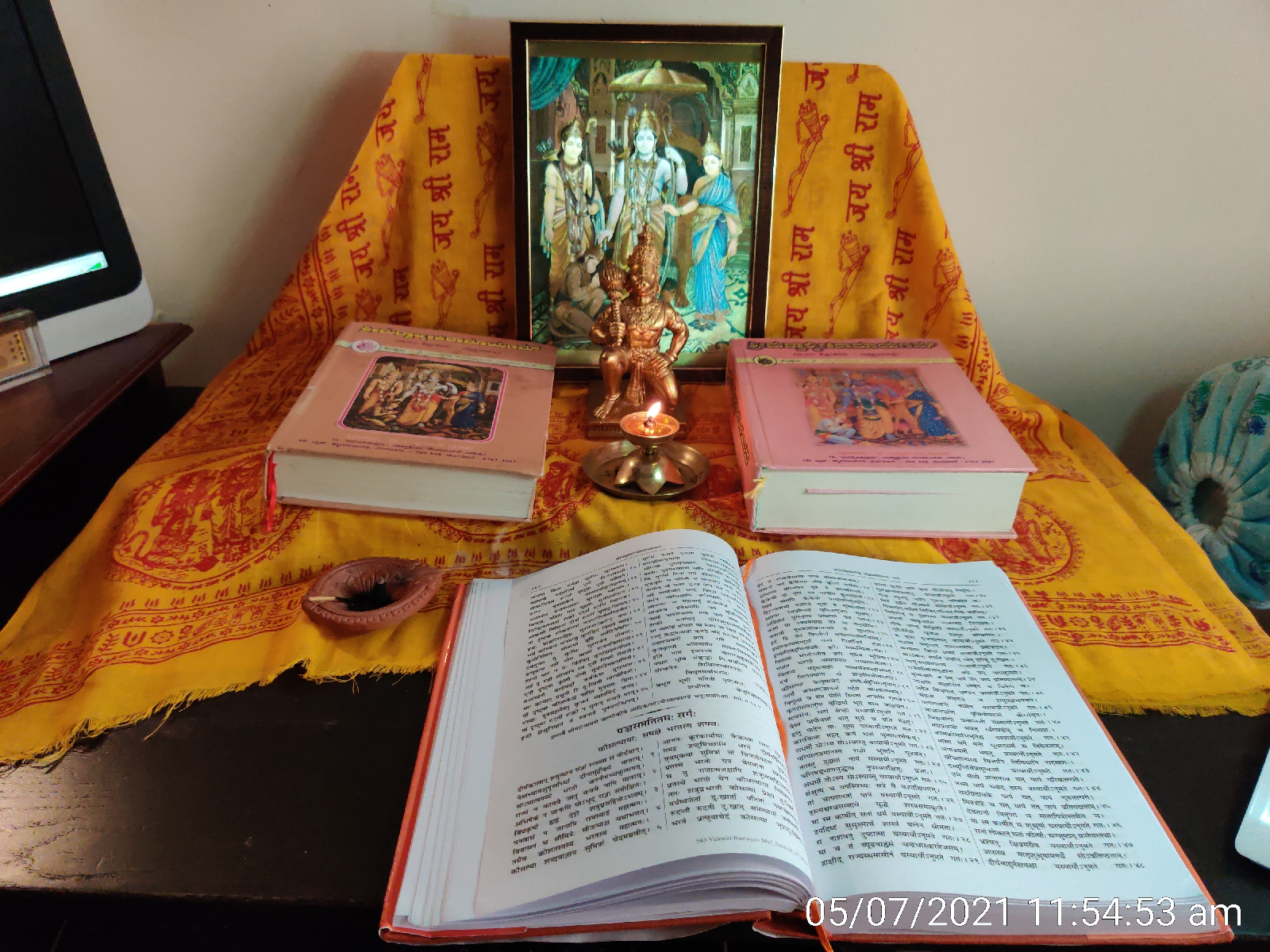
Tuesday, July 6, 2021

Valmiki Ramayana - July 6


July 6 - Sargas 77 and 78 of Ayodhya Kanda.

In these two short chapters, we see some solid action from Shatrughna.

***

After the purification ceremony on the tenth day of Dasharatha's passing, Bharata dutifully performs the prescribed Shraddha on the 12th day. He gives elaborate and generous gifts to Brahmins and others. We all know the importance of these rituals in Hindu customs. 

On the thirteenth day, they go to the cremation spot on the bank of Sarayu to gather the ashes of the king. Bharata breaks down uncontrollably.

Seeing him thus, Shatrughna is also very distressed. He says, 

मन्थराप्रभवस्तीव्रः कैकेयीग्राहसंकुलः      ।
वरदानमयोऽक्षोभ्योऽमज्जयच्छोकसागरः ॥

"We have all been drowned in the ocean of sorrow that began with the outflow of wickedness from Manthara; in the ocean that harbours a crocodile in the form of evil Kaikeyi. The ocean was created by the king's unstinting boons, and cannot be controlled in any way." 

Sage Vasishtha cries a halt to these lamentations. They have to get on with the job at hand including the dispersion of ashes. He counsels the two brothers, 

त्रीणि द्वन्द्वानि भूतेषु प्रवृत्तान्यवशेषतः । 
तेषु चापरिहार्येषु नैवं भवितुमर्हसि      ॥

" Three pairs of opposite experiences are inevitable for all creatures - pain and pleasure, joy and sorrow, birth and death. Those cannot be averted and you should not grieve like this."

Sumantra also adds his words to make the brothers recover their poise somehow and return to the palace. 

***
Shatrughna says something significant on the way:

बलवान् वीर्यसम्पन्नो लक्षमणो नाम योऽप्यसौ। 
किं न मोचयते रामं कृत्वापि पितृनिग्रहम्       ॥

पूर्वमेव तु विग्राह्यः समवेक्ष्य नयानयौ           । 
उत्पथं यः समारूढो नार्या राजा वशं गतः.     ॥

"How come the mighty Lakshmana too came up short in his handling of the situation? He should have imprisoned the king and liberated Sri Rama from this situation. 

" After all we all knew even before how this king strayed from his righteous path by yielding to the wiles of a woman. We should have exercised our discretion on what is right and wrong in royal responsibilities and controlled the king." 

***

The sight of Manthara greets them. It provokes Shatrughna to uncontrollable rage. Valmiki describes how Manthara appeared to them:

प्राग्द्वारेऽभूत् तदा कुब्जा सर्वाभरणभूषिता । 
लिप्ता चन्दनसारेण राजवस्त्राणि बिभ्रती    ॥

विविधं विविधैस्तैस्तैर्भूषणैश्च वरभूषणैः      । 
बभासे बहुभिर्बद्धा रज्जुबद्धेव वानरी         ॥

"Just at the palace entrance  appeared Manthara, bedecked with splendid ornaments. She had anointed herself with sandal paste and wore clothes worthy of a queen. 

She had elaborately chosen her ornaments and had spared no effort in decking herself up. Indeed she looked like a monkey bound up with many ropes. "

(Valmiki's humour cannot escape anyone here. My father told me about these shlokas some 55 years ago.) 

***

Shatrughna catches hold of Manthara. His rage terrifies all the women around who scatter away thinking he will kill her and also others present with her. They run looking for Kausalya to save them. 

As Shatrughna drags Manthara on the floor, her splendid ornaments scatter all around. Valmiki the poet says the royal floor looked like the night sky full of stars. 

Manthara gives a terrible shriek that reverberates loudly throughout the palace. Kaikeyi is benumbed with fright and supplicates to Bharata. 

Bharata restrains Shatrughna. He says a woman should not be slain under any circumstance. In fact, if this were permitted, he would have finished off Kaikeyi already. But Sri Rama would never never have forgiven them and ever set eyes on them if they had committed the act. 

When Manthara is released by Shatrughna, she falls at Kaikeyi's feet sobbing, and the queen consoles her. 

***

॥        श्रीरामजयम्         ॥ 


Monday, July 5, 2021

The pinnacle of Indian dance - Odissi by Sujata Mohapatra

Vid. Sujata Mohapatra is the daughter-in-law and disciple of Padma Vibhushan Guru Kelucharan Mohapatra. She is the goddess of Indian dance as far as I know. Watch her here in a very recent performance, depicting prayers to Sri Rama, Krishna and so on. I give below a shloka she dances to extolling Sri Rama and its meaning. 

 केकीक्ण्ठाभनिइलम् 
सुरवरविलसद्- 
विप्रपादाब्जचिह्नम् 
 शोभाढ्यं पीतवस्त्रं 
सरसिजनयनं 
सर्वदा सुप्रसन्नम् । 

 पाणौ नाराचचापं 
 कपिनिकरयुतं 
बन्धुना सेव्यमानम् 
 नौमीड्यं  जानकीशं 
 रघुवरमनिशं 
पुष्पकारूढरामम् ॥ 

With his mien of a colour like that of the neck of a peacock, 
The supreme among gods bearing the mark of sage Bhrigu's lotus feet on his chest, 
Resplendent, Wearing a golden yellow garment, 
With lotus-like eyes, 
Forever smiling cheerfully! 

Holding a sharp arrow and bow in his hands, 
Surrounded by an army of monkeys, 
Served by his brother Lakshmana always, 
 I bow down to Him, worshippable, the husband of Janaki/Sita, 
The supreme one of Raghu clan, lord of all, 
Enthroned on the Pushpaka, Sri Rama!

Valmiki Ramayana - July 5


July 5 - Sargas 75 and 76 of Ayodhya Kanda. 

Bharata meets Kausalya. Miserable and shrunken in sorrow, she suggests that Bharata must be very happy to take over the throne. Bharata is hurt so much that he goes out of his way to clear his name.

Then they perform Dasharatha's last rites.

***

When Bharata recovers, he again speaks harshly to Kaikeyi at her despicable act. He tells the ministers present that he has no intention of taking the throne. He wants to go and meet Kausalya.

Hearing the noises and voices, Kausalya has gathered that Bharata is back. She walks with Sumitra towards Kaikeyi's chambers to meet him. Midway they encounter Bharata and Shatrughna. Kausalya looks in a terrible state as she embraces Bharata. Then she says something expected:

कामं वा स्वयमेवाद्य तत्र मां  नेतुमर्हसि       ।
यत्रासौ पुरुषव्याघ्रस्तप्यते मे सुतस्तपः       ॥

इदं हि तव विस्तीर्णं धनधान्यसमन्वितम्      ।
हस्त्यश्वरथसम्पूर्णं राज्यं निर्यातितं तया        ॥

"Dear Bharata, perhaps you should yourself take me now to the forest, where my son, a tiger among men, is performing tapas.

"This large kingdom is now all yours,  made rich with grain and fortune of all kinds, abounding in an army with elephants, horses, and chariots. It has been delivered to you by your mother (on a silver platter as they say now).  "

Imagine Bharata's chagrin when he realises that Kausalya thinks he is a party to Kaikeyi's sinful act. The personality of Bharata comes out loud and clear as he protests most vehemently that he is being imputed motives of sin by Kausalya.

Poet Valmiki says that Bharata swears and curses in unmitigated indignation that whosoever might be responsible for Sri Rama's banishment should suffer the consequences. This type of cursing is common even today when someone wants to clear his character from public mistrust or accusations of mala fides.

Bharata curses that whoever is responsible for sending away Sri Rama to the forest should suffer the most terrible retribution. This goes on for more than forty shlokas! All of them use the expression यस्यार्योऽनुमते गतः - "one by whose order the noble Sri Rama has been exiled." The shlokas are very colourful descriptions of transgressions, indulgences, errors of omission, adharmic acts, crimes, sins of all sorts - towards people, towards one's family, towards society at large, towards Brahmins and sages, and even egregious acts that destroy one's own life. I give just three examples :

बलिषड्भागमुद्धृत्य नृपस्यारक्षितुः प्रजाः             ।
अधर्मो योऽस्य सोऽस्यास्तु यस्यार्योऽनुमते गतः   ॥

"May that blighter by whose order the noble Sri Rama has been exiled incur the same sin as a king who has collected taxes at the rate of one-sixth of income from his citizens but does not discharge his responsibilities towards ensuring their protection and welfare." (Yes, that is the income tax rate mentioned in many scriptures!)


गाः स्पृशतु पादेन गुरून् परिवदेत च                   ।
मित्रे द्रुह्येत सोऽत्यर्थं यस्यार्योऽनुमते गतः           ॥

"May that blighter by whose order the noble Sri Rama has been exiled incur the same sin of transgression as one who kicks a cow, insults his gurus, and betrays his friends."

पुत्रदासैश्च भृत्यैश्च स्वगृहे परिवारितः                    ।
स एको मृष्टमश्नात् यस्यार्योऽनुमते गतः             ॥

"May that blighter by whose order the noble Sri Rama has been exiled incur the same sin as a householder, living with children, wife, servants, and attendants, who does not share his lavish meal with them but instead eats them secretly alone."

More than anything else, we discover the temperament of Bharata. I am sparing you many other colourful analogies that we may find difficult to relate to in our times!

Kausalya is contrite that she misunderstood the nature and calibre of her son Bharata and bracketed him with Kaikeyi. Just as she is making amends, sage Vasishtha walks in. He says that the last rites of king Dasharatha are pending and that they should be performed with due ceremony and no further discussion.

The servants bring the dead king from the oil bath and clean the corpse and decorate it elaborately after placing it on a regal bed. Bharata wails uncontrollably seeing his dead father. They then prepare the bier and carry the king in a royal procession through the main street of Ayodhya amid much wailing and mourning by one and all. 

Finally, the king is cremated with all due honours by the priests. Bharata, Shartughna, and the queens, including Kausalya, Sumitra and Kaikeyi, pay their last respects to the departed monarch. 

The funeral ceremonies are not very different from what is ritualistically observed even today.


***


॥                 श्रीरामजयम्                 ॥ 


Sunday, July 4, 2021

Valmiki Ramayana - July 4


July 4 - Sargas 73 and 74 of Ayodhya Kanda.

The Karuna Rasa in Bharata leads to a conflagration of righteous indignation. He speaks his mind to Kaikeyi leaving no doubt about how he is devastated by her devilish act. The famous monologue of Sivaji Ganesan as Bharata in Sampurna Ramayanam comes to mind as I picture the scene. Except that the histrionics are a bit tempered by Valmiki as he was unfamiliar with Tamil cinema.

Bharata makes six points with emphasis and redundancy to avoid any ambiguity.

  1. It has been the time-honoured tradition particularly among the renowned Ikshwakus that the eldest son is heir to the throne. How could this escape Kaikeyi, also of noble royal blood? 
  2. By her machination exploiting Dasharatha's weakness for her embrace, in one stroke, Kaikeyi has killed the king and banished Sri Rama - a vile deed for which she will rot in hell. 
  3. Bharata will NEVER forsake righteousness. He will never comply with Kaikeyi's evil scheme. He will bring back Sri Rama, and serve him. 
  4. Bharata is distressed to even imagine how the citizens will mis-attribute Kaikeyi's evil scheme to him. That is a feeling worse than death. 
  5. Kaikeyi has irretrievably wronged Kausalya by separating her from her son. No mother regards anyone more fondly than her own flesh and blood son. 
  6. There is only one recourse to Kaikeyi now - to kill herself. 

***

दुःखे मे दुःखमकरोर्व्रणे क्षारमिवादधाः             ।
राजानं प्रेतभावस्थं कृत्वा रामं च तापसम्           ॥

Bharata tells Kaikeyi : " You are rubbing salt into my terrible wounds by suggesting that I become the king -wounds you have inflicted by sending my father to the next world and reducing Sri Rama to an ascetic life in the forest."

तं हि नित्यं महाराजो बलवन्तं महाबलः             ।
उपाश्रितोऽभुद्धर्मात्मा मेरुर्मेुरुवनं यथा                 ॥

"Are you not aware that the king, even as a supreme monarch, depended heavily on Sri Rama for ruling Ayodhya- even as the majestic Meru Parvata derives its greatness from the Meruvana on it?"

***

Then Bharata tells the story of the divine cow Kamadhenu, the mother of all bovines in the world. One day she was deeply distressed to see two bullocks on earth being maltreated in a farmer's field and toiling in the hot sun without food. She started shedding copious tears seeing her two children being so mistreated. The tears fell on Indra and he was alarmed, thinking that some calamity was imminent for heaven. He asked Kamadhenu what disaster was she hinting at? See Kamadhenu's reply:

शान्तं पापं न वः किञ्चित्  कुतश्र्चिदामराधिप     ।
अहं तु मग्नौ शोचामि स्वपुत्रौ विषमे स्थितौ        ॥

"God forbid, oh king of gods, that anything untoward happens to you all. I am not suggesting any such calamity. I merely grieve over the hardship being suffered by my two children - seeing those two bullocks toiling on earth."

Indra wondered aloud how deep the filial love was from a mother towards her children. Note that Kamadhenu was the mother for all cows and bulls in the universe and yet she cared for each one of them. Such being the case, imagine what ultimate grief Kausalya, with only one son, would be suffering now on account of Kaikeyi!!!


***

न ह्यहं पापसङ्कल्पे पापे पापं त्वया कृतम्         ।
शक्तो धारयितुं पौरैरश्रुकण्ठैर्निरीक्षितः            ॥ 

"Oh woman of evil designs, I shudder to think how I am going to carry the burden of your sinful act and survive the looks of Ayodhya's citizens as they stare at me, overwhelmed by their grief!"

 
सा त्वमग्निं प्रविश वा स्वयं वा दण्डकान् विश    ।
रज्जुं बधान वा कण्ठे न हि तेऽन्यत् परायणम्    ॥

"There is no recourse for you now, after what you have done. Either you enter fire and immolate yourself, or vanish into the Dandaka forest, or hang yourself. "


***

As Bharata declares that he will go and bring back Sri Rama, he falls to the ground. Valmiki compares him to an elephant felled in the forest. He again compares him to the main flagstaff of Indra himself falling to the ground inauspiciously.   

***


॥                 श्रीरामजयम्                 ॥ 


Saturday, July 3, 2021

Valmiki Ramayana - July 3


July 3 - Sargas 71 and 72 of Ayodhya Kanda. 

We begin to read about Bharata for the first time in Ramayana. 

Imagine someone who has become the heir to a powerful kingdom, thanks to his mother's successful ploy. How he would react to this opportunity depends on the circumstances, his personality, and his values. In the idyllic world of Ramayana, just as Sri Rama was the embodiment of Dharma, Bharata valued what is really important in life. He worshipped the ideal of being true to one's elders and serving the people selflessly. Here we begin to read his first reactions to the calamitous goings-on in Ayodhya. 

***
Valmiki describes the route taken by Bharata and his large entourage through various regions and towns, crossing mountains and rivers at convenient and safe points. They are unable to travel as fast as the messengers from Ayodhya who had expertly sped on horses. 

***

स गङ्गां प्राग्वटे तीर्त्वा समायात् कुटिकोष्टिकाम्           ।
सबलस्तां स तीर्त्वाथ समगाद् धर्मवर्धनम्                 ॥

स तांस्तु प्रियकान् प्राप्य शीघ्रानास्थाय वाजिनः          ।
अनुज्ञाप्याथ भरतो वाहिनीं त्वरितो ययौ                    ॥     

अयोध्यां मनुना राज्ञा निर्मितां स ददर्श ह                    ।
तां पुरीं परुषव्याघ्रः सप्तरात्रोषितः पथी                    ॥

Bharata crossed the holy Ganga at Pragvata and came to the river Kutikoshtika. He crossed that river too with his large entourage and passed the village of Dharmavardhana. After passing some more villages and resting for the night in a delightful grove, he decided that their passage was rather slow because of the large detachment that accompanied him. He, therefore, changed his horses to swifter ones and directed the army to proceed at their pace but that he would travel ahead as swiftly as possible. Bharata's chariot then advanced rapidly to reach Ayodhya.

At last, after travelling as fast as he could over seven days and nights, completely exhausted, Bharata, the tiger among men, arrived and sighted Ayodhya, that glorious city built by Manu.

***

Bharata was greeted by uniformly depressing sights all around. The city had neither its usual hustle and bustle, nor were its citizens going about their affairs cheerfully. The gardens were without joyous couples and visitors. There were neither holy Vedic chants nor worship at temples.  Everything looked dismal and mournful.

बभूव पश्यन् मनसोऽप्रियाणि            
        यान्मान्यदा नास्य पुरे बभूवुः          ।
अवाक्शिरा दीनमना न हृष्टः 
        पितुर्महात्मा प्रविवेश वेश्म           ॥

Beholding so many gloomy sights that were unprecedented in Ayodhya, Bharata was silent and depressed as he entered his father's palace.

***

Not finding his father there, he goes to Kaikeyi's chambers, where the king is most likely to be. But more distressing sights of unkempt surroundings greet his eyes as his mother receives him with much ardour.

***

Among the navarasas, the nine moods described by Bharatamuni in Natyashastra, the one representing kindness, pathos, sympathy, affection, softness, nobility,  is Karuna rasa. Valmiki has depicted the character of Bharata to exemplify Karuna rasa. His experiences and life choices all overflow with Karuna.

Imagine his increasing consternation, anguish, and horror, as his mother Kaikeyi begins to unravel the sequence of events that has come to pass in Ayodhya. They are more horrific in their reality than the fantastic nightmare he had back in Rajagriha.

***

या गतिः सर्वभूतानां तां गतिं ते पिता गतः         ।
राजा महात्मा तेजस्वी यायजूकः सतां गतिः      ॥

"Dear Bharata, your father, who was high-souled and devoted to performing yajnas for universal welfare, has passed on, meeting the same destiny that beckons all living beings. He has attained the state that is coveted by all righteous men."

WHAT! Bharata gets a huge shock. He is incoherent in his distress, recalling how loving Dasharatha was as a father, and what a calamity it is for everyone in Ayodhya. What was his illness? How did he die? What were his last words? Sri Rama and Lakshmana are indeed so fortunate that they were by his side, and could perform his last rites....

रामेति राजा विलपन् हा सीते लक्ष्मणेति च         ।
स महात्मा परं लोकं गतो मतिमतां वरः              ॥

"Dear son, the high-souled and greatly wise king breathed his last crying out words, "Oh Rama, Oh Sita, Oh Lakshmana! " 

"In fact, your father was  bound by the laws of Time (= Death) just like an elephant is bound by chains. The last words he said, very wistfully, were "indeed blessed are those who will behold Sri Rama, Sita and Lakshmana when they return to Ayodhya!""

WHAT!? Where was Sri Rama then? Why was he not at father's side??? Where had the three gone away?


स हि राजसुतः पुत्र चीरवासा महावनम्                 ।
दण्डकान्  सह वैदेह्या लक्ष्मणानुचरो गतः             ॥

"My son, prince Rama, along with Sita, followed by Lakshmana, went away to the great Dandaka forest, clad in tree-barks and leaves."

WHAT!!!!!???? For what adharmic act was Rama punished thus? Did he embezzle the property of a Brahmin? Did he kill a sinless man, rich or poor?  Did he covet another's wife? Did he kill a foetus? 

"No, No, No, Bharata, no such act of transgression happened. Rama was  sent away to the forest as per my bidding by the king!

मया तु पुत्र श्रुत्यैव रामस्येहाभिषेचनम्                   ।
याचितऽस्ते पिता राज्यं रामास्य च विवासनम्        ॥

तमपश्यन् प्रियं पुत्रं महीपालो महायशाः               ।
पुत्रशोकपरिद्यूनः पञ्चत्वमुपपेदिवान्                     ॥    

"Dear son, as soon as I heard of the king's imminent plan to install Rama as the Yuvaraja, I put my foot down. I demanded that you be made the king and Rama be sent to the forest at once.

"Poor king, unable to set his eyes any more on Rama, was plunged in sorrow and breathed his last."

तत् पुत्र शीघ्रं विधिना विधिज्ञैः
      वसिष्ठमुख्यैः सहितो द्विजेन्द्रैः              ।
संकाल्य राजानमदीनसत्त्वम्
       आत्मानमुर्व्यामभिषेचयस्व                ॥

"Now then, dear son Bharata, all that remains for you is to crown yourself as the king of this earth  without any delay whatever, duly installed with all proper ceremonies by the knowledgeable priests and sages led by sage Vasishtha, giving up any trace of sorrow in your heart."


***


॥                          श्रीरामजयम्                        ॥


Friday, July 2, 2021

Valmiki Ramayana - July 2


July 2 - Sargas 69 and 70 of Ayodhya Kanda.

During the very night when the messengers from Ayodhya arrive into Rajagriha, the capital of Kekaya, Bharata has a terrible nightmare.

He is so badly shaken that his friends and attendants are unable to cheer him up next morning, however much they try. They regale him with jokes, music, and sport. But he does not respond. When his associate enquires what is bothering Bharata, he replies:
"My friend, I had a terrible dream. I saw my father pale, dishevelled, smeared with muck, falling from a mountain into cowdung. As he floated in cowdung, he was swallowing oil and laughing strangely. He was eating rice mixed with til. Finally he settled in a pool of oil. 

"I saw many unnatural calamities like the moon lying on the ground and the earth splitting open. 

" My father wore black clothes and sat on an iron seat as women in dark clothes laughed at him. "

***

त्वरमाणश्च धर्मात्मा रक्तमाल्यानुलेपनः     । 
रथेन खरयुक्तेन प्रयातो दक्षिणामुखः        ॥

प्रहसन्तीव राजानं प्रमदा रक्तवासिनी       । 
प्रकर्षन्ती मया दृष्टा राक्षसी विकृतानना    ॥

"Then I saw the noble king wearing a garland of red flowers, bedaubed in red sandal paste, hurrying southward in a chariot drawn by donkeys. 

" I saw him being greeted by a grotesque demoness wearing blood-red clothes who dragged him away guffawing and mocking at him." 

***
Bharata is sure that such a dream, not occasioned by any happening the previous day, had come to him portending some calamity for the king. 

***
The Ayodhya messengers arrive and are ushered into the palace with due courtesies. They greet Bharata with great warmth and offer their respects to him as well as his grandfather and uncle. 

They lose no time in conveying the precise message from sage Vasishtha :

पुरोहितस्त्वां कुशलं प्राह सर्वे च मन्त्रिणः      ।
त्वरमाणश्च निर्याहि कृत्यमात्ययिकं त्वया       ॥

"Dear prince Bharata, sage Vasishtha, the chief priest of the kingdom,  has sent his greetings and blessings to you. The ministers also send their greetings. The sage has instructed that you should return to Ayodhya at once, and complete some pressing tasks to be done you that are overdue."

***

Valmiki describes how some 30 crore coins (वराहाः) and several other gifts of clothes and jewellery have been bought from Ayodhya by the messengers, to be given by Bharata to the Kekaya king: 20 crores to Bharata's grandfather, and the rest to his uncle. Bharata cordially offers the gifts to them. 

Bharata's distinct unease from the nightmare is only accentuated by the sudden arrival of these messengers. He enquires anxiously about everyone. I quote only two shlokas:

कच्चित् स कुशली राजा पिता दशरथो मम । 
कच्चिदारोग्यता रामे लक्ष्मणे च महात्मनी   ॥

"I trust all is well with the king Dasharatha, my father!? I trust the noble Sri Rama as well as Lakshmana is in good health?" 

Then he asks about his mothers - first Kausalya, then Sumitra, and then Kaikeyi. See what he says about Kaikeyi!!! 

आत्मकामा सदा चण्डी क्रोधेन प्राज्ञमानिनी । 
अरोगा चापि मे माता कैकेयी किमुवाच ह   ॥

" And how is my mother Kaikeyi, self-centred, willful, stubborn, and quick to fight, too sure of her own astuteness? Is she well? What did she say to me?" 

The messengers earn our respect when we see how they deflect their answers assuring Bharata that everyone is doing well. They add, 

श्रीश्च त्वां वृणुते पद्मा युज्यतां चापि ते रथः ॥

" Dear Bharata, goddess Lakshmi with a lotus in her hand is awaiting you. Please get your chariot ready to leave at once." 

***

Valmiki describes how Bharata takes leave of his dear grandfather and uncle. They arrange elaborate gifts for him, including elephants, horses, prize donkeys and so on. Valmiki mentions that the grandfather gifts him from the inner chambers special guard dogs fierce like tigers with a huge muscular build and with prominent canines. 

Bharata is loath to accept all these gifts under his mood of ill-boding that refuses to leave him. But he is cordial and respectful. 

Bharata and Shatrughna start their journey with a large entourage arranged by the Kekaya king and with the caravan full of gifts. 

***

॥           श्रीरामजयम्            ॥


Thursday, July 1, 2021

Valmiki Ramayana - July 1


July 1 - Sargas 67 and 68 of Ayodhya Kanda.

We read about the great concern expressed among all the sages and ministers who have been guiding and administering Dasharatha's regime. They don't want Ayodhya to remain without a ruler. They paint an interesting picture of a king-less kingdom. 

Vasishtha sends swift riders to go and bring Bharata and Shatrughna back from the far-off Kekaya desha as soon as possible without revealing the status of affairs back home. Valmiki is very happy to describe their passage. 

***

Sages and counsel for Dasharatha, viz. Markandeya, Vamadeva, Maudgalya, Kashyapa, Katyayana, Gautama, Jabali, and the various ministers, all addressed sage Vasishtha, the kulaguru, about the distressing situation in Ayodhya and the need to avert the disorder of a kingless state. 

Valmiki chooses to narrate what will happen to a nation without a ruler by giving the choicest of examples. 

Since there will be no righteousness and piety in the form of properly conducted yajnas and yagas, as prescribed in the Vedas ( and also emphasised in the Bhagavad-Gita), Nature will cease to shower her blessings in the form of rains and good crops. This idea is embedded in our culture and yajna and yaga ceremonies represent the stability and maturity of a society that expresses itself in giving back to Nature what is earned by rightful effort in cooperation with all existence.

People will lose interest in hard work and honesty.  Farmers will lose motivation to till their land, sow in time, and tend their crops, as the future is uncertain. Travelling businessmen will desist. There will be no fast vehicles zipping about Ayodhya. There will be no majestic tuskers roaming grandly in the city. 

Traders will down their shops fearing robbers. Families will loosen bonds of affection and mutual support. Women and children will become disobedient. Students will lose interest in studies. And so on. I quote two shlokas that caught my attention:

नाराजके जनपदे तूद्यानानि समागताः          ।
सायाह्ने क्रीडितुं यान्ति कुमार्यो हेमभूषिताः   ॥

नाराजके जनपदे धनवन्तः सुरक्षिताः            ।
शेरते विवृतद्वाराः कृषिगोरक्षजीविनः           ॥

In a land without a ruler, young women will not deck themselves up in fine clothes and golden ornaments and happily go about with friends laughing and playing in the gardens during evenings. 

In a land without a ruler, rich people in the fields of agriculture, animal husbandry and trade will feel very insecure. They will be unable to sleep peacefully keeping their doors open to visitors and guests.

This sentiment is expressed even in Kalidasa's works to describe how young women feel safe, joyous and prosperous in a well-ruled land. In the same way, rich people will offer hospitality and charity instead of securing themselves against robbers behind double-barred super-secure doors.

And so on.

***

Sage Vasishtha gives his verdict. "King Dasharatha is dead. His eldest son Sri Rama is in exile in the forest. His brother, the capable Lakshmana, is also with him in exile. We have only one recourse. As desired by the king Dasharatha, we should immediately bring back Bharata and Shatrughna from their uncle's kingdom, Kekaya. We should install Bharata as king and adhere to the word of our late king."

He calls five very competent messengers. Valmiki gives their names - Siddhartha, Vijaya, Jayanta, Ashoka and Nandana. He gives them detailed instructions that they should travel by the swiftest means to reach Bharata. They should completely hide their distress about the recent events in Ayodhya. They should give the following message to Bharata:

पुरोहितस्त्वां कुशलं प्राह सर्वे च मन्त्रिणः      ।
त्वरमाणश्च निर्याहि कृत्यमात्ययिकं त्वया       ॥

"Dear prince Bharata, sage Vasishtha, the chief priest of the kingdom,  has sent his greetings and blessings to you. The ministers also send their greetings. The sage has instructed that you should return to Ayodhya at once, and complete some pressing tasks that are pending on your account."

The words are chosen to trigger the quick and unquestioning compliance desired, as they are coming from Bharata's preceptor and the chief priest.

Valmiki the master story-teller describes how the five men hasten home, collect clothes, weapons and food for their travel, and proceed on swift horses. Their journey through many regions and across many rivers westward towards Kekaya (which may be in present day Afghanistan?) is mapped. They cross many many rivers including the Ganga, touching Hastinapur, Panchala, and so on. They stop and worship holy mountains and there is a sacred shrine for Vishnu mentioned where they pray. They eventually reach the city where Bharata is staying, arriving there late into the night.

***


॥                      श्रीरामजयम्                       ॥ 


Wednesday, June 30, 2021

Valmiki Ramayana - June 30


June 30 - Sargas 65 and 66 of Ayodhya Kanda.

Already half of 2021 is done and dusted, and Covid is nowhere near being tamed. As the days roll by, we engage ourselves as best as we can, and what better activity can one find than reading the Valmiki epic!?

Before I tell you what we read today, let us recall who Valmiki is. He was Ratnakara, a dacoit. His reputation for ruthlessness did not deter Narada from going into the forest and coming to be accosted by him. Trust Narada to instil sense in the man who quickly mended his old ways of breaking people's skulls for their money. Vamiki instead  began his search for abiding riches hidden in one's soul. 

Fast forward to the beginning of Valmiki Ramayana, When sage Valmiki asks Narada maharshi if there ever was or is an ideal man on earth who breathes and lives Dharma, Narada tells him the story of such a man, Rama.

The beginning of Valimiki's poem is strange. Valmiki goes for his bath in the river and  bursts into rhyme at the sight of a hunter killing a bird. He realises to his astonishment there is poetry in the words that came out of him in anger and sorrow. Then Brahma tells him it is divine will that Valmiki should put his newly discovered gift for poetry to tell the world the story of Rama. Thus is born the world's first shloka (a poem with four padas in a metre) from the sadness expressed by the sage at the killing of the bird (shoka).

Valmiki then uses his spiritual power to visualise the entire story of Ramayana and writes down the kavya. 

Did Valmiki ever live in cities? See royal ceremonies? Interact with a wide spectrum of people to understand their ways and ideas and idiom? So how come we have this fantastic narrative? 

Do we need any more proof that Valmiki Ramayana is a divine inspiration and not a laboured poem?

***

We are already privy to the fact that Dasharatha is dead. But it seems no one in Ayodhya knows it next morning. 

***

As usual, panegyrists expert in singing the glories of their kings, their dynasties and conquests, and stories to inspire society, assembled at Dasharatha's palace.  They sang musically, being mindful of the subtle tones of the Veena. Their loud and attractive chants were joined in by others who clapped and sang, perhaps in a more common style. The birds on trees and in royal cages joined with their chirping. Thus there was a celebratory welcome to the morning, a ceremony designed to wake up Dasharatha.

Attendants came to give the king his royal bath with unguents and perfumes. They carried golden pitchers of water. Prasada (holy offerings) and water from holy rivers and springs, and other items for the king's partaking, were brought. His dress and other accessories were carried in. 

As the entire entourage waited, even after sunrise, there was no sign of the king. Murmurs started that it was unusual for the king not to have risen. Hordes of Dasharatha's women then went into his sleeping chamber. The king lay between Kausalya and Sumitra. It seemed they were all exhausted and too deep in sleep. His other queens began to call him and touch him but finding no response they closely examined why the king was not stirring. They discovered to their horror that there was neither breath nor pulse. 

The women started wailing. That woke up Kausalya and Sumitra. It did not take long for them to realise that the king had passed away. Kausalya fell to the floor wailing, like a fallen star. The noises brought everyone to the chamber including Kaikeyi.

There was a huge uproar of wailing.

***

स कामा भव कैकेयि भुङ्क्ष्व राज्यमकण्टकम् ।
त्यक्त्वा राजानामेकाग्रा नृशंसे दुष्टचारिणि     ॥

न लुब्धो बुध्यते दोषान् किंपाकमिव भक्षयन्   ।
कुब्जानिमित्तं कैकेय्या राघवाणां कुलं हतम्    ॥

अनियोगे नियुक्तेन राज्ञा रामं विवासितम्        ।
सभार्यं जनकः श्रुत्वा परितप्स्यत्यहं  यथा        ॥

स मामनाथां विधवां नाद्य जानाति राघवः       ।
रामः कमलपत्रताक्षो जीवन्नाशमितो गतः       ॥

Kausalya's life breath has only one purpose now. To speak to Kaikeyi. 

"Oh Kaikeyi, you of most vile deeds, now rejoice at having won your desire. You have single-mindedly got rid of the king. Now enjoy your kingdom unimpeded.

"A greedy man indeed does not realise what harm will befall him when he partakes of some bad but attractive food. Egged on by that hunchback Manthara, Kaikeyi has destroyed the dynasty of Raghus.

"When he comes to know that Kaikeyi has managed to get Rama banished to the forest with his wife Sita by the king, king Janaka will suffer as much as I am doing now.

"And to think that the pious Rama, with lotus eyes, who has been taken out of the equation here even though he is still alive, will never come to know that I have been made a widow with no one to care for me! "

And so on.

Some administrators who are around do the practical thing of getting her hand maids to gently escort Kausalya to her chamber, so she can recover her poise. 

तैलद्रोण्यां तदाऽमात्याः संवेश्य जगतीपतिम् ।
राज्ञः सर्वाणयथादिष्टाश्चक्रुः कर्मण्यनन्तरम्     ॥

The ministers then consulted the wise men what was to be done next. The king's body had to be preserved for last rites until at least one of his sons was present to perform the ceremonies. So they did as directed and prepared a casket of oil and immersed the king's body in it. They did whatever more had to be done to keep the vigil.

The entire Ayodhya was stricken with the tragedy of Dasharatha's death. Valmiki describes the scenes of wailing and the citizens'  apprehensions for the future of the city and the kingdom. Ayodhya was like the night sky without stars. Everyone blamed Kaikeyi for the turn of events.

***


॥                  श्रीरामजयम्                  ॥ 
 

Tuesday, June 29, 2021

Valmiki Ramayana - June 29


June 29 - Sargas 63 and 64 of Ayodhya Kanda.

We read the heart-rending story of the way Shravana kumara (his name is not mentioned in Valmiki Ramayana!) is killed by Dasharatha's arrow and the curse he gets from his father in the forest. Then Dasharatha dies.

***

One thing is very clear to me by now. Valmiki, called Adi Kavi, the original poet in Indian history, is a past master at describing three things: nature, human emotions, and how people strive to learn from life's experiences. Of course sometimes it is too late.

***

स राजा रजनीं षष्ठीं रामे प्रव्राजिते वनम्           ।
अर्धरात्रे दशरथः सोऽस्मरद् दुष्कृतं कृतम्      ॥   

कश्चिदाम्रवणं छित्त्वा पलाशांश्च निषिञ्चति         ।
पुष्पं दृश्ट्वा फले गृघ्नुः स शोचति फलागमे       ॥

The king spent the sixth night after Sri Rama's going into exile in great unease. In the middle of the night he recalled a great misdeed that he had committed in the past.

The king then starts speaking about how people are bound to get the fruits of their actions good or bad. He gives the example of a man swayed by the most attractive looks of palasha flowers (indeed the red flowers set the forest aflame with their looks).  Such a man expects some fantastic fruits from those trees and cuts down his entire grove of mango trees and plants palasha trees in their place. He is bound to regret his thoughtless act driven by pure greed because palasha yields nothing as good as mango fruits. 

***

The king slowly recalls that terrible night when as a young prince he had gone out hunting. Swollen with pride over his capability to hit a target by locating it precisely on merely hearing its sound, he wanted to use this Shabdavedi skill and hunt an elephant or a wild buffalo. 

Valmiki launches into a beautiful description of the mountains and forests and rivers during the monsoon. The rivers were muddy with gushing waters.  It seems to be the best time for hunting.

Approaching the bank of the Sarayu river in the dark night, Dasharatha heard the sound that resembled an elephant drinking water from the river. He at once aimed and shot a fierce arrow (Valmiki says it hissed like a venomous snake) at the prey. What a shock when he heard a human scream at being hit by the arrow and falling into the water!

The unfortunate man was living in the forest, leading the life of a rishi, taking care of his aged, infirm, blind parents in their Vanaprastha days. He had now come to fetch water for his thirsty mother in the dead of night.

***

वृद्धौ च मातापितरावाहं चैकेषणा हतः         ।
केन स्म निहताः सर्वे सुबालेनाकृतात्मना       ॥

"My aged mother and father have been slain along with me by a single arrow! Who would be that fool that has committed this heinous act? As far as I know we lead a life of rishis in prayer and have not harmed anyone any time."

Hearing these words, Dasharatha drops his bow and arrow with mouth agape! Then he sees the rishikumara. He is terribly frightened and is unable to think. He reaches the ascetic on the bank and sees his body smeared in blood and dust, his matted locks dishevelled, and the water pitcher fallen from his hand. The ascetic burns him with his looks and says, "what a cruel act! why did you kill me oh king? I am a mere forest dweller fetching water for my parents!"

Writhing in pain, the ascetic takes in everything. He tells Dasharatha that indeed he is not a Brahmin so the king would not incur the ultimate sin. (The old man was a Vaishya and his wife a Shudra. They had gone to spend their last days in meditation in the forest, being tended by their ascetic son.) 

However this act is mindless and bodes ill for the king for sure. Dasharatha has effectively killed him and his parents in one stroke. He tells the king to go at once ad break the news to his father in the hut a short distance away, and dies.

***

Dasharatha fills the water pot and walks full of dread and anguish to the hut. He sees the old couple wondering where their son has gone away.

तत्राहं दुर्बलावन्धौ वृद्धावपरिणायकौ          ।
अपश्यं तस्य पितरौ लूनपक्षाविव द्विजौ      ॥

"Oh Kausalya, there in the hut I saw an aged couple, very weak and blind. They were without anyone to support them. They were the parents of the rishikumara and resembled a pair of birds with wings cut off. They were leading the life of rishis."

The old man speaks as he hears footsteps. He says, "son, if I have said or done anything to upset you, do not take it to heart. You are our life. Please speak. Please give your mother water, she is parched and waiting anxiously."

Dasharatha finds it extremely arduous to bring himself to narrate the happenings. He tells how he is Dasharatha, the prince, come out hunting at night. How he mistook the rishikumara collecting water to be an elephant and killed him by his Shabdavedi arrow.

The old rishi is stunned. He then speaks, "Oh king, if you had not come personally to break the news, your head would have splintered to a thousand pieces. As a Kshatriya, if you had knowingly killed a forest dweller, you would have been ruined even if you were Indra. Killing an ascetic would make your head explode. Since you have committed this act unknowingly, your Ikshwaku race is saved. 

"Take us to our son."

***

When Dasharatha takes the old blind couple to their dead son, their words as they embrace their son are simply heart-rending. It is obvious the couple no longer wish to live.  The old man blesses his dead son to go to the higher world reserved for the most meritorious. He tells Yama that they would like to soon join their son there.

Indra himself comes and takes the young man's soul to the higher world. The aged couple perform their son's last rites and ascend the funeral pyre and lay down their bodies. Before going, the old ascetic pronounces a curse on Dasharatha.

पुत्रव्यसनजं दुःखं यदेतन्मम साम्प्रतम्           ।
एवं त्वं पुत्रशोकेन राजन्कालं करिष्यसि         ॥

"Oh king, just like I am dying now, sorrowing for my son, you too shall die grieving separation from your son." 

***

Dasharatha completes the sorrowful tale. He describes how he sees his end is near, as he loses his sight and slowly loses control over his senses. He speaks increasingly incoherently, speaking of the glorious Sri Rama and how only the most fortunate will be able to see Sri Rama and celebrate his return to Ayodhya.

Dasharatha dies.

***


॥               श्रीरामजयम्                ॥ 


Monday, June 28, 2021

Valmiki Ramayana - June 28


June 28 - Sargas 61 and 62 of Ayodhya Kanda.

If anyone has yet not realised what kind of words one will have to listen to after committing a colossal act of injustice and inhumanity in haste, we get to read of it once more today.

Kausalya's grief is not extinguished despite words of comfort and reassurance from Sumantra. She takes up the matter with Dasharatha.

As the noble and righteous king, how did he stoop to such a low act? Does he realise that a tender princess Sita used to comfort and luxury will have to suffer unprecedented cold and heat and rain in the forest? Eat forest produce instead of dainty dishes? Hear the scarifying shrieks of wild animals instead of the lilting music of court musicians? That Rama will have to sleep on the ground supporting himself on his arm, instead of sleeping in a royal bed?

Rama could have easily taken the kingdom by force. It was his right. But he is a man of Dharma. 

What will happen after fourteen years? Will Rama accept the kingdom already ruled by Bharata for so long? 

Kausalya gives an elaborate analogy of a Shraddha ceremony. If one first feeds relatives (good people indeed) and then offers the ceremonial feast to worthy Brahmins, will they accept it? It will be a subversion of the right order and unacceptable. This analogy resonates with anyone who has witnessed Shraddha ceremonies even in our time.

Similarly, articles of worship and Yajna once used are never recycled and reused in another worship. 

Even animals don't like to eat left-overs of other animals. A lion does not eat a carcass hunted by another animal. Rama will not take charge of the kingdom from Bharata on his return.

How about thinking of the condition Dasharatha has reduced Kausalya to by his misdeed? A woman has nobody to look up to except her husband or son. Now Dasharatha has rendered her destitute. All this!  

And only two people will be happy - Dasharatha's darling wife Kaikeyi and her dear son Bharata.

हतं त्वया राष्ट्रमिदं सराज्यं 
      हताः स्म सर्वाः सहमन्त्रिभिश्च  । 
हता सपुत्रास्मि हताश्च पौराः
       सुतश्च भार्या च तव प्रहृष्टौ     ॥

"Oh king, you have destroyed this country and its rule of law. Everyone in this country has been ruined by you, as well as your entire administration. Even though I have a son as a prince, you have pretty much killed me, and my son, and every decent person around. Only your wife Kaikeyi and her son are very happy. "

Kausalya even adds that Dasharatha has lost all Dharma- of any of the four castes- and his sin is beyond redemption. 

***

These words reduce a decrepit and distressed Dasharatha to dismal depths of despair. He collapses. After he slowly recovers, he  begs Kausalya to tone down her hurtful words. He says that he is beginning to recall an act he had committed once using his special skill as a Shabdavedi (aiming at a target by hearing its sound alone while hunting) and his sin is now bearing fruit. Dasharatha also reasons with Kausalya. 

भर्ता तु खलु नारीणां गुणवान्निर्गुणोऽपि वा  । 
धर्मं विमृशमानानां प्रत्यक्षं देवि दैवतम्        ॥

"After all, is it not Dharma that a woman stands in support of her husband however good or bad he may be? Indeed, oh queen, they say that a husband is god to a woman." 

Kausalya realises that the king is hurt very badly by her words. She falls at his feet and begs forgiveness. She apologises that her own terrible plight made her say all these abominable things. The wound inflicted by fate is far more painful than that made even by any great weapon. 

Please, Dasharatha should forgive her. Of course she considers it her highest duty to take care of her husband and will never again hurt the king. 

***

॥               श्रीरामजयम्                ॥


Sunday, June 27, 2021

Valmiki Ramayana - June 27


June 27 - Sargas 59 and 60 of Ayodhya Kanda.

Between outbursts of grief, Dasharatha asks Sumantra to continue his report. Sumantra describes how he stayed back unable to leave Guha's place and was hoping that Sri Rama may come back. When that did not happen, he received information about Sri Rama's visit to Bharadwaja's ashrama, crossing of the Yamuna and their proceeding to Chitrakuta. Sumantra then turned back towards Ayodhya. 

Sumantra displays his poetic ability also as he paints a picture of all nature and how even his royal horses displayed a marked sorrow. Nothing seemed right. In fact these descriptions remind me of how it is described in the Bhagavatam - the way the gopis and gopas and all nature rued the departure of Sri Krishna, away from Gokula to proceed to Mathura, knowing well that he would never come back to Gokula and the good old days. We have to state that Valmiki has subtly described the effect a divine incarnation has on everyone and everything around, without stating it in so many words.

Sumantra concludes by saying something significant:

नामित्राणां न मित्राणामुदासीनजनस्य च       ।
अहमार्ततया कञ्चिद् विशेषं नोपलक्षये         ॥

"My lord, I did not see any difference in the extent of grief displayed by either your well-wishers, or your detractors, or those people indifferent to you. "

It is now the turn of Dasharatha to say something significant:

कैकेय्या विनियुक्तेन पापाभिजनभावया        ।
मया न मन्त्रकुशलैर्वृद्धैः सह समर्थितम्          ॥

न सुहृद्भिर्न चामात्यैर्मन्त्रयित्वा  सनैगमैः          ।
मयायमर्थः सम्मोहात् स्त्रीहेतोः सहसा कृतः     ॥

"Alas, incited by Kaikeyi who harboured only evil intentions, I have acted thus, without getting concurrence from those well-versed in royal strategy, or wise in years. I did not consult near and dear ones, nor my ministers, nor those who know what is adherence to Dharma. I acted in haste, driven by my infatuation and a weakness for the woman." 


***

Kausalya now gets into a proper tizzy.   Just like Dasharatha, she speaks nothing else than Rama's unjust suffering, how she wishes to go and join him in the forest at once, and how she will lose her life otherwise.

***

Sumantra means in Sanskrit "one well-versed in good strategy." This name is not accidental for the senior most minister of Dasharatha. Imagine that someone is lamenting how a very dear one is in some far-off place perhaps suffering a lot, imagining the worst, as there is no way to know their dear one's  condition. Don't we all cheer them up by mentioning as many credible things as possible to show that the dear one may not be suffering so much, after all? This is what Sumantra does.


त्यज शोकं च मोहं च सम्भ्रमं दुःखजं तथा      ।
व्यवधूय च सन्तापं वने वत्स्यति राघवः         ॥

लक्ष्मणश्चापि रामस्य पादौ परिचरन्वने            ।
आराधयति धर्मज्ञः परलोकं जितेन्द्रियः          ॥

विजनेऽपि वने सीता वासं प्राप्य गृहेष्विव        ।
विस्रम्भं लभतेऽभीता रामे सन्न्यस्तमानसा        ॥

रामं वा लक्ष्मणं  वापि दृष्ट्वा जानाति जानकी    ।
अयोध्या क्रोशमात्रे तु विहारमिव संश्रिता         ॥

"Dear queen Kausalya, please abandon all your dismay. Stop imagining that the worst is happening to Sri Rama.  Sri Rama has completely got over his distress and is settling down in the forest. 

"Even Lakshmana is at Sri Rama's feet, serving him in the forest. He is single-mindedly devoted to Sri Rama, knowing his Dharma. Lakshmana is one with great control over his senses and is pursuing only the hereafter (salvation).

"And what can I say about Sita!? Even though she is now in an uninhabited forest, she is going about as if it is her own palace. She is full of confidence and displays no fear. She has fully merged her mind in Sri Rama and thinks of nothing else.

"I saw her enjoying the journey very much, asking about trees, flowers, fruits, scenery, and the villages we passed. She was in a very childlike happy, curious, mood.

"When she sees Sri Rama, or Lakshmana, Janaki knows well that they are not too far away from Ayodhya (and can return any time they wish). So she indeed thinks this sojourn in the forest is only like a picnic."

***

॥                    श्रीरामजयम्                     ॥ 


Saturday, June 26, 2021

Valmiki Ramayana - June 26


June 26 - Sargas 57 and 58 of Ayodhya Kanda.

Two short sargas, two unhappy narratives.

***

Seeing Sri Rama, Lakshmana and Sita disembark from the boat that Guha's man had taken them in across the Ganga, and watching them move away into the forest, both Guha and Sumantra heaved sighs of deep anguish. 

***

Guha's messengers track Sri Rama and company as they visit Bharadwaja's Ashram, cross the Yamuna, and make their way towards Chitrakuta. This information reaches Guha and Sumantra. They both feel a little less concerned about Sri Rama's whereabouts.

Soon Sumantra makes his way back. He drives a wonderful chariot drawn by swift horses.  The countryside he passes through is very beautiful. But nothing seems important. He enters a mournful looking Ayodhya full of apprehensions for the future. 

Six nights have passed since Rama left Ayodhya. The citizens are still wishful that they will see them all return with Sumantra. But when Sumantra enters the city without the three, a pall of gloom covers everyone. Sumantra tells them that the last he saw of Sri Rama was when he had crossed the Ganga.

***

शुश्राव च वचस्तेषां वृन्दं वृन्दं च तिष्ठताम्         ।
हताः स्म खलु ये नेह पश्याम इति राघवम्         ॥

दानयज्ञविवाहेषु समाजेषु महत्सु च                  ।
न द्रक्ष्यामः पुनर्जातु धार्मिकं राममन्तरा              ॥


Those who heard the words of Sumantra, gathered in groups and said repeatedly, "we are all ruined. We shall see Sri Rama no more!"

"In all our activities, be they of giving donations to others, or performing yajnas and prayers, or conducting weddings, or even in large gatherings for special occasions, we shall never again see that most righteous man, Sri Rama!" 

Sumantra could not take all such conversations. Women at their windows and people at street corners and market places were saying the same thing. Sri Rama was a father figure to all, a dear ruler, and Ayodhya felt bereaved, Sumantra covered his face and hurried to the Palace.

***

Scenes of wailing in the palace brought him no relief. On seeing him return without Rama, Dasharatha first collapsed and when revived, sat mutely and heard Sumantra describe the travelogue of Sri Rama till he waved goodbye from across the Ganga to him.

Kausalya could not contain herself. She needled Dasharatha,

अद्येममनयं कृत्वा व्यपत्रपसि राघव                 ।
उत्तिष्ठ सुकृतं तेऽस्तु शोके न स्यात् सहायता      ॥ 

देव यस्या भयाद् रामं नानुपृच्छसि सारथिम्         ।
नेह तिष्ठति कैकेयी विश्रब्धं प्रतिभाषताम्।         ॥

"Oh king of Raghus, are you feeling ashamed by your unrighteous deed of sending Rama into exile? Get up. You may feel blessed that you fulfilled your promise. But nobody will come and commiserate in your present grief.

"Why are you not asking Sumantra to narrate in detail the travails of Rama? Kaikeyi, fearing whom you dare not ask questions, is not here. So you may speak without fear." 

***

When Dasharatha comes to his senses, he speaks with Sumantra, expressing his dismay that the two princes and Sita have been forced into a most inhospitable environment without any of the luxuries and royal paraphernalia they deserved to enjoy. The dangers of the forest do not escape him. 

***

Pressed to tell the message he had brought from the three of them, Sumantra bows deeply to Dasharatha and says that Rama has conveyed his most sincere respects to the king. He has also sent words of love and consolation to Kausalya. His words to her are to be with dignity but without ego, with concern but without anxiety towards all especially Kaikeyi and Bharata. 

कुमारे भरते वृत्तिर्वर्तितव्या च राजवत्      ।
अर्थज्येष्ठा हि राजानो राजधर्ममनुस्मर      ॥

"Dear mother Kausalya, please conduct yourself towards Bharata as you should towards the king, even though he is young (i.e. he wasn't the senior most to deserve the throne). After all a king is a king and deserves to be respected and followed as such. "

Rama adds that Bharata should also take good care of all his mothers without difference and respect the elderly king's wishes and rule well. When Rama speaks to Bharata about taking care of Kausalya who is missing her own son, he breaks down in sorrow.

***

But Lakshmana was irrepressible in his outburst. He spared no words. For what offence was Rama banished? The king may decide whether his actions at the behest of Kaikeyi were warranted or not but  let him look at the fate of them three - Sri Rama Sita and Lakshmana now! Maybe the king thought he could do anything he pleased. Or perhaps he had some fear of God. But the action itself was unjust. This foolish and unjust act was bound to bring sorrow to all.

अहं तावन्महाराजे पितृत्वं नोपलक्षये     ।
भ्राता भर्ता च बन्धुश्च पिता च मम राघवः ॥

"Therefore I do not regard king Dasharatha any more as my father. My brother, my protector and lord,  and always my own by filial bond, as well as my father, is Rama and Rama alone." Lakshmana adds that the king by his act has forfeited his right to rule over the people.

***

What about Sita? She was bewildered, sorrowful and unable to say anything as she mutely watched her husband's condition. All she could do was shed copious tears.


तथैव रामोऽश्रुमुखः कृताञ्जलिः 
        स्थितोब्रवील्लक्ष्मणबाहुपालितः          ।
तथैव सीता रुदती तपस्विनी 
        निरीक्षते राजरथं तथैव माम्                ॥

"Leaning on Lakshmana's arms, Rama stood, his face streaming down with tears, and palms folded, while Sita glared at me and the royal chariot, weeping."

Thus ends Sumantra's account.


***

॥                       श्रीरामजयम्                      ॥ 


Friday, June 25, 2021

Valmiki Ramayana - June 25


June 25 - Sargas 55 and 56 of Ayodhya Kanda. 

Sage Bharadwaja gives his benediction to Sri Rama, Lakshmana and Sita for their safe and successful sojourn in the forest. He also gives detailed directions on how to reach Chitrakuta after crossing the Yamuna river. 

The three are quite energised after getting the blessing of the famous sage and proceed in the direction of Yamuna.

There is a description of the way they cross the river, and reach Chitrakuta. There is a quaint description of the forest. Then Lakshmana builds a hermitage. Sri Rama does an elaborate ceremony of griha pravesha before moving in.

***

तौ काष्ठसंघाटमथो चक्रतुः सुमहाप्लवम्              ।
शुश्कैर्वशैः समाकीर्णमुशीरैश्च समावृतम्               ॥

ततो वैतसशाखाश्च जम्बुशाखाश्च वीर्यवान्            ।
चकार लक्ष्मणश्च्छित्वा सीतायाः सुखमासनम्          ॥

 तत्र श्रियमिवाचिन्त्यां रामो दाशरथिः प्रियाम्         ।
ईषत्स लज्जमानां तामध्यारोपयत प्लवाम्             ॥     

The two brothers built a large stable raft with logs of trees bound with strong creepers, with bamboo reeds for the floor, and covered with fragrant Ushira (lamancha/vetiver) grass for comfort. Lakshmana fashioned a fine seat for Sita with jamun wood and reeds.  Sri Rama took a bashful Sita's hand as she looked unbelievably like goddess Lakshmi and helped her climb on to the raft. The brothers carefully loaded up their belongings. Lakshmana and then Rama got on to the raft and sailed the swift flowing Kalindi/Yamuna river and crossed to the southern bank.

***

Just as she did for river Ganga, Sita also says a prayer to Yamuna to bless them for a safe sojourn and return to Ayodhya after the exile. She vows to make generous offerings on their return.

***


They rest under a large banyan tree as advised by sage Bharadwaja. Then they start walking towards Chitrakuta. It is an incredibly beautiful forest filled with sights, sounds, and fragrances. 

Sri Rama tells Lakshmana who is walking in the front that whatever fruits and flowers Sita asks for, he should fetch. Sita is also having a great time asking Sri Rama coming behind her about the different flower trees and other creepers and shrubs, some of which she has not seen before. As per Sita's wishes, Lakshmana gathers a wide range of lovely forest flowers for her. 

The brothers hunt deer for food and the three appease themselves. Then they proceed to the Chitrakuta hill.


En route they visit the ashrama of sage Valmiki and take his blessings. Interesting that this location is quite far away from his eventual ashrama on the bank of Tamasa river as we saw early in the Balakanda. 

They rest for the night.

***

Next morning, Sri Rama wakes up Lakshmana from his well-deserved rest. He cheers him up pointing to the pleasant cries of birds. As they walk on towards Chitrakuta, Sri Rama again tells Sita about the wonderful kimshuka trees with a plethora of red flowers that look as if the trees have decorated themselves with garlands. Then the bhallataka trees overladen with flowers and fruits. He points Lakshmana to the very large honeycombs hanging in many trees. Peacocks, song birds, elephants, many other animals seem to be welcoming them. There is plenty of sweet water.
 
There stands the Chitrakuta mountain amidst all these bounties of nature.


***

Sri Rama instructs Lakshmana to build a sturdy hut for their stay. Lakshmana sets about getting the wood, bamboo, grass and so on. Soon he erects a beautiful hut on the flat top.

***
तां निष्ठितां बद्धकटां दृश्ट्वा रामस्सुदर्शनाम्             ।
शुश्रूषमाणमेकाग्रमिदं  वचनमब्रवीत्                    ॥

ऐणेयं मांसमाहृत्य शालां यक्ष्यामहे वयम्               ।
कर्तव्यं वास्तुशमनं सौमित्रे चिरजीविभिः                ॥

Seeing the completed hut, beautiful in every way, with a sturdy  structure of tree-logs,  covered with thick and weather-hardy mats, all done so quickly by the ever-efficient Lakshmana, who was now waiting full of attention for further instructions from him, Sri Rama spoke thus:

"Dear Lakshmana, since we intend to live here for long, we should propitiate the guarding deities and purify the vastu of this new hut. We should make offerings as prescribed in rituals of the venison of a black antelope and other materials. Please fetch the needed materials."

There is now an elaborate description of the materials hunted down by Lakshmana and then prepared in the fire and offered by Sri Rama along with Vedic chants and prayers. We see the continuity of tradition here as even today a proper vastu homa is a must for any Hindu home newly constructed or newly occupied.


***

We have already read how Sri Rama and even so Lakshmana are adept at many things. Not only are they experts in handing divine weapons, they know royal traditions, Vedic and scriptural rituals, architecture,  building boats, finding their way about in the forest. No wonder we have read in our literature how learned young men would master up to 64 different arts and crafts.

There is also some consternation in us as we read how they hunted wild boar and deer and ate meat. This requires just a little bit of thinking. They were warriors of the highest class. They had undertaken a fourteen year exile in the forest. No doubt they would eschew every royal comfort and fancy palatial cuisine. But warriors ate meat. Simple.

Also the Vedic rituals involved sacrifices. It is a testimony to the evolution of our civilisation and culture that Brahminical traditions of prayer and worship without animal offerings and such have evolved over the last millennium.

What we have retained however is the high ethical values of conduct and adherence to truth and pursuit of larger good that has been an unbroken tradition of Sanatana Dharma.


***

॥                     श्र्रीरामजयम्                   ॥ 

Thursday, June 24, 2021

Valmiki Ramayana - June 24


June 24 - Sargas 53 and 54 of Ayodhya Kanda. 

As they prepare to pass the night on their grass beds under the peepul tree, Sri Rama is in a dark mood and utters words of concern about Ayodhya, Dasharatha and their mothers. He bemoans the condition his old and incapable father must be in after yielding to the mean Kaikeyi's demands purely occasioned by his weakness for sexual pleasure. 

इदं व्यसनमालोक्य राज्ञश्च मतिविभ्रमम्           ।
काम एवार्थधर्माभ्यां गरीयानिति मे मतिः         ॥

को ह्यविद्वानपि पुमान् प्रमदायाः कृते त्यजेत्     ।
छन्दानुवर्तिनं पुत्रं तातो मामिव लक्ष्मण            ॥

"Lakshmana, seeing this woeful condition the king has been reduced to, and his mental aberration, I have to say that I think passion (desire for pleasure) surpasses in its influence any considerations of one's material and righteous welfare.

"Otherwise, Lakshmana,  how do you explain such an act? It is unlikely even in an uneducated person! That a man abandons his son for the sake of a woman, as my father did of me, a dutiful and obedient son!?"


Sri Rama goes on to paint a very grim prospect for Kausalya and others. Kaikeyi would rather that the king dies once Bharata is installed as heir apparent. Bharata will enjoy the kingdom all for himself. Sri Rama imagines the worst for Kausalya and Sumitra at the hands of Kaikeyi. He urges Lakshmana to go back at once to Ayodhya to take care of them.

अहमेको गमिष्यामि सीतया सह दण्डकान्        ।
अनाथाया हि नाथस्त्वं कौसल्याया भविष्यसि    ॥

मया हि चिरपुष्टेन दुःखसंवर्धतेन च                  ।
विप्रयुज्यत कौसल्या फलकाले धिगस्तु माम्      ॥ 

एको ह्यहमयोध्यायां च पृथिवीं चापि लक्ष्मण     ।
तरेयमिषुभिः क्रुद्धो ननु कार्यमकारणम्               ॥

"Dear Lakshmana, I will go alone with Sita into the Dandaka forest.  You please proceed at once and be her support and take care of the queen Kausalya who has no protector now.

"What an irony that Kausalya brought me up so well and with so much difficulty. Now she has been separated from me and I am not taking care of her when the time has come for it! How unworthy a son am I! Fie on me!

"Indeed, Lakshmana, it is not difficult for me to single-handedly take over Ayodhya and even the whole world with my arrows once provoked. But such aggression is unwise without any just cause."

And so on. As we read the shlokas we realise how utterly human albeit noble and scrupulous Sri Rama was. Valmiki has not tried to gold-plate the character into a deity who is beyond human emotions.

To all this Lakshmana has a very simple response.

नैतदौपयिकं राम यदिदं परितप्यते             ।
विषादयसि सीतां च मां चैव पुरुषर्षभ         ॥

न च सीता त्वया हीना न चाहमपि राघव      ।
मुहूर्तमपि जीवावो जलान्मत्स्याविवोद्धतौ    ॥

"Oh Rama, it behoves you not to lament like this as it is totally unproductive. You are through your tears and words causing great distress to Sita and me too, oh tiger among men!

"Neither Sita nor I will survive even for a moment separated from you. We will die like fish pulled out of water."

Lakshmana says neither Ayodhya nor Dasharatha, Sumitra, Shatrughna nor anyone else in Ayodhya has any attraction for him if it means he will leave the side of Rama. Not even heaven. So the discussion is closed.

Sri Rama realises Lakshmana's mindset and gladly agrees that he will stay on with them.

***

They rest well after that and next day proceed southward. They pass many beautiful forests and see many eye-catching sights. Proceeding further they come to the holy confluence of Ganga and Yamuna at Prayag. Sri Rama points Lakshmana to rising smoke in the yonder distance and says that this holy spot must be the home of a great muni. Soon they discover the Ashrama of sage Bharadwaja. The hermitage is surrounded by verdant nature full of birds and animals all living in harmony as it were. The place is abuzz with disciples performing many homas and austerities.

ततस्त्वाश्रममासाद्य मुनेर्दर्शनकाङ्क्षिणौ ।
सीतायानुगतौ वीरौ दूरादेवावतस्थतुः     ॥

हुताग्निहोत्रं दृष्ट्वैव महाभागः कृताञ्जलिः  ।
रामः सौमित्रिणा सार्धं सीतया चाभ्यवादयत् ॥

Then approaching the Ashrama of the sage, desirous of having his darshan, Sri Rama, Lakshmana and Sita waited at some distance to be received.

After they were cordially received and ushered into the presence of the sage, Sri Rama, the noble one, offered his obeisances as he beheld the sage performing homa with agnihotra. Sri Rama, Lakshmana and Sita all offered their deep respects.

***

Sri Rama introduces himself and Lakshmana to the rishi as the princes from Ayodhya and this Sita as the daughter of the great king Janaka and his wife. He has been sent to the forest by his father and Sita and Lakshmana have decided to come along.

Bharadwaja says he knows the unfortunate sequence of events. He offers the best of hospitality to them. He treats them to a dainty dinner made with fruits and roots and shoots of the forest. He makes them very comfortable for the night. He also regales Sri Rama and others with many stories through the night. What a wonderful time they should have had!

Next morning, Bharadwaja says that this ashrama is situated very well amidst bountiful nature at the confluence of the holy rivers Ganga and Yamuna. So Sri Rama may stay here for the entire duration of the exile with no difficulties at all.

Sri Rama replies, 

भगवन्नित आसन्नः पौरजनपदो जनः        ।
सुदर्शमिह मां प्रेक्ष्य मन्येऽहमिममाश्रमम्   ॥

आगमिष्यति वैदेहीं मां चापि प्रेक्षको जनः ।
अनेन कारणेनाहमिह वासं न रोचये            ॥ 

"Revered sage, there are many towns and villages in this vicinity. Many people will therefore easily spot me in the ashrama. They will start coming here desirous of seeing Sita and me. That will disturb the ashrama very much. Also that situation is unsuitable for my intended sojourn in the forest. I therefore respectfully decline your offer. Please suggest a secluded and somewhat inaccessible place."

Hearing these very sensible words of Sri Rama, Bharadwaja recommends a beautiful hill not very far away (around 35 km) called Chitrakuta.

वासमौपयिकं मन्ये तव राम महाबल         ।
नानानगगणोपेतः किन्नरोरगसेवितः          ॥

मयूरनादभरितो गजराजनिषेवितः               ।
गम्यतां भवता शीलश्चित्रकूट: स विश्रुतः      ॥

"In that case, dear Rama, oh mighty one, I consider a most suitable place for your stay to be the Chitrakuta hill. It is surrounded by many trees. It is home to a wide range of simians, deer, bears, other animals, birds like peacocks, elephants, snakes and even demi-celestials (Kinnaras). It is very beautiful. It has rivulets, waterfalls, lakes and caves. You will find your stay there with Sita to be most delightful."


***


॥                 श्रीरामजयम्                   ॥